There's been a lot of talk about that trendy computer topic, "The Cloud".
Sometimes I feel like the developers of these concepts are like Madison
Ave. advertising companies that used to tell us how we NEEDED the latest
gadget, should drink the "cool" beers or wear the trendiest clothes. Instead,
we now NEED to put all our stuff online in "The Cloud". (Can't you just
imagine George Carlin doing a routine on "a cloud for our stuff'.?)
Well, grumpy old reprobate that I am, I haven't put any of my genealogy "stuff"
into "The Cloud" via Evernote or Dropbox. I don't have a smartphone so I don't
have a need for their apps on my phone, and while I suppose I could make use of
the two sites with my laptop I haven't. On the other hand, I do make use "The
Cloud" in another way. I have my family tree on five different genealogy
websites:
Ancestry.com
Rootsweb
WikiTree
MyHeritage.com
Geni.com
I know that seems a bit of overkill but chalk it up to a bit of paranoia. I figure
if one of my trees disappears, then I have a backup. And a backup to a backup,
and a backup to the backup to the first backup, and so on. These are in various
stages, with the Ancestry.com being the most complete gedcom. The plan is to
eventually upload the gedcom from Ancestry to the other sites. Meanwhile,
all five sites act as cousin bait.
Now, if you'll excuse me, I just remembered I need to back up this blog to my
mirror site on Wordpress.
Tuesday, July 31, 2012


Monday, July 30, 2012
THE CAPTIVITY OF SAMUEL BUTTERFIELD
As I've said before, I sometimes wonder I'm here at all given the
number of ancestors and relatives involved in the Indian wars in
Colonial New England. Some were killed, some were captives, and
some survived because of the mercy shown by their captors. The
following is from Samuel Abbott Green's Groton During the Indian Wars
pages 94-95. The Penhallow book mentioned is Samuel Penhallow's
Indian Wars. Samuel Butterfield was the son of my 8x great granduncle
Nathaniel Butterfield:
"Penhallow, in his History, gives several instances of extreme cruelty to
the prisoners on the part of the savages, and mentions the following case
of a man who was captured in this town: —
`A third was of Samuel Butterfield, who being sent to Groton as a Soldier,
was with others attackt, as they were gathering in the Harvest; his bravery
was such, that he kill'd one and wounded another, but being overpower'd
by strength, was forc'd to submit; and it hapned that the slain Indian was a
Sagamore, and of great dexterity in War, which caused matter of Lamentation,
and enrag'd them to such degree that they vow'd the utmost revenge; Some
were for whipping him to Death; others for burning him alive; but differing
in their Sentiments, they submitted the Issue to the Squaw Widow,
concluding she would determine something very dreadful, but when the
matter was opened, and the Fact considered, her Spirits were so moderate
as to make no other reply, than, " Fortune L'guare. Upon which some were
uneasy; to whom she answered, If by killing him, you can bring my Husband
to life again, I beg you to study what Death you please; but if not let him be
my Servant; which he accordingly was, during his Captivity, and had favour
shewn him." (Pages 38, 39.) '
The account of Butterfield's case was in substance originally printed in a
pamphlet entitled "A MEMORIAL of the Present Deplorable STATE of New
England" (1707),— now of great rarity, — which appeared twenty years
before Judge Penhallow's History was published. This pamphlet has since
been reprinted in the introduction to the sixth volume, fifth series, of the
" Collections of the Massachusetts Historical Society." The account is as
follows: —
`A Man had Valiantly Killed an Indian or two before the Salvages took him.
He was next Morning to undergo an horrible Death, whereof the Manner
and the Torture was to be assigned by the Widow Squa of the Dead Indian.
The French Priests told him, they had indeavoured to divert the Tygres
from ther bloody Intention, but could not prevail with them; he must prepare
for the terrible Execution. His cries to God were hard, and heard; when
the Sentence of the Squa, was demanded, quite contrary to every ones
Expectation, and the Revengeful Inclination so usual and well-known among
these Creatures, she only said, His Death won't fetch my Husband to Life; Do
nothing to him! So nothing was done to him. (Page 58.*)' "
The Butterfields are my ancestors through the family of my Dad's Mom, Cora
Barker.
EXTENSION FOR THE SECOND AMERICAN CIVIL WAR BLOG CHALLENGE DEADLINE
Back in May I announced the Second American Civil War Blog Challenge
and set the deadline for August 1st to submit links to your posts. Then like
many of us I got wound up in indexing the 1940 US Census and pushed the
Challenge to the back burner. Frankly, I dropped the ball. I didn't post the
occasional reminders of the Challenge here and on Facebook. As a result,
Ive only received a few submissions at this point.
So I'm extending the deadline for another month and a half to Sept.15th. I'll
be attending a family wedding over Labor Day weekend so I added the extra
two weeks after my return.
Once again, here's the rules:
Did you have ancestors in America during the Civil War? If so, where were
they and what were their circumstances? How did the Civil War affect them
and their family? Did the men enlist and did they perish in battle or die of
illness? On which side did they fight, or did you have relatives fighting on
BOTH sides? How did the women left at home cope, or did any of them find
ways to help the war effort? Were your ancestors living as slaves on Southern
plantations and if so when were they freed, or were they freemen who
enlisted to fight? Did any ancestor take part in a battle that took place in
1862?
Write a blogpost on these questions, or, if you think of another topic to do
with your family history and the Civil War, write about that. Send me the link
after you publish it on your blog by August, and on August 8th I'll publish all
the links here.
That gives everyone most of the summer to research and write(or maybe visit
a Civil War location connected somehow to the family). Have fun with it and
I look forward to reading what everyone writes!
Sunday, July 29, 2012
"DEAR PAPA AND MAMMA..."
Here's another of the letters recently found in the Fred Blanchard house in
Berlin NH. Helen Blanchard was the daughter of Fred Blanchard and Eliza Ann
"Lizzie" (Ellingwood) and is my 2nd cousin 2x removed. Helen's granduncle
was my 2x great grandfather Asa F Ellingwood.
Helen was 19 years old at the time this was written and apparently had been
ill. I don't know what the nature of her illness was but it must have been
something that required a personal nurse for some time. Also, the letter
is postmarked from Providence RI. I do know that she recovered from
whatever had ailed her and married Lewis Whipple om 1907. They
ended up living in Rhode Island where Helen died on 29sep 1939. I've
wondered how the Blanchards all eventually ended up in Rhode Island;
perhaps it began with Helen's stay there.
Mentioned in the letter are several Ellingwood relatives: William
Ellingwood ("Uncle Willie"), Rosella Ellingwood ("Aunt Rose") and
Lettice Ellingwood ("Aunt Lettie"). "Mamma" was Fred Blanchard's
second wife, Anna Hutchinson.
Thanks again to K. who found these letters and allowed me to share them.


Dear Papa and Mamma
I thought just a few words written by myself would be welcome even
though you had heard from me other ways.
I am feeling well for me; have been down stairs to dinner every day this
week, and was down for a little while Sun. I had a call from Uncle Willie
that day too. I haven't such a ferocious appetite now but eat enough
nevertheless.
Dr Lakes(?) says I cannot come home this week I am only waiting for

(page 2)
a pleasant day to go out on the lawn for a few minutes.
Aunt Lettie and Aunt Rose were down to see me yesterday.
My nurse is still here but she has very little to do for me. Dr says I
don't need a trained nurse any longer, that there is little but what I
could do for myself. But I guess he thinks it is not his place to send
her away now that he has said that. I like to have her stay but dont
want to or feel as if I ought to after I don't need a nurse.
All are well as usual.
Love to you all
Apr.20/98 Helen.
Wednesday, July 25, 2012
"A MARCH IN THE RANKS, HARD-PREST" BY WALT WHITMAN
Last year I posted a series about my 2xgreat grandfather Asa Freeman
Ellingwood who was a Union soldier at the First Battle of Bull Run. when
I read this poem by Walt Whitman, it made me think of the Union retreat
that Asa was part of after the defeat:
A March in the Ranks, Hard-prest
by Walt WhitmanA MARCH in the ranks hard-prest, and the road unknown;
A route through a heavy wood, with muffled steps in the darkness;
Our army foil’d with loss severe, and the sullen remnant retreating;
Till after midnight glimmer upon us, the lights of a dim-lighted building;
We come to an open space in the woods, and halt by the dim-lighted building;
’Tis a large old church at the crossing roads—’tis now an impromptu hospital;
—Entering but for a minute, I see a sight beyond all the pictures and poems ever made:
Shadows of deepest, deepest black, just lit by moving candles and lamps,
And by one great pitchy torch, stationary, with wild red flame, and clouds of smoke;
By these, crowds, groups of forms, vaguely I see, on the floor, some in the pews laid down;
At my feet more distinctly, a soldier, a mere lad, in danger of bleeding to death, (he is shot in the abdomen;)
I staunch the blood temporarily, (the youngster’s face is white as a lily;)
Then before I depart I sweep my eyes o’er the scene, fain to absorb it all;
Faces, varieties, postures beyond description, most in obscurity, some of them dead;
Surgeons operating, attendants holding lights, the smell of ether, the odor of blood;
The crowd, O the crowd of the bloody forms of soldiers—the yard outside also fill’d;
Some on the bare ground, some on planks or stretchers, some in the death-spasm sweating;
An occasional scream or cry, the doctor’s shouted orders or calls;
The glisten of the little steel instruments catching the glint of the torches;
These I resume as I chant—I see again the forms, I smell the odor;
Then hear outside the orders given, Fall in, my men, Fall in;
But first I bend to the dying lad—his eyes open—a half-smile gives he me;
Then the eyes close, calmly close, and I speed forth to the darkness,
Resuming, marching, ever in darkness marching, on in the ranks,
The unknown road still marching.
Tuesday, July 10, 2012
THE "SYMON INDIAN" LETTER OF LT. PHILIP CHALLIS
In my previous post I mentioned that the Indian Symon had figured in
another bit of family history. The ancestor in question was Philip Challis,
my 8x greatgrandfather, and while he and Symon may or may not have met,
Philip Challis was one of three officers who sent the following letter to the
Royal Governor in Boston to report on an attack Symon made on the town
of Amesbury. Ma. This is from Genealogical History of the Quinby (Quimby)
Family in England and America by Henry Cole Quinby (Tuttle Company,
Rutland, Vt., 1915) pp 68-69
"THE "SYMON INDIAN" LETTER
The following is the letter mentioned a few pages back. The heroine referred
to is Elizabeth (Osgood) Quinby, the daughter of William1 Osgood and wife of
Robert* Quinby of Amesbury. The original letter is preserved in the Massachusetts
Archives, vol. 69, pp. 141-2. The words italicized (in parenthesis) are crossed out
in the original.
Amesbury: 9: 5 mo: 1677
Sr: Be pleased by these to undrstand yt yesterday being ye Sabbath. There was 5
Indians seen by Jno: Hoyt Junr follow one another in a strait file upon Thomas
Haynes's hill & goe into ye bushes & a sixth to follow ye five (sixth): seen by
anothr: & in ye Aftrnoone one Indian was seen by two off Sergt: Belchers men:
& ye last night ye Indians weere about ye garison wher Sergt Belchers men keep:
& Just now there was an Indian seen undr the fence creeping towrd Thomas Hayn's
towrds ye place where ye: men were slain on fryday last: Soe yt wee doe assuredly
conclude yt Symon & his party are nott Drawne off fro ye town but evr & anon
shew yms: by one two or some few of ym to draw out or weake strength into ym &
to cuts us off And ye grounds off this or opinion is further confirmed unto us by ye
relacn off ye wounded woman: wch according to yr desire wee whose names are
undrwritten tooke fro her mouth: viz: That there were about ten yt killed or men,
& about twenty yt shee saw in all & yt she knew ye most off those yt shee saw iff
nott all off them to be Indians yt Dwelt formerly here-abouts & att Newbury ffalls:
although she (m) did nott know all yr names butt some shee knew by name: &
named Symon: & Pooky John formerly soe called now Andrew: & one Jeoffry now
called Samuel & one named Joseph as she thinks.(wee asked her how long it was.)
And yt It was Symon yt knockt her on ye head, whome when he came to her she
desired him nott To kill her: why sd he good wife Quinby:(wch was her name) doe
you think yt I will kill you? Sd shee because you kill all english: sd he I will give Qurtr
to never an english dogg off you all, & gave her a blow on ye head whereupon she
called him Rogue & threw a stone att him, & then he gave her twoe more & settled
her for Dead: Wee Asked whither she was sure yt It was Symon & how long It was
ere yt she saw him before she Answrd yt about 3 years since he was att their house
with an otter: wch time pson & Token Sargt: Samll ffoot being then att ye house doth
very well remember & Affirms ye same This Con sidred in Conjunction with Symon's
being & living an apprentisce servant with Goodwife Quinbies father att (during) ye
same time yt her selfe also lived with her father whose name was Will Osgood
seems to confirme unto us her perfect knowledg of Simon Which things Considred
wee Doubt Nott but yt Itt is Symon & his party yt layes siege unto or towne Neither
Do wee scruple ye womans certaine knowledg off Symon Indian.
further more shee relates yt when Symon was about to kill her, & she called
to ye garrison: He says why doe you call to ye Garrison. I will have that too
by and by
This is a faithfull & true relac & acct off or
present Concernmts fro Sr yr humble servts
Philip Challis Leift:
Jeremiah Belcher
Samell foot "
Monday, July 09, 2012
"THE MURDEROUS TOMAHAWK": THE PETITION OF MARY KIMBALL 1676
In my previous post about the death of John Ames, I mentioned that his wife
Priscilla Kimball's father, Thomas Kimball, had been killed by Indians and that
she, her mother, and four sibings had been taken captive. The incident had
occurred during King Philip's War on 3May 1676 and is recounted in George
Wingate Chase's History of Haverhill Massachusetts:
"Haverhill was not long permitted to escape the murderous tomahawk. On the
2d of May , one of its own people, Ephraim Kingsbury, was killed by the Indians.
He is believed to have been the first person slain in this town by the savages,
but the incidents connected with his death have been lost . The next day,
(May 3d,) the house of Thomas Kimball, of Bradford, was attacked, and he was
killed ; and his wife and five children,— Joanna, Thomas, Joseph, Priscilla, and
John,—taken captive. Phillip Eastman. of Haverhill, was captured at the
same time
This outrage was committed by three well known "converted Indians," named
Symon, Andrew, and Peter. There is a tradition, that they set out with the intention
of killing some one in Rowley, whom they supposed had injured them, but finding
the night too far spent, they did not dare proceed further, and so avenged
themeelves on Mr. Kimball. It is quite probable that Symon intended to wreak his
vengeance on some one who was concerned in securing his punishment for the
theft before mentioned. He was a cruel and blood-thirsty villain, as the following
facts will abundantly show.
Soon after her return from captivity, Mrs. Kimball addressed the following
petition to the Governor and Council:
"To the Hon. Governor and Councell.
The humble petition of Mary Kimball sheweth that Simon, the Indian who
killed my husband, Thomas Kimball, hath threatened to kill me and my children
if ever I goe to my own house, so that I dare not goe to looke after what little I
have there left, for fear of my life being taken away by him; and therefore, doe
humbly entreate the Hon. Governor and Councell that some course may be taken,
as God shall direct, and your wisdom, shall think best, to secure him; for I am in
continual fear of my life by him; and if any course may be taken for the recovery
of what is yet left in their hands of my goods that they have not destroyed, (as
there was two kittens and two or three bags of linnen when I came from them)
that I might have it restored, leaving myself and my concernes under God, to
your wisdoms. Remaine your humble suppliant. 'Mary Kimball." (pp124-125)"
Mary Kimball was born Mary Smith in 1637 9n Ipswich, Ma, the daughter of
John Smith and Isabella Drake. She was my 9x great grandmother.
Symon the Indian was involved in an attack on another town where one of
my ancestors lived, and I'll tell that story next.
"AN ILL DESIGN":THE DEATH OFJOHN AMES, 9JUL 1724
During the period of the colonial New England Indian Wars, summer was the
season when raids and casualties increased on both sides. As a consequence,
I've several ancestors who died violently in the summer months. One such was
my 8x great grandfather John Ames of Groton, Ma. John was no stranger to
deaths caused by the wars: his wife was Priscilla Kimball whose father
been killed when she was a child and who had been taken captive . So John
probably took precautions but it didn't save him. The incident was described by
the historian Samuel Abbott Green in his book "Groton in the Indian Wars".(He
quotes several sources which excerpts I've boldfaced since Green omits
the quotations marks for some of them):.
"It was on Thursday, July 9, 1724, that John Ames was shot by an Indian, one of
a small party that attacked his garrison in the northwesterly part of the town.
Ames lived on the north side of the Nashua River, a short distance below the
Hollingsworth paper-mills. He is said to be the last person killed by an Indian
within the township. The Indian himself was immediately afterward shot by
Jacob Ames, one of John's sons. "The Boston Gazette," July 13, 1724, thus refers
to the event: —
A Man was kill'd last Week at Groton, by the Indians, and 't is suppos'd one
Indian was kill'd by one of our Men in the Garrison; the Indians left their
Packs, 5 in number, which were taken and secur'd by the English.
In the Gazette of July 27, it is said that " An Indian Scalp was brought to Town
last Week from Groton."
"The New England Courant," July 13, 1724, reports that "Last week the Indians
kill'd a Man at Groton, and had one of their own Men very much wounded."
The same newspaper, in its issue of July 27, says that "The Scalp of an Indian
lately kill'd at Groton is brought to Town."
"The Boston News Letter," July 16, 1724, gives the following version: —
From Groton we are inform'd, That 5 Indians came into that Place, and kill'd
one Man, upon which one of our Men shot out of the Garrison and kill'd an
Indian and got his Scalp in order to bring to Town, and have likewise taken
the Indian Packs.
The same paper, of July 30, says that "An Indian Scalp from Groton was brought
in here last Week."
These accounts, taken in connection with Jacob Ames's petition, found in the
printed Journal of the' House of Representatives for November 20, 1724, and
herewith given, show conclusively that they relate to the assault in which
John Ames was killed. It is equally certain that Penhallow, in his History, refers
to the same attack when he speaks of the damage done at Groton in the
summer of 1724.
A Petition of Jacob Ames, shewing that he was one of the Weekly Scouts near
the Garrisons on the Westerly part of the Town of Groton; and on the Ninth Day
of July last, when it was the Petitioners Week to be on Duty, a Number of
Indians appeared at the Garrison of the Petitioners Father John Ames, and
killed him at the Gate, and then rush'd violently into the Garrison to surprise
the People there. And the Petitioner did with Courage and Resolution by
himself defend the Garrison, and beat off the Indians, Slew one of them and
Scalp'd him; praying, That altho' it happened to be his Week to be on Duty,
that this Court would take the Premises into their wise and serious
Consideration, and grant what other Allowance more than the Establishment
by Law, shall to them seem meet, for his aforesaid Service. Read, and in
Answer to this Petition. Resolved, That over and above the Fifteen rounds
due to the Petitioner by Law, for recovering the said Scalp, and the good
Services done this Province thereby, the Sum of Fifteen Pounds be allowed
and Paid out of the Publick Treasury to the said Jacob Ames for his good
Service as aforesaid.
Sent up for Concurrence.
Mr. Butler, in his History, gives the following version of this affair, which was
gathered largely from grandchildren of the Ezra Farnsworth mentioned in it.
The account was taken down in writing more than a hundred years after the
occurrence of the event, which will explain any inaccuracies due to tradition.
Mr. Butler refers the assault to a period much later than the actual fact: —
`An Indian had been seen, for several days, lurking about the town, it was
conjectured, upon some ill design. Mr. Ames, who lived on the intervale, on
the west side of Nashua river, now owned by John Boynton, Esq., went into
his pasture to catch his horse. Discovering the Indian, he ran for his house;
the Indian pursued and shot him as he entered his gate. The dead body
prevented the gate's closing, as it would otherwise have done of itself, and
the Indian pressed in to enter the house, where Ames had a son and daughter.
The son seized his gun, and shot at him, as he entered the gate. The ball,
striking the latch of the door, split, and one part of it wounded the Indian,
but not severely. As the son attempted to close the door against the enemy,
after the shot, the Indian thrust his foot in, and prevented. The son called
to his sister to bring his father's gun from the bedside, and at the same
time striking the Indian's foot with the breach of his gun, compelled him
to withdraw it, and closed the door. While the Indian was in the act of
reloading his gun, the young man found means to shoot through a
crevice and killed him. Two men, at work about a mile distant in a
mill, Ezra and Benjamin Farnsworth, hearing the reports of the guns,
and suspecting the cause thereof, were soon at the place, and found
the bodies of Ames and the Indian both weltering in their blood. This
is the last man killed by an Indian within the bounds of Groton.
(Pages no, 111.)'
Mr. Butler says, in his History (page 100), that "in the summer of 1723,
one man was killed at Groton." I am inclined to think that this allusion
is to John Ames,as I can find no other authority for the statement.
(Groton During the Indian Wars Samuel Abbott Green pp131-133).
Nearly 20 years later, on 30Jul 1743, John Ames' son, likewise named John
(who was my 7x great grandfather) was, like his father, also killed by Indians.
There are some who say it was he, not his father, who was the last man killed
by Indians in Groton.
Friday, July 06, 2012
GERSHOM FLAGG AT WHEELWRIGHT POND, 6JUL1690
((First posted on 21Jul 2009. I'm reposting it since today is the 322 anniversary
of the Battle of Wheelwright Pond))
My 9x great grandfather Gershom Flagg was born in Watertown, Ma. in 1641 but
by 1689 he was residing in Woburn, Middlesex, Ma. That year he was appointed
Lieutenant in a company commanded by Captain Noah Wiswall(Wiswell) which
was sent off to Maine as part of the expedition under the joint command of Benjamin
Church and my ancestor Jeremiah Swain.
There are two different accounts of what sort of company made up Captain Wiswall's
command. One says it was comprised of militiamen infantry, but the other version
says it was made up of friendly Indians hostile to the Maine tribes. Apparently, there
were some who were not all that hostile, as this story from Daniel Neal's "History
ofNew-England Vol 2" (p80) relates:
"Befides, their Motions were difcovered to the Enemy by fome Indian Auxiliaries,
whobeing fent out with Lieutenant Flag to get Intelligence of the Enemy, confulted
togetherin their wn Language at Winnopiffeag, and obliging the Lieutenant to
return with buttwo Indians, nineteen of them ftaid in thofe Parts eleven Days
without an Englifhman in their Company ; in which Time they found out the Enemy,
lay with them two Nights,and told them every thing they knew of the Numbers,
Motions and Defigns of the Englifh: Upon which they retired into their inacceffible
Woods and Swamps, and appeared no more in a Body while the Army was in thofe
Parts... "
It was perhaps then inevitable that matters turned out as they did on 6Jul 1690 at
Wheelwright Pond near Lee, New Hampshire (pp95-96) :
"All the open Country was fo infefted with Parties of the Enemy at this Time, that
it was hardly fafe for a Man to ftir out of his Houfe, or follow his Bufinels in the
Field. A Council of War was therefore called at Portfmoutb, which ordered Captain
Wifwel and CaptainFloyd with a large Body of Men to fcour the Woods as far as
Cafco. They marched out of Quochecho on the 4th of July, withe above 100 Men,
and on the 6th came up with a large Party of the Enemy at Wheelwright-Pond.
It was obferved, that there were feveral French Soldiers mix'd with thefe Indians,
to difcipline and inftruct them in a regular Way of Fighting .The Engagement
lafted feveral Hours, but Victory declared at laft for the Enemy, Captain Wifwel,
Lieutenant Flag, Serjeant Walker, with fifteen of their Men, being killed, and a
great many more wounded. When Wifwel fell, Captain Floyd retreated with the
Remainder of the Army, in the beft Manner he could, leaving his wounded Men
behind him-, but next Morning Captain Convers, with twenty Men, being fent
out towardsthe Place of Battle, found feven of the wounded Englifh yet alive,
and brought them back to the Camp. The Indians flufhed with this Victory,
made a Defcent upon Amefbury, furprized Captain Foot, and tortured him to
death ; but the Townfmen taking the Alarm, fecured themfelves in their Fort:
However, the Enemy killed three Perfons, burnt three or four Houies, deftroyed
their Cattle, and then retired..."
July seems not to have been the best month for many of my ancestors..
Wednesday, July 04, 2012
SIMON STONE'S HAPPY JULY 4TH IN 1690
((Originally posted on 6Jul 2009))
On 4Jul 1690 my 8x great grandfather Simon Stone wasn't having a very good day
but displayed amazing tenacity which Cotton Mather pointed to as an example of
why one should never despair. Author Samuel Green quoted Mather in a book
published in 1883:
"Cotton Mather mentions, in his Magnalia, a few instances of "mortal wounds
upon the English not proving mortal," and gives the case of an inhabitant of this
town who was in a garrison at Exeter, New Hampshire, when that place was
assaulted, July 4, 1690. He says : —
`It is true, that one Simon Stone being here Wounded with Shot in Nine several
places,lay for Dead (as it was time!) among the Dead. The Indians coming to
Strip him,attempted with Two several Blows of an Hatchet at his Neck to cut
off his Head, which Blows added you may be sure, more Enormous Wounds
unto those Port-holes of Death,at which the Life of the poor Man was already
running out as fast as it could. Being charged hard by Lieutenant Bancroft
they left the Man without Scalping him; and the English now coming to Bury
the Dead, one of the Soldiers perceived this poor Man to fetch a Gasp ;
whereupon an Irish Fellow then present, advised 'em to give him another
Dab with an Hatchet, and so Bury him with the rest. The English detesting
this Barbarous Advice, lifted up the Wounded Man, and poured a little Fair
Water into his Mouth at which he Coughed ; then they poured a little Strong
Water after it, at which he opened his Eyes. The Irish Fellow was ordered now
to hale a Canoo ashore to carry the Wounded Men up the River unto a
Chirurgeon; and as Teague was foolishly pulling the Canoo ashore with the
Cock of his Gun, while he held the Muzzle in his Hand, his Gun went off
and broke his Arm, whereof he remains a Cripple to this Day: But Simon
Stone was thoroughly Cured, and is at this Day a very Lusty Man; and as
he was Born with Two Thumbs on one Hand, his Neighbours have thought
him to have at least as many Hearts as Thumbs.' (Book VII. page 74.)
Many families who have lived in Groton trace back their line of descent to
this same Simon Stone, who was so hard to kill, and to whom, fortunately,
the finishing " Dab with an Hatchet" was not given."-
Green, Samuel A., Groton During the Indian Wars, Groton, Ma. 1883 pp56-57
The astonishing thing to me reading this today is how Simon Stone wasn't accused
of being a witch, given the two thumbs and his amazing recovery!
2012 Notes
I forgot in my original posting to mention that the Irishman's advice made me
chuckle. Being Irish on my Mother's side of the family I could appreciate the
man's apparent philosophy that one less Englishman in the world was a good
thing. Luckily his son had already been born so I'd still be here today if they
had given him a "Dab".
"Strong Water" most likely was "Aqua Vitae" aka whiskey.
It's probable the Bancroft mentioned in the story was one of my Bancroft
relatives.
And it was a happy 4th of July for Simon Stone because he survived it!
Tuesday, July 03, 2012
HOW CAPTAIN ELEAZER GILES LOST HIS LEG.
My branch of the Ellinwood/Ellenwood/Ellingwood family were farmers, but many
of my ancestors had siblings who made their living upon the ocean, or married men
who did. One of my collateral relatives, Sarah Ellenwood, married Eleazer Giles
of Salem, Ma. Since tomorrow is July 4th, I thought I'd share what I recently found
about him in William Richard Cutter's Historic Homes and Places and Genealogical
and Personal Memoirs Relating to the Families of Middlesex County, Massachusetts
Volume 3, p.932:
"Captain Eleazer Giles, son of Eleazer Giles (4), was born in Salem, now
South Danvers, October, 1744. Married, March 9, 1768, Sarah Ellen Wood,
of Beverly. He was a seafaring man, shipmaster, of great personal courage,
energy and determination. At the age of twenty-four he commanded a schooner
owned by John Prince and Miles Ward, Jr., of Salem. In the Revolution he
commanded the armed brig "Saratoga," of Beverly, belonging to John and
Andrew Cabot, and his brother was a lad in the crew. In 1776 Captain Giles
sailed from Beverly in a brig of ten guns and soon afterward fell in with a
fleet of merchantmen laden with stores, bound from Jamaica to London, four
of which he captured: the ship ''Lucia," four hundred tons: brigs "Alfred,"
"Success" and another, name unknown, of three hundred tons each. In another
cruise he was less successful. Falling in with a British vessel of equal or
superior force and relying on the boasted bravery of a newly shipped crew,
he gave battle. Immediately upon the attack, a portion of his men proved by
their conduct that his confidence in their bravery had been misplaced; and
after a short but sharp engagement, in which he was wounded, he was
compelled to surrender, and was carried to Halifax. His brothers Thomas and
Benjamin who were in the crew were killed, and his brother-in-law, Benjamin
Ives, was wounded. Captain Giles had to have his leg amputated twice in one
day, after reaching Halifax, once below, then above the knee. The operation
was performed by Dr. Jeffries, of Halifax, later of Boston, and the surgeon of
the privateer, Dr. Elisha Whitney, of Beverly. He lived thirty years afterward,
and continued to follow the sea, having a wooden leg. He was master and
owner of a brig which he had built and later altered into a ship called the
"Harriet," the name of his daughter mentioned below, and it was employed
in the Liverpool trade. He had a large property, but died abroad and in some
way his heirs were defrauded of the greater part of it. He resided in Beverly
and was actively interested in politics."
One of the things this excerpt proves that no name is so simple that it can't be
made more complicated: notice how Sarah Ellenwood was transformed into
"Sarah Ellen Wood". If I hadn't Googled her name along with "Eleazer Giles"
I might not have found this.
The other thing is that researching the collateral lines of your ancestry is
just as fascinating as your direct lines!
Saturday, June 30, 2012
ISAAC & THE FOUR BEARS
In light of the recent rash of bear sightings in unexpected places here in
Massachusetts (such as on Cape Cod), I thought I'd share this story cousin
Florence O'Connor included in her book The Ancestors and Descendants
of Asa Freeman Ellingwood and Florilla (Dunham) Ellingwood. It's told
by my 2x great granduncle Isaac Harris Ellingwood, the brother of my
2x great grandfather Asa Freeman Ellingwood:
" FOUR LARGE BEARS
I can remember a bear experience that I had. Bears had been troubling our
sheep so we were on the lookout for them.We were on a hunt one day in
the pasture. I sent the hired man and boy into the back field to see if they
had bothered the sheep during the night. When Willie and I came into the
field we crept along and there not 20 feet from us were four large bears.
There was no time to do anything but to face them. I sent Willie back for
the other men while I stood there and watched to see what they would do,
so I loaded the gun with buckshot and fired. The bears disappeared, one
went up a tree and the others I could not see I suppose they were all up
the tree and rushed up. But they were not. I looked off a litte way and
there were two eating the carcass of a sheep that they had killed. I
decided it was time to fire again, and cocking my gun, I fired. One of the
bears jumped about ten feet. I expected her to come for me then, and I
had the other barrel of my gun in readiness. all would have gone well had
it not accidentally gone off. The bear came within ten feet of me and
stood there glaring. I dared not run and there was no time to reload. I was
certainly in somewhat of a serious predicament. The two bears in the tree
wanted to come down again and I had more than my hands full.
I had no desire to have four bear safter me at once. The two in the tree would
drop down a little and then go back up. It was a funny experience, but there was
no laugh in it for me.I hardly know what would have happened if help had not
come just then" (pp47-48).
And.....that's where it ends. But since I do know great great granduncle Isaac
wasn't eaten by bears, I'm pretty sure the encounter turned out alright for him.
But I can say with some forebearance, probably not for the bears.
Friday, June 29, 2012
DEAR FRED
The letters found by C. while remodeling the Fred Blanchard home show that families
in late 19th century America had problems and secrets like those that beset
families today; they were just better at hiding them. The following is a letter from
Columbia (Briggs)Ellingwood, Fred Blanchard's former mother in law. Her late
daughter had been Fred's first wife and the mother of his three children, Helen,
Jessie and Adnah. Reading the letters it's important to keep in mind that all three
eventually turned out well despite the problems the letters discuss.
It's also important in regard to the following letter not to jump to a conclusion. What
might have been scandalous behavior back in the 1890's is oftimes totally innocent
in today's society. As the song goes, "In olden days a glance of stocking was looked
on as something shocking...".
So here are the images of the letter and my transcription:

Mechanic Falls November 30th 1898
Dear Son Fred you said in your last letter you wrote me now give me a rest
but there was something I thought might do you good so I wrote some but
you have never answerd either of them but Fred I have never laid up
anything against either of you for I know you have poor health both of you
that makes lots of difference with us all I have a clear concince I know I
have allways tried to have the children hear to you and Annie and use her
well I have never said anything against her to them I can see just how it is I
was afraid it would be so

(page 2)
when they got grown up I have had children enough of my own to know
how much a Mother had to put up with I didn't expect she could put up
with them as we Mothers have to with our own Children but I did hope
they could stay at home untill they had a home of their own God only
knows how I have felt for the Children because they couldn't see or
realize what they was doing no Child can until it is to late how many
Children have run away from good homes to have their own way and
ruind by so doing now you are thinking Jessie has a good place now
fred she is with me and for the price of her life I can't let her
(page 3)
go back there only to get her cloths the man told her she couldn't stop
there any longer and do you want to know why I will tell you but don't
you let any one I told you this dont even tell Annie unless she will never
tell it to anyone Jessie has never told no one but me and she dont know
I am telling you I am down to my Brothers to see his Widdow and see if
she will Board Jessie and let her have use of the instrument to take
lessons on she will and let her Board here if you will pay what the raw
materials will cost and let her help her to make up the rest She hasn't
any thing to live on only her Pension so she will have to have that

(page 4)
now Fred if you ever tell what I am going to tell you as a secret I shall
never tell you anything come what will never tell Jessie I wrote this to
you she came to me for advice Mr Trask hant what a Man ought to be if
I could see you Fred I would tell but dare not put it in black and white
for fear of trouble but I shant let her go back there only to get her clothes
Mrs Trask told her she might stay all Winter and help her do the work
oh Fred it is too bad but I thank God she came to me she didn't know
what to do the poor Girl is to be pittied if she hant done right she cant
see it she thinks she is the one who has been misused and she cant see
she is to blame but if she l.ives to have a Family of her own
 (page 5)
she will see who was to blame Jessie cant do housework for a living she
hant strength I have tried her she will work then she will look pale no
Collar in her Lips or Ears if she comes here to board Mrs Hawks will fit her
for a teacher 15 dollars a quarter She is the one to fit her if she had 6
Bottles of Ayers Sassaparilla I think she would be lots better I dont say
without knowing what it is for if you cant get it at wholesale I can if she
is sick I will take her home

(page 6)
I'll do the very best I can as I would have one for my own Child
Have got to close let me know what you will do for her at once
If I had the means I would use it but I hant God knows my Heart if we
deceiver ourselves and others God we can't deceive
Love to you both as dear Children
Mother of Old.
Despite all this early furor Jessie Blanchard eventually became the wife of J.J.
White, a successful and prosperous jeweler in Providence RI and the mother of
children of her own.
in late 19th century America had problems and secrets like those that beset
families today; they were just better at hiding them. The following is a letter from
Columbia (Briggs)Ellingwood, Fred Blanchard's former mother in law. Her late
daughter had been Fred's first wife and the mother of his three children, Helen,
Jessie and Adnah. Reading the letters it's important to keep in mind that all three
eventually turned out well despite the problems the letters discuss.
It's also important in regard to the following letter not to jump to a conclusion. What
might have been scandalous behavior back in the 1890's is oftimes totally innocent
in today's society. As the song goes, "In olden days a glance of stocking was looked
on as something shocking...".
So here are the images of the letter and my transcription:

Mechanic Falls November 30th 1898
Dear Son Fred you said in your last letter you wrote me now give me a rest
but there was something I thought might do you good so I wrote some but
you have never answerd either of them but Fred I have never laid up
anything against either of you for I know you have poor health both of you
that makes lots of difference with us all I have a clear concince I know I
have allways tried to have the children hear to you and Annie and use her
well I have never said anything against her to them I can see just how it is I
was afraid it would be so
(page 2)
when they got grown up I have had children enough of my own to know
how much a Mother had to put up with I didn't expect she could put up
with them as we Mothers have to with our own Children but I did hope
they could stay at home untill they had a home of their own God only
knows how I have felt for the Children because they couldn't see or
realize what they was doing no Child can until it is to late how many
Children have run away from good homes to have their own way and
ruind by so doing now you are thinking Jessie has a good place now
fred she is with me and for the price of her life I can't let her
(page 3)
go back there only to get her cloths the man told her she couldn't stop
there any longer and do you want to know why I will tell you but don't
you let any one I told you this dont even tell Annie unless she will never
tell it to anyone Jessie has never told no one but me and she dont know
I am telling you I am down to my Brothers to see his Widdow and see if
she will Board Jessie and let her have use of the instrument to take
lessons on she will and let her Board here if you will pay what the raw
materials will cost and let her help her to make up the rest She hasn't
any thing to live on only her Pension so she will have to have that

(page 4)
now Fred if you ever tell what I am going to tell you as a secret I shall
never tell you anything come what will never tell Jessie I wrote this to
you she came to me for advice Mr Trask hant what a Man ought to be if
I could see you Fred I would tell but dare not put it in black and white
for fear of trouble but I shant let her go back there only to get her clothes
Mrs Trask told her she might stay all Winter and help her do the work
oh Fred it is too bad but I thank God she came to me she didn't know
what to do the poor Girl is to be pittied if she hant done right she cant
see it she thinks she is the one who has been misused and she cant see
she is to blame but if she l.ives to have a Family of her own

she will see who was to blame Jessie cant do housework for a living she
hant strength I have tried her she will work then she will look pale no
Collar in her Lips or Ears if she comes here to board Mrs Hawks will fit her
for a teacher 15 dollars a quarter She is the one to fit her if she had 6
Bottles of Ayers Sassaparilla I think she would be lots better I dont say
without knowing what it is for if you cant get it at wholesale I can if she
is sick I will take her home

(page 6)
I'll do the very best I can as I would have one for my own Child
Have got to close let me know what you will do for her at once
If I had the means I would use it but I hant God knows my Heart if we
deceiver ourselves and others God we can't deceive
Love to you both as dear Children
Mother of Old.
Despite all this early furor Jessie Blanchard eventually became the wife of J.J.
White, a successful and prosperous jeweler in Providence RI and the mother of
children of her own.
MARTHA & THE NAMELESS NOBLEMAN
Two weeks ago while I was visiting the South Middleboro Cemetery in Middleboro
Ma. looking for graves of my Benson relatives I came across a set of headstones
that caught my attention even though I thought they were not for any of my relations.
Living in Massachusetts I've visited many old cemeteries and seen various methods
of preservation for deteriorating headstones such as the framing on these. But
there were two things about these that I had never seen before. One was the
concrete base. None of the other headstones in the cemetery had it and whoever
had made it was probably trying to both prop the stones up in a secure position and
prevent them from sinking into the ground:

The other item were the metal plates fastened to the backs of the stones. They
had more information added to the text of the original inscriptions(I've boldfaced
the parts I believe were added):

"Grandson Of The Nameless
Nobleman Of Plymouth
In Memory Of Mr John
LeBarron. He Died
Aug 1 1801
Aged 79 Years & 4 Months."

"In Memory Of Mrs
Mary -Raymond- Wife
Of Mr John LeBarron
She Died March 25 1791
Aged 60 Years & 8 Months
Repaired 1974 By R M LeBarron R D 1
Greenwood PA"
Next to these there was another repaired gravestone. The metal plate
was fastened to the front of this one:

"In Memory Of Martha-Benson- Widow Of
William Parker-Who Died Oct 13 1777
In The 76th Year Of Her Life -Martha
Was Married First To James LeBarron-Son
Of The Nameless Nobleman Of Plymouth-
James Died May 10 1744 & Martha Married
William May15 1745-James Is Probably
Buried Here Beside Martha -As Is Her
Son LeBaron Robert M LeBarron
R D 2 1974 "

"The Nameless Nobleman of Plymouth" was a Frenchman, Dr. Francis LeBaron
who arrived in Plymouth in the late 1600's and made a place for himself in the
community. There's a great site here run by David Blanchette where you can learn
all about Dr. LeBaron's story. But then when I saw the second headstone with
the name "Martha Benson" I realized I must have a family connection with her.
From what I've found so far online, it appears that it's a close connection: Martha
is the daughter of my 6x great grandparents John Benson and Elizabeth Briggs..
It's been 38 years since Robert Lebarron repaired those gravestones and fastened
the metal plates to them. I wonder if he is still alive. Thanks to him, I found the
grave of my 5x great grandaunt Martha Benson
Wednesday, June 27, 2012
SEEKING CALEB BENSON 2
Before I go on one of cemetery tours I usually check Find A Grave to see if
there are any relatives listed as being buried in towns I planned to visit. I
don't care if someone has already taken pictures; I want to take my own,
and if there isn't a picture, then I plan to post the one I've taken.(although
I'm woefully behind that at the moment). I usually just look at the list of
interments, print out the list of photo requests, and then write the names of
relatives to look for at the bottom of the list. But I'd left the list at home when I'd
set out for Middleboro.
When I got back here to my apartment and sure enough, I'd written Caleb
Benson on the South Middleboro Cemetery. I hadn't spotted it on my own so
now I cheated and looked at the Find A Grave photo. No wonder I hadn't
spotted it: it wasn't a headstone, but one of those small ground level markers.
The next day I went back, found the stone and took my own picture.

That night when I shared the picture with Ellingwood cousin Mary Ennis, she
commented on the title "Rev." Neither one of us had know he was a clergyman,
nor was there any indication of it in cousin Florence O' Connor's book on the
Ellingwoods. A Google search turned up a reference in Michael J. Maddigan's
South Middleborough: A History to a dispute in the Third Baptist Church between
Deacon Caleb Benson and a new minister. I also discovered other facts about Caleb
One was that he had a twin brother named Joshua.
The second and more fascinating was that several of Caleb's children were Loyalists
and were among the New Englanders who fled to Canada during the American
Revolution. Meanwhile, his daughter Content Benson was married to my 4x great
grandfather Asa Barrows who was a Minuteman and supporter of the Revolution.
As to Caleb's own sentiments, I have no clue as yet.Since he stayed in Massachusetts
I would think he was not a Loyalist but I could be wrong.
It's another thing to add to my list Family history questions to be answered!
Tuesday, June 26, 2012
SEEKING CALEB BENSON
After my success finding relatives in the cemeteries along Rte 58 in
Carer and Plympton, Ma., I decided next to search in the nearby towns
of Middleboro and Rochester. I was especially hoping to find the grave
of my 5x great parents Caleb Benson and Deborah (Barrows) Benson.
The day I set out to search, though, I left my list of cemeteries in the towns
at home. When I realized it, I decided it was a nice day for a ride and I'd
just wing it. I took the roundabout route, driving down Rte 58 and then
across to drive up Rte 105 in Middleboro and watching for cemeteries
along the way until I spotted the South Middleboro Cemetery by the
South Middleboro United Methodist Church.


The moment I got out of the car and walked through the entrance
into the cemetery I spotted a number of Benson headstones. Since
the Benson branch of my family tree has a lot of blanks I didn't recognize
most of the family members buried there so I made sure I took pictures
of every Benson grave.
The church was founded in 1748, which was the same period that my
ancestor Caleb Benson had lived. Yet I hadn't found his headstone there.
So where was Caleb Benson's grave?
Carer and Plympton, Ma., I decided next to search in the nearby towns
of Middleboro and Rochester. I was especially hoping to find the grave
of my 5x great parents Caleb Benson and Deborah (Barrows) Benson.
The day I set out to search, though, I left my list of cemeteries in the towns
at home. When I realized it, I decided it was a nice day for a ride and I'd
just wing it. I took the roundabout route, driving down Rte 58 and then
across to drive up Rte 105 in Middleboro and watching for cemeteries
along the way until I spotted the South Middleboro Cemetery by the
South Middleboro United Methodist Church.


 |
| My third cousin 4x removed. |
 |
| I'm not sure how I'm related to these folks yet. |
 |
| Benson Burial Plot |
 |
| The gate to the plot. |
into the cemetery I spotted a number of Benson headstones. Since
the Benson branch of my family tree has a lot of blanks I didn't recognize
most of the family members buried there so I made sure I took pictures
of every Benson grave.
 |
| Grave of Consider Benton, brother of my ancestor Caleb Benton |
The church was founded in 1748, which was the same period that my
ancestor Caleb Benson had lived. Yet I hadn't found his headstone there.
So where was Caleb Benson's grave?
Monday, June 25, 2012
THE FAMILY OF ELMER MERRILL ELLINGWOOD
In the previous post I mentioned I'd made another Ellingwood connection. K., the
sister of the young lady who'd found the Blanchard family letters told me that
her husband's grandmother had once been married to Elmer Ellingwood and
there had been a son, Elmer Jr. who had died at seven years old. So after checking
my data base I realized this was Elmer Merrill Ellingwood, my third cousin 1x
removed.
Elmer was another descendant of John Wesley Ellingwood, my great great
grandfather Asa's older brother. I've written about this branch of the family.
Its members moved around a lot and had more than its share of tragedy. When
K. sent me some images of newspaper clippings, I realized Elmer had continued
the family misfortunes. His first wife was Florence(Flossie) Riff who he'd wed
13Dec 1933. Elmer Jr. was born in 1933 and was then killed in 1943 in an accident
of some sort(I haven't found a record of it but K. tells me it was an accidental
death). By that time Elmer Sr and Flossie had divorced because he'd married
his second wife Lilian Wirtanen on 19Oct 1939. By 1950 they had five children.
The following is a clipping K sent me. It's a wire service story from the
Youngstown Ohio Vindicator of June 28, 1950:

" 3 of 5 Children Die on Healthful Farm
East Windsor, Conn., June 28 (UP)
Elmer Ellingwood moved his family here from a Whitingham, Vt
lumber camp so his children would have a healthier and happier
life on a Connecticut farm.
Less than 24 hours after they arrived, three of his five children
died in a small pond they were exploring on the tobacco farm
where Ellingwood was to begin work Monday.
Drowned were were Rollin, aged 10, Larry, 8 and six-year-old
Marsha."
This is the worst tragedy in a family all too well familiar with heartbreak.
Elmer had lost four children. Not only that, both his father Wesley
and brother Charles had died by self inflicted gunshots six years
apart(1932 and 1938 respectively) in Vermont. Another brother, Edward,
had died after being hit by a truck. And It wasn't the last of it,
because twenty-eight years later daughter Jacklyn was a suicide by
drowning in Springfield, Ma. By that time there were five more children,
all daughters, in Elmer's family. Despite their losses, the family carried on.
Elmer passed away on 17May 1983 in Springfield, Ma.
Saturday, June 16, 2012
THE QUESTION OF LIZZIE ELLINGWOOD BLANCHARD
I've expressed my belief many times here that sharing genealogical research
online is a good thing because of the things you can learn and the contacts you
make with people who've seen your family tree or genealogy blog. Here's another
case in point.
This last Tuesday I received this message from K.(I am not giving her full name
out of respect for her privacy)through my tree on Wikitree :
"Hi Bill, I bought a home that was owned by Fred H Blanchard. I am trying to find
information on his first wife and mother of his children Eliza Ann Ellingwood.
We found several letters from the children to their father but we can not find
much info on what happened to Lizzy...."
I checked my RM5 database here on my computer. The only Eliza Ann
Ellingwood I could find was a daughter of my 2x great granduncle Isaac Harris
Ellingwood who'd died in 1859 before she'd turned three years old. But when I
doublechecked that against the source it came from, Florence O'Connor's book
on the Ellingwoods I realized I'd missed an entry: On page 37 under "Children
of Isaac and Columbia Ellingwood Eighth Generation" is the following:
"Lizzie Ellingwood married ---? Blanchard
Helen Blanchard(9) m. Lewis Whipple
Jessie Blanchard(9) m. J. J. White
Adna Blanchard (9)"
After kicking myself mentally for missing that, I used the information as a
starting point and using documents I found on FamilySearch and Ancestry,com
I was able to able to find more. This was what I sent back to C. along with some
of the documents I found:
"Hi K,
Sorry it took so long to get back to you. I needed to do some research
on this, since I somehow missed Eliza Ann when I was entering the
family into my data base. It might be because she was the second
child of Isaac Harris Ellingwood and Columbia Briggs named Eliza Ann.
The first had died two years before Eliza Ann Ellingwood Blanchard
was born. Eliza is my first cousin 3x removed.
As best as I can figure out, she died sometime between the birth of
her son Adnah on Jan 14 1882 and Fred's marriage to Anna A Hutchinson
on Jan 10 1886. It's possible she died in childbirth or shortly
afterward which was all too common back then when many children were
born at home and infections were easy to develop. I've been trying to
find a record of her death or burial but so far no luck
.

I don't know whether or not you already know what became of the
children so I thought I'd share what I've found about them They all
seem to have ended up in Rhode Island:
Helen was born May3 1879 in May 3 1869 in Milan, NH. She married Lewis
Whipple on Sept18, 1907 in Berlin, NH. Lewis was a construction foreman
from Providence R.I and Helen was a schoolteacher. I've traced them through
the U.S. census from 1910-1930 in Cranston and then Providence R.I. I found
no record of children. Lewis kept working in the carpentry and home construction
business but Helen apparently didn't continue with teaching.

Jessie was born on June 24h, 1880 in Milan. She married John Joseph
White on Jun 18th 1899 in Rhode Island. He was a jeweler working in Cranston
RI and eventually had his own company. The 1930 Census said he was
making $50,000 a year and the family was well enough off to afford a
cook. Jessie and JJ had three sons and one daughter: Frederick, Reginald,
Milton, and Patricia. Sometime after 1930 either JJ died or they were
divorced because Jessie remarried in 1946. Ironically it was to her
(very) distant cousin Clarence Howard Ellinwood.(all Ellingwoods/Ellinwoods
/Ellenwoods are descended from Ralph Ellinwood of Salem Ma.[1607-1673]).
She died a year later in Falmouth, Ma on July 29th 1947.

Adnah was born 14 Jan 1882 in Milan. He's an interesting person. I couldn't
find him on the Censuses and I suspect it is because he was out of the country
a lot. As early as 1912 he was visiting Honduras in Central America. He seems
to have worked out of Georgia and Alabama but by1918 on the WWI Draft
Registration card he gives his residence as being Cranston, R.I. and he was
working as the manager of the Blanchard Manufacturing Co. He died in
Jacksonville Florida on April 13th 1940 but was buried back in Cranston. I've
found no record of a wife or children."

Now, K. is not related to the Blanchard family but as she said she and her
husband had found some letters because they had purchased the Blanchard
house and in the process of remodeling it have found letters hidden there.
They date from the late 1890's which was after Lizzie's death and Fred's
marriage to his second wife, Annie Hutchinson. When K. and her sister
C. searched online for information on Eliza Ann Ellingwood from Milan NH
they found my Wikitree entry, and because they contacted me, I've been able
to correct my database and add new names to it.
And there is an Ellingwood connection with their family after all. I'll talk about
and the letters in another posting.
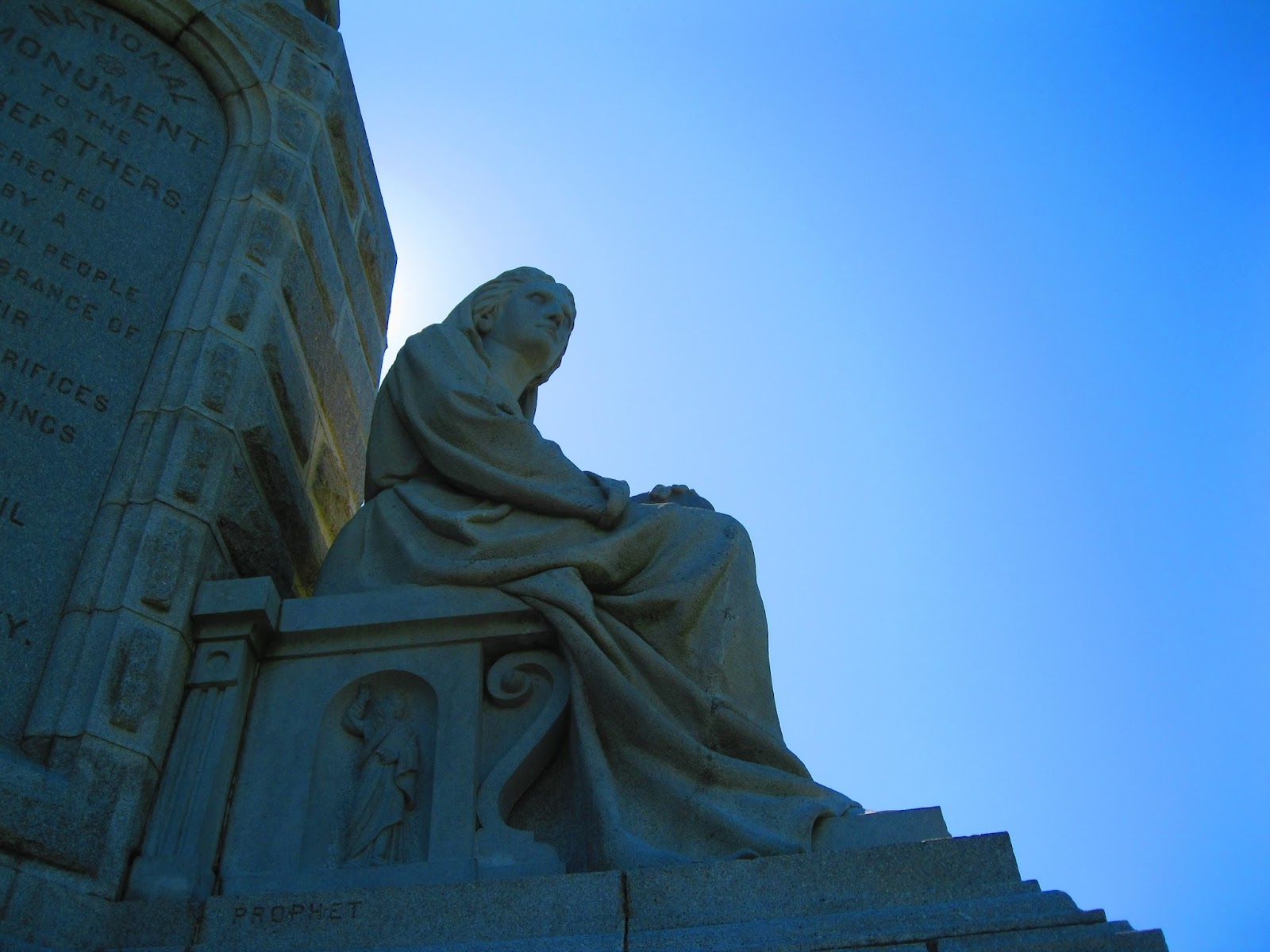
FOREFATHERS MONUMENT PLYMOUTH, MA.
As I was leaving Plymouth after my visit to the Harlow Old Fort House, I
noticed a sign on a street corner that said "Forefathers' Monument". I'd
never heard of it so I decided to take a look. Besides, the street was
named Allerton St. How could I not drive up a street named after an
ancestor?

The National Monument to the Forefathers is situated at the top of a
hill and stands eighty-one feet tall. It was completed in 1888. When I
visited it mid-Thursday afternoon, I was the only one there. It's a shame
it doesn't draw more people because it's a beautiful piece of work.




VISITING THE HARLOW OLD FORT HOUSE
A week ago I learned that the house built by my 8x great grandfather William
Harlow in Plymouth, Ma. still exists and was open for tours on Thursday afternoon.
Now I live about twenty miles from Plymouth and except for visiting Plimoth
Plantation about forty-five years ago I haven't visited the historical sites down
there. Considering how much of our family history took place in Plymouth and
the adjoining towns I decided it was time I fixed that. So yesterday I drove Ping
the Wonder Car down to visit the Harlow Old Fort House.


It was a nice day and I took one of the backroads, Rte 36, most of the way. I'm
glad I went now because in a week or so when people start visiting Plymouth
on vacation the traffic will be heavier. The Harlow House is located at 119 Sandwich
House just past Plymouth Center and right across from the Plymouth Fire Dept.
headquarters. I arrived twenty minutes before the start of the tour so I looked
around a bit and took a picture of one of the rooms through a window. I also
looked around the gift shop and the workshop where events and educational
programs are held. Pat, the young lady in charge, asked me to sign the visitors'
book and when I told her I was a Harlow descendant she asked if I could add
the details of my lineage. Luckily, I just happened to have a relationship
chart with me that I had printed out that morning.


The tour started at 2pm and there was only myself and an elderly couple from
Colorado. Our guide was a gentleman named Ron who was very good. He
demonstrated the steps William Harlow would have taken in constructing a
wooden barrel(my ancestor was a cooper by trade) and then led us into the
common room for a discussion of what life was like for the Harlow family in
the late 1600's. The discussion continued in a third room and I was impressed
with how knowledgeable and enthusiastic Ron was talking about the history
of the house.
I won't go into specifics of Ron's tour; after all, if I did that there'd be no
reason for you to go and hear him yourself, and you really should do it if
you are in the Plymouth area on a Thursday afternoon. But I do want to
paraphrase something Ron said: how many people can say they've stood
on the same floor, in the same house, in the same location(the house has
not been moved) that their ancestors did centuries before?
Thanks to the Plymouth Antiquarian Society and their volunteers, I can say that!
((Admission for adults is $5.00, $2.00 for children. You can read more about the
Harlow House and the two other houses maintained by the Plymouth Antiquarian
Society here at their site.))


Harlow in Plymouth, Ma. still exists and was open for tours on Thursday afternoon.
Now I live about twenty miles from Plymouth and except for visiting Plimoth
Plantation about forty-five years ago I haven't visited the historical sites down
there. Considering how much of our family history took place in Plymouth and
the adjoining towns I decided it was time I fixed that. So yesterday I drove Ping
the Wonder Car down to visit the Harlow Old Fort House.


It was a nice day and I took one of the backroads, Rte 36, most of the way. I'm
glad I went now because in a week or so when people start visiting Plymouth
on vacation the traffic will be heavier. The Harlow House is located at 119 Sandwich
House just past Plymouth Center and right across from the Plymouth Fire Dept.
headquarters. I arrived twenty minutes before the start of the tour so I looked
around a bit and took a picture of one of the rooms through a window. I also
looked around the gift shop and the workshop where events and educational
programs are held. Pat, the young lady in charge, asked me to sign the visitors'
book and when I told her I was a Harlow descendant she asked if I could add
the details of my lineage. Luckily,
chart with me that I had printed out that morning.


The tour started at 2pm and there was only myself and an elderly couple from
Colorado. Our guide was a gentleman named Ron who was very good. He
demonstrated the steps William Harlow would have taken in constructing a
wooden barrel(my ancestor was a cooper by trade) and then led us into the
common room for a discussion of what life was like for the Harlow family in
the late 1600's. The discussion continued in a third room and I was impressed
with how knowledgeable and enthusiastic Ron was talking about the history
of the house.
I won't go into specifics of Ron's tour; after all, if I did that there'd be no
reason for you to go and hear him yourself, and you really should do it if
you are in the Plymouth area on a Thursday afternoon. But I do want to
paraphrase something Ron said: how many people can say they've stood
on the same floor, in the same house, in the same location(the house has
not been moved) that their ancestors did centuries before?
Thanks to the Plymouth Antiquarian Society and their volunteers, I can say that!
((Admission for adults is $5.00, $2.00 for children. You can read more about the
Harlow House and the two other houses maintained by the Plymouth Antiquarian
Society here at their site.))


Subscribe to:
Posts (Atom)