((In honor of St Patrick's Day, I'm reposting this from March, 2012))
I've written before about the way some work of chance leads me to
encounters with places related to my family's history. Last month
I took some pictures in a local cemetery that I thought might make a
good St Patrick's Day post, a reminder of the perils our Irish ancestors
braved to come to America. But when I researched the story behind
a stone monument, I didn't realize that while I was not related to the
dead it commemorated, I was connected to it in another way.
A tall Celtic cross sits atop a small hill in the midst of the Central Cemetery in
Cohasset, Ma, overlooking a tidal pond. On the landward side is the
following inscription:
This Cross Was Erected And Dedicated
May 30th 1914 By The A.O.H. And The L.A.A.O.H.
Of Massachusetts To Mark The Final
Resting Place Of About Forty Five
Irish Emigrants From A Total Company
Of Ninety Nine Who Lost Their Lives
On Grampus Ledge Off Cohasset
October 7, 1849 In The Wreck Of The
Brig St.John From Galway Ireland
R.I.P.
Edwin Victor Bigelow gives the details of the wreck of the St.John in
his A Narrative History of the Town of Cohasset, Massachusetts, published
by the Cohasset Town Historical Commission in 1898:
On Sunday morning at seven o'clock, October 7, 1849, under a heavy northeast
storm, the British brig St. John, loaded with immigrants brought from Galway,
Ireland, was driven upon Grampus Ledge near Minot, and ninetynine lives
were lost. Another brig, the Kathleen, had managed to creep into the mouth
of our harbor and to anchor; but the St. John was farther out where the gale
struck furiously and made her drag anchors.
The masts were cut away, but still she dragged on. After the first heavy thump
on the Grampus Rock the old hulk rapidly tumbled to bits. Previous to the
breaking up, the jolly-boat was hanging by the tackles alongside when the
stern ringbolt broke and she fell into the waves. Captain Oliver, the second
mate, and two boys jumped into her to clear her, when about twenty-five
passengers poured into her and swamped her so that all perished but the
captain. The first mate hauled in the captain, who caught the end of a rope.
Then the longboat was loosed and the captain with the first mate and eight
of the crew and two passengers scrambled into her, reaching shore at the
Glades. Many more passengers were drowned in their desperate endeavors
to get into the longboat which saved the captain and crew. Ten others, upon
a piece of the deck which was wrenched off by the waves, were floated
safely to shore, seven men and three women.
The St. John was only an hour in tumbling to pieces under the incessant banging
of the waves upon her. Ninety-nine lives were lost and twenty-two were saved.
One of the survivors was a young woman who afterwards settled in Cohasset,
marrying a man whose name was by strange coincidence St. John. (pp463-464)
You can also read about the aftermath of the wreck by no less an author than
Henry David Thoreau who happened upon the scene the day after the storm
as bodies were being recovered and buried by the townspeople of
Cohasset. His account of the incident can be found in his book On Cape Cod.
Now we come to the coincidence:
The wreck of the St John took place while construction was being completed
of a lighthouse at nearby Minot Rock. On page 463 of Bigelow's book, just
before his recounting of the tragedy, there is this on the lighthouse:
"It was finished in the fall of 1849, and Isaac A. Dunham took charge of it,
lighting the lamp for the first time on December 13, 1849."
Isaac Dunham was the first Keeper of Minot Light. Even though it was not
in service at the time of the storm that sank the St John, he was present in
Cohasset and part of the group dealing with the aftermath. He stayed
at Minot Light only ten months, resigning in 1850 because he felt the
structure was unsafe. A year later the first Minot Lighthouse was destroyed
by a terrible storm, taking the lives of two men stationed there.
My great great grandmother was Florilla Dunham, Isaac Dunham is my 2x
cousin 7x removed, and many of his relatives qre buried in Mt. Vernon Cemetery
here in Abington,
And I wouldn't have known about him except for taking these pictures in
the cemetery in Cohasset, and then using two of them for a St Patrick's
Day post!
A blog about genealogy and thoughts about the various roots and branches of my family tree as well as the times in which my ancestors lived.Included are the West, White,and McFarland families.WARNING:DO NOT TAKE ALL OF MY FAMILY RECORDS AS GOSPEL. ALWAYS CONFIRM YOUR OWN RESEARCH!
Showing posts with label history. Show all posts
Thursday, March 16, 2017
Saturday, May 31, 2014
THE GENEABLOGGER WORLD WAR ONE CHALLENGE
One hundred years ago, on June 28, 1914, Archduke Franz Ferdinand of Austria was
assassinated in the Serbian city of Sarajevo. One month later, on July 29th World War 1
began. It was the first "global conflict" and it affected many families in Europe and the
Americas. So to commemorate the start of World War 1 I thought I'd ask my fellow
geneabloggers:
Where your ancestors were in 1914, and what effect the war would have
on their families?
Did any of them see military action? Were any family members killed? Do you have any
photographs of them in uniform?
Did the War force your ancestors to leave their homes? Was it the reason they emigrated
to another country? Where did they go?
Write a blogpost on any of the above, or something else about World War 1 and your family. When it's posted, send me the link. If you have already written a blogpost that you'd like to use, then send me the link to that post.
The deadline for submissions will be July29th, 2014. I'll publish the list of links here a week later on August 5th.
assassinated in the Serbian city of Sarajevo. One month later, on July 29th World War 1
began. It was the first "global conflict" and it affected many families in Europe and the
Americas. So to commemorate the start of World War 1 I thought I'd ask my fellow
geneabloggers:
Where your ancestors were in 1914, and what effect the war would have
on their families?
Did any of them see military action? Were any family members killed? Do you have any
photographs of them in uniform?
Did the War force your ancestors to leave their homes? Was it the reason they emigrated
to another country? Where did they go?
Write a blogpost on any of the above, or something else about World War 1 and your family. When it's posted, send me the link. If you have already written a blogpost that you'd like to use, then send me the link to that post.
The deadline for submissions will be July29th, 2014. I'll publish the list of links here a week later on August 5th.
Monday, May 06, 2013
THE THIRD AMERICAN CIVIL WAR CHALLENGE BLOGPOSTS ROUNDUP
Welcome to the Third American Civil War Blog Challenge roundup. This year I decided
to post the Challenge entries today on May 6 in commemoration of the six day Battle of
Chancellorsville which concluded on 6May 1863. It was the second bloodiest battle of the
Civil War and was where Confederate General Stonewall Jackson was fatally wounded
by his own men.
These were the questions I posed in the Challenge:
"Did you have ancestors in America during the Civil War? If so, where were they
and what were their circumstances? How did the Civil War affect them and
their family? Did the men enlist and did they perish in battle or die of illness?
On which side did they fight, or did you have relatives fighting on BOTH sides?
How did the women left at home cope, or did any of them find ways to help
the war effort? Were your ancestors living as slaves on Southern plantations
and if so when were they freed? Or were they freemen of color who enlisted
to fight?"
There are nine blogposts this year but I think the quality makes up for the lack of
quantity. There are posts based on letters, eyewitness accounts, music, a diary, and
documents, and they cover events ranging from Gettysburg to El Paso. So sit down
with your beverage of choice, relax, and read!
| Civil War Monument, Hobart Park, Whitman, Ma |
Sara Campbell says this about her post "My research goal is always to personalize the
individuals and gain an understanding of their lives beyond the bare dates and places found
in the records. After developing a profile of this family for a talk at the Chicopee Library
in commemoration of the 150th anniversary of the Civil War, I have 'adopted' them and
want to know more " You can read what Sara learned in her blogpost entitled
Civil War Research - Holyoke's Richard Wall at her Remembering Those Who came
Before blog.
Diane MacLean Boumenot recently discovered some fascinating letters written by
a relative who served in the Union Army . She shares them with us, along with the background
of the soldier and how the letters were preserved at her blog One Rhode Island Family.
The post is entitled The Civil War Letters of William Wilberforce Douglas .
Heather Wilkinson Rojo at Nutfield Genealogy had done many posts about her distant
relatives The Hutchinson Family Singers She says " As the first celebrity musical act in
American history, the Hutchinson Family Singers used their fame to advance progressive
causes. They sang about women’s suffrage, abolitionism, temperance, Native American
causes, and worker’s rights. They are most famous for their Civil War Era songs." You
can read the lyrics to some of the songs and learn more about the Hutchinsons in
Hutchinson Family Singers Civil War Song Lyrics
| Civil War Monument, Marshfield Hills Cemetery, Marshfield, Ma. |
From A to Zophar is Wendy Grant Walter's blog devoted to her 2x great grandfather
Zophar Skinner. He was another soldier in the Union Army and kept a diary of his
experiences during the year 1863 which included being present at the Battle of Gettysburg.
You can read his entries for July 1st to July 5th 1863 and see pictures of Zophar and his
diary in Zophar Skinner and the 2nd RI Infantry at Gettysburg
LindaRe shares family stories and history from Copiah, Jefferson, and Lincoln Counties
in Mississippi at her Between the Gate Posts blog. Her contribution to the Challenge
deals with what happened during April 1863 when Union cavalry under the command of Col.
Benjamin Grierson came raiding through the area. The story is told through the eyewitness
accounts of the slaves working that day when they saw A Body of Cavalrymen Coming up the Road .
Like many of us Caroline Cohoe Shultz has some families and relatives that are hard nuts to
crack as far as information about them goes. Her 2x great granduncle Ralph Fielding was
one such person for Caroline. Then a record in Ancestry.com's lead her to a Civil War
Pension file, which not only yield answers about Ralph but provided more information
about the rest of his family, Follow Caroline's investigation. at her Calling all Cousins
blogpost, Third American Civil War Challenge - I Found Him! The Elusive Ralph Fielding!
It shows why pension files are a valuable resource for genealogists.
| Civil War Memorial Bridge, Abington, Ma |
Over on her genealogy musings blog, Holly Timm takes a look at the whereabouts of her
family in the late great unpleasantness... It illustrates that while you may not have ancestors
who fought in some great battle, they still were effected someway or another by events that
happening hundreds of miles away from where they lived.
Carol A. Bowen Stevens' 2x great grandfather Peter Preston Holsinger was a Virginian and
a Confederate cavalryman who twice was captured in battle and sent to a prisoner of war
camp. Carol shares the details of Peter's experiences along with some documents she
found about them at her geneablog Reflections From the Fence. Read all about it in
Peter Preston Holsinger, Civil War Veteran, Third American Civil War Challenge
Finally, during my research on the family of my great grandmother Clara Ellingwood West
I've discovered a number of Ellingwood men who fought on the Union side during the War.
The most colorful story I've found so far is that of my distant cousin Ralph Everett Ellingwood
He was a farm-boy from Ohio who has seen more adventure by the time he was twenty-one
than most men see in an entire lifetime.
| Inscription, Civil War Monument, Mayflower Cemetery, Duxbury, Ma. |
And that concludes this year's American Civil War Challenge. There will be two more
before the Challenge ends in April 2015 on the 150th anniversary of the War's conclusion.
So if you have any Civil War family stories to share, please blog about them and share them
with us next year in the next edition of the American Civil War Challenge!
Saturday, June 16, 2012
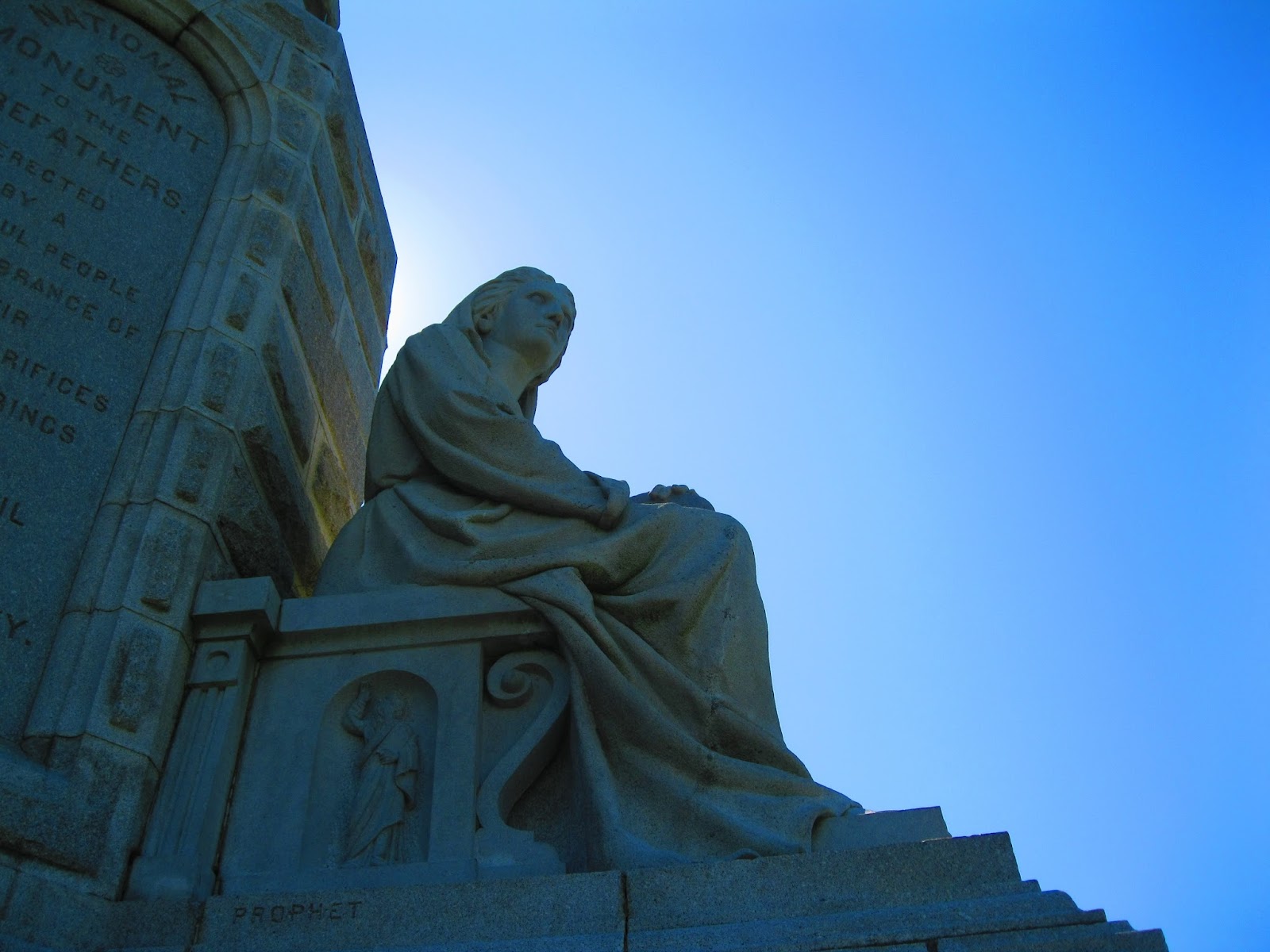
FOREFATHERS MONUMENT PLYMOUTH, MA.
As I was leaving Plymouth after my visit to the Harlow Old Fort House, I
noticed a sign on a street corner that said "Forefathers' Monument". I'd
never heard of it so I decided to take a look. Besides, the street was
named Allerton St. How could I not drive up a street named after an
ancestor?
The National Monument to the Forefathers is situated at the top of a
hill and stands eighty-one feet tall. It was completed in 1888. When I
visited it mid-Thursday afternoon, I was the only one there. It's a shame
it doesn't draw more people because it's a beautiful piece of work.
noticed a sign on a street corner that said "Forefathers' Monument". I'd
never heard of it so I decided to take a look. Besides, the street was
named Allerton St. How could I not drive up a street named after an
ancestor?
The National Monument to the Forefathers is situated at the top of a
hill and stands eighty-one feet tall. It was completed in 1888. When I
visited it mid-Thursday afternoon, I was the only one there. It's a shame
it doesn't draw more people because it's a beautiful piece of work.
Monday, January 30, 2012
ABINGTON CIVIL WAR MEMORIAL ARCH REDEDICATION FRI. SEPT.21
I received the following anonymous comment on my post about the
Civil War Memorial Bridge here in Abington and I thought I'd repost it
here so others like myself who might be interested in attending could see it:
Wonderful blog and great photos!
In answer to what will happen to honor our Civil War soldiers and the 300th Anniversary of Abington, MA, a subcommittee has been created and is run by Robyn Fernald of Abington.
I am also serving on the committee as a member of the 22nd MA Volunteer Infantry, Co.D. - US Sanitary Commission - Boston Branch who will be running a Civil War encampment the weekend of September 21-23, 2012.
There will be Union and Confederate units there at the event, many of whom belong to the Rockland GAR Hall.
The Arch Ceremony will be on Sept 22. Details are still being ironed out. It is my hope to recreate some small parts of the grand procession Mr. Hobarth (town historian) wrote about when North, East, South and Abington proper celebrated the end of the war.
If you are interested in more information about us, here are some links thru Facebook
Island Grove Encampment Event:
https://www.facebook.com/events/182123475221746/
22nd MA Vol. Infantry Co. D.
https://www.facebook.com/groups/22ndmass/
US Sanitary Commission - Boston Branch
https://www.facebook.com/groups/136253156395042/
I look forward to attending this with my camera!
Thursday, January 05, 2012
WHEN YOU SAY CHARGOGGAGOGGMANCHAUGGAGOGGCHAUBUNAGUNGAMAUGG, YOU'VE SAID IT ALL.
((I first posted this back in May 2008. It's one of my favorites of all my
blogposts.))
Massachusetts and New England has some interesting
geographical names and I thought I'd occasionally write about
some of the more unique ones. And if I'm going to do that, I
might as well start right at the top:
Chargoggagoggmanchauggagoggchaubunagungamaugg.
No, I'm not gargling.
That is the original Nipmuc Indian tribe name as well as the
official name for a lake that is also known as "Lake Webster"
because of the town where it is located. When I was a kid and
we drove by it once my folks told me the name meant "You
fish on your side, we'll fish on our side, and nobody fishes in
the middle." but according to the Wikipedia article here,
that definition was a humorous attempt by a local writer to
resolve the arguments over the meaning of the word.
The Nipmuc Indian Association of Connecticut (Webster is
close to the Connecticut-Massachusetts border) website says
the name incorporates the name of a local Nipmuc village of
Monuhchogok but there also seems to be some reference
to a "meeting place" in the name.
The word has several distinctions. It is often cited as the
longest place name in the USA and the 6th longest in the
world. The letter "g" is used 16 times which is the most
times any letter is used in any word in the English language
and the letter "a" is used 9 times, again the most times for
that letter in the language.
I think the Nipmucs would have preferred to keep their
beautiful lake and forgo the linguistic distinctions.
It is a mouthful, though, isn't it?
Do any of you fellow geneabloggers have a unique place name
near you? Write about it on your own blog and let me know
and I'll post the link here!
UPDATE:
Randy has commented with "Funny Place Names"
Jessica has as well with "Speaking of Funny Place Names..."
blogposts.))
Massachusetts and New England has some interesting
geographical names and I thought I'd occasionally write about
some of the more unique ones. And if I'm going to do that, I
might as well start right at the top:
Chargoggagoggmanchauggagoggchaubunagungamaugg.
No, I'm not gargling.
That is the original Nipmuc Indian tribe name as well as the
official name for a lake that is also known as "Lake Webster"
because of the town where it is located. When I was a kid and
we drove by it once my folks told me the name meant "You
fish on your side, we'll fish on our side, and nobody fishes in
the middle." but according to the Wikipedia article here,
that definition was a humorous attempt by a local writer to
resolve the arguments over the meaning of the word.
The Nipmuc Indian Association of Connecticut (Webster is
close to the Connecticut-Massachusetts border) website says
the name incorporates the name of a local Nipmuc village of
Monuhchogok but there also seems to be some reference
to a "meeting place" in the name.
The word has several distinctions. It is often cited as the
longest place name in the USA and the 6th longest in the
world. The letter "g" is used 16 times which is the most
times any letter is used in any word in the English language
and the letter "a" is used 9 times, again the most times for
that letter in the language.
I think the Nipmucs would have preferred to keep their
beautiful lake and forgo the linguistic distinctions.
It is a mouthful, though, isn't it?
Do any of you fellow geneabloggers have a unique place name
near you? Write about it on your own blog and let me know
and I'll post the link here!
UPDATE:
Randy has commented with "Funny Place Names"
Jessica has as well with "Speaking of Funny Place Names..."
Tuesday, February 15, 2011
CIVIL WAR MEMORIAL BRIDGE AT ISLAND GROVE PARK, ABINGTON, MA.
The War Memorial Bridge at Island Grove Park here in Abington was
built and dedicated as part of the 1912 Bicentennial of the town's founding.
It was thought a fitting place for a Civil War memorial because Island
Grove had been favorite gathering place for the New England Abolitionist
movement to hold gatherings. William Lloyd Garrison often spoke here
and in fact if you watch some of the early episodes of the History Detectives
they show a flyer announcing an event at Island Grove Park that Garrison
appeared at that day.
Time and the elements are showing a bit on the arch but people still cross over
the pond to the park using the bridge!
I took these photos a few weeks ago over the course of two days. The figures
depict a soldier and a sailor, and the inscription reads:
"Abington to her sons who offered their lives for the Union 1861-1865."
We'll be celebrating Abington's 300th birthday next year! I'm wondering how
we'll be doing that?
built and dedicated as part of the 1912 Bicentennial of the town's founding.
It was thought a fitting place for a Civil War memorial because Island
Grove had been favorite gathering place for the New England Abolitionist
movement to hold gatherings. William Lloyd Garrison often spoke here
and in fact if you watch some of the early episodes of the History Detectives
they show a flyer announcing an event at Island Grove Park that Garrison
appeared at that day.
Time and the elements are showing a bit on the arch but people still cross over
the pond to the park using the bridge!
I took these photos a few weeks ago over the course of two days. The figures
depict a soldier and a sailor, and the inscription reads:
"Abington to her sons who offered their lives for the Union 1861-1865."
We'll be celebrating Abington's 300th birthday next year! I'm wondering how
we'll be doing that?
Wednesday, December 15, 2010
OTIS V. GRAY: A HISTORY MYSTERY
A few Sundays ago I spent an enjoyable Sunday afternoon with my
brother in law Pete looking over some family heirlooms. Pete like myself
is of two heritages, one side of the family descended from immigrants,
the other from colonial New England stock. The items he showed me
come from the second side and included albums of beautiful century-old
postcards, greeting cards, and calling cards, and I'll relate the story
behind them in a later post. Another item is a legal document with a bit
of a mystery behind it, and we're hoping someone reading this can help
us solve it.
Many of Pete's ancestors came from the coastal town of Scituate, Ma.
and among them are members of the Otis family.The most famous
member of the family was James Ois, a mercurial figure who was
prominent in Boston in the days leading up to the American Revolution.
He battled mental illness which included violent outbursts of temper.
That, coupled with his sarcastic comments led to many confrontations
with the Tories of Boston.
The document Pete showed me is an indication of how heated those
confrontations became. It's a court wit for Lewis Grant, a prominent
Tory who'd been the target of some of Otis' tirades. According to the
writ Gray had broken into Otis' house and assaulted him on November
11th, 1771 and "beat wounded & evil intreated" Otis. Just how badly
Otis was beaten is unknown but he was able to file charges. Gray was
arrested and released the next day after promising to appear in court.
The question is, how did the trial turn out?
With Pete's permission I started searching the internet to try to discover
the outcome but had no luck. Then I turned to J L Bell of Boston 1776
but he had never heard of the case either. He suggested I contact Jeff
Purcell who is writing a biography of James Otis. Although Jeff hadn't
heard about the court case he did share some fascinating information
about Otis and I'm looking forward to reading his book when it's
published.
So at this point, we're at a dead end. I've attached a transcription Peter
sent me of the writ so you can read it, and if any of my readers have any
suggestions on how to further research this I'd appreciate hearing from
you. I know there are resources not available on the Interenet; I just
need some idea of where to start looking.
Or perhaps we should submit it to the History Detectives?
What do you all think?
Friday, October 09, 2009
ANOTHER "TEA REBELLION"
Here's another regional New England poem from the early 20th century.
This is from "Pine Tree Ballads" by Holman Day:
ANOTHER " TEA REBELLION "
When Mis' Augusty Nichols joined the Tufts
Minerva Club,
She polished up on manners and she then com-
menced to rub
At the hide of Mister Nichols who, while not
exactly rude,
Was hardly calculated for a howling sort of
dude.
Now when Augusty Nichols got to see how
style was run,
You bet she went for Nichols and she dressed
him down like fun;
And the thing in all his actions that she couldn't
bear to see
Was to have him fill his saucer and go whoof-
ling up his tea.
After more'n a month of stewing;—making
mis'able his life,
She taught him not to shovel all his vittles
with his knife.
And after more'n a volume of pretty spicy talk
She got him in the hang of eating pie with
just his fork.
She trained him so's he didn't slop the vittles
round his plate,
She plagued him till he wouldn't sit in shirt-
sleeves when he ate,
And then she tried her Waterloo, with faith in
high degree
That she could revolutionize his way of drink-
ing tea.
He drank it as his father always quaffed the
cheering cup,
He poured it in his saucer, raised the brimming
puddle up
And gathered in the liquid with a loud re-
sounding " Swoof "
That now at last inspired Mrs. Nichols' fierce
reproof.
But here was where the victim—ah, here was
where the worm
Arose and fairly scared her by the vigor of his
squirm,
—Sat down his steaming saucer and with a
dangerous light
A-gleaming in his visage, he upbore a Yan-
kee's right.
From the days of Boston's party up to now I
think you'll see
That a Yankee's independent when you bother
with his tea.
" Consarn your schoolmarm notions," thun-
dered Mrs. Nichols' spouse,
" You've kept a'dingin' at me till I'm meechin
round the house.
I've swallered that and t'other for I didn't like
to row
But ye ain't a-going to boss me in the thing
ye've tackled now.
I'm durned if I'll be scalded all the time I'm
being stung
So I'll cool my tea, Mis' Nichols, while ye jab
me with your tongue."
* * * * * * * * * * * * * * * * * * * * * ** * *
There are rights ye cannot smother, tyrants,
whoso'er ye be,
And the good, New England Yankee 's mighty
touchy, sir, on tea.
Day, Holman Pine Tree Ballads : Rhymed Stories of Unplaned Human Natur'
Up In Maine (Boston, Ma., Small , Maynard & Co 1902) pp225-227
This is from "Pine Tree Ballads" by Holman Day:
ANOTHER " TEA REBELLION "
When Mis' Augusty Nichols joined the Tufts
Minerva Club,
She polished up on manners and she then com-
menced to rub
At the hide of Mister Nichols who, while not
exactly rude,
Was hardly calculated for a howling sort of
dude.
Now when Augusty Nichols got to see how
style was run,
You bet she went for Nichols and she dressed
him down like fun;
And the thing in all his actions that she couldn't
bear to see
Was to have him fill his saucer and go whoof-
ling up his tea.
After more'n a month of stewing;—making
mis'able his life,
She taught him not to shovel all his vittles
with his knife.
And after more'n a volume of pretty spicy talk
She got him in the hang of eating pie with
just his fork.
She trained him so's he didn't slop the vittles
round his plate,
She plagued him till he wouldn't sit in shirt-
sleeves when he ate,
And then she tried her Waterloo, with faith in
high degree
That she could revolutionize his way of drink-
ing tea.
He drank it as his father always quaffed the
cheering cup,
He poured it in his saucer, raised the brimming
puddle up
And gathered in the liquid with a loud re-
sounding " Swoof "
That now at last inspired Mrs. Nichols' fierce
reproof.
But here was where the victim—ah, here was
where the worm
Arose and fairly scared her by the vigor of his
squirm,
—Sat down his steaming saucer and with a
dangerous light
A-gleaming in his visage, he upbore a Yan-
kee's right.
From the days of Boston's party up to now I
think you'll see
That a Yankee's independent when you bother
with his tea.
" Consarn your schoolmarm notions," thun-
dered Mrs. Nichols' spouse,
" You've kept a'dingin' at me till I'm meechin
round the house.
I've swallered that and t'other for I didn't like
to row
But ye ain't a-going to boss me in the thing
ye've tackled now.
I'm durned if I'll be scalded all the time I'm
being stung
So I'll cool my tea, Mis' Nichols, while ye jab
me with your tongue."
* * * * * * * * * * * * * * * * * * * * * ** * *
There are rights ye cannot smother, tyrants,
whoso'er ye be,
And the good, New England Yankee 's mighty
touchy, sir, on tea.
Day, Holman Pine Tree Ballads : Rhymed Stories of Unplaned Human Natur'
Up In Maine (Boston, Ma., Small , Maynard & Co 1902) pp225-227
Thursday, October 08, 2009
GRAVE CONCERNS IN SUMTER COUNTY FLORIDA PT 2
I emailed my concern about the planned movement of the Lake
Panasoffkee Cemetery to an official with the Sumter County
government and received a one line reply, to whit:
"The living are a higher priority and thank you for your input"
I'm hoping that if enough of us send emails to the County
Commission and comment on the story in the Fort Sumter
newspaper we might make them rethink that.
You can find email addresses for the county officials at their
website here.
You can comment on the story here at the Sumter County Times
website here.
Please do it as quickly as you can. If they've already outlined
the unmarked graves with orange paint,work is probably
going to start soon.
Thank you.
Panasoffkee Cemetery to an official with the Sumter County
government and received a one line reply, to whit:
"The living are a higher priority and thank you for your input"
I'm hoping that if enough of us send emails to the County
Commission and comment on the story in the Fort Sumter
newspaper we might make them rethink that.
You can find email addresses for the county officials at their
website here.
You can comment on the story here at the Sumter County Times
website here.
Please do it as quickly as you can. If they've already outlined
the unmarked graves with orange paint,work is probably
going to start soon.
Thank you.
GRAVE CONCERNS IN SUMTER COUNTY, FLORIDA
George Geder has alerted the genealogical community about another disturbing
case of a cemetery being sacrificed in the name of "progress". The Lake
Panasoffkee Cemetery in Sumter County, Florida is to be moved even though
the developer in the original land deal has decided to build their project in
Georgia instead.
Now the cemetery is a small one with what is now believed to be 50 graves of
African Americans and Seminole Indians. According to an article you can read
here from the Sumter County Times, County Admistrator Bradley Arnold
"said the gravesite is a family cemetery. When asked what criteria were used to
establish Panasoffkee as a “family cemetery,” Arnold stated “the county holds
title to the property.”
The reason for the move is "The cemetery is close to being in the middle of an
industrial area that is encroaching on the present site. We are moving it.”
The Sumter County Historical Society and relatives and descendants of those
buried at the Lake Panasoffkee site have protested the move but the County
seems determined to go ahead with it anyway.
A quick search of Wikipedia revealed that Sumter County is in a mainly rural
area of Florida that has experienced an upsurge recently due, ironically, to the
arrival of a rather large senior citizen retirement community.
It seems to be a trend lately that sites such as these are being sacrificed in the
name of progress, that a people's heritage and local history mean nothing compared
to increasing the tax revenues in town and county coffers. Recently there is
the case of an Indian mound in Oxford, Alabama being used to provide landfill
for the construction of a Sam's Club. According to the Mayor of Oxford:
"We want to take care of people's remains," Smith said. "That can be moved.
What it's going to be is more prettier than it is today."
Right. A Sam's Club is a "more prettier" thing.
The trouble is, many of these sites are cemeteries of Indians and African Americans
who in earlier times either were not allowed to be buried in town or church cemeteries
or who preferred to be buried on ancestral lands according to their cultures' rites and
beliefs. Often they were buried in out of the way places to prevent desecration.
And now ironically the land they were buried in has become valuable and they face
removal to another place.
As genealogists and family historians, we should do what we can to help the Sumter
County Historical Society convince the County Commission that there are some things
more valuable than progress. The website for the Sumter County Government is here
and there are email addresses for Mr. Arnold and the County Commissioners. You
can also make comments to the story at the Sumter County Times website as well as
vote on a poll on the subject. Perhaps some of the other Southern state historical and
genealogical societies can help the Sumter County Historical Society get the word out
to the citizenry?
Folks, you might think it's no big deal. But as time goes on, more and more of us are
going to be facing this sort of situation as businesses look to expand and local
governments look for ways to attract tax revenue.
We need to start taking a stand now before it's our families whose graves are being
moved.
case of a cemetery being sacrificed in the name of "progress". The Lake
Panasoffkee Cemetery in Sumter County, Florida is to be moved even though
the developer in the original land deal has decided to build their project in
Georgia instead.
Now the cemetery is a small one with what is now believed to be 50 graves of
African Americans and Seminole Indians. According to an article you can read
here from the Sumter County Times, County Admistrator Bradley Arnold
"said the gravesite is a family cemetery. When asked what criteria were used to
establish Panasoffkee as a “family cemetery,” Arnold stated “the county holds
title to the property.”
The reason for the move is "The cemetery is close to being in the middle of an
industrial area that is encroaching on the present site. We are moving it.”
The Sumter County Historical Society and relatives and descendants of those
buried at the Lake Panasoffkee site have protested the move but the County
seems determined to go ahead with it anyway.
A quick search of Wikipedia revealed that Sumter County is in a mainly rural
area of Florida that has experienced an upsurge recently due, ironically, to the
arrival of a rather large senior citizen retirement community.
It seems to be a trend lately that sites such as these are being sacrificed in the
name of progress, that a people's heritage and local history mean nothing compared
to increasing the tax revenues in town and county coffers. Recently there is
the case of an Indian mound in Oxford, Alabama being used to provide landfill
for the construction of a Sam's Club. According to the Mayor of Oxford:
"We want to take care of people's remains," Smith said. "That can be moved.
What it's going to be is more prettier than it is today."
Right. A Sam's Club is a "more prettier" thing.
The trouble is, many of these sites are cemeteries of Indians and African Americans
who in earlier times either were not allowed to be buried in town or church cemeteries
or who preferred to be buried on ancestral lands according to their cultures' rites and
beliefs. Often they were buried in out of the way places to prevent desecration.
And now ironically the land they were buried in has become valuable and they face
removal to another place.
As genealogists and family historians, we should do what we can to help the Sumter
County Historical Society convince the County Commission that there are some things
more valuable than progress. The website for the Sumter County Government is here
and there are email addresses for Mr. Arnold and the County Commissioners. You
can also make comments to the story at the Sumter County Times website as well as
vote on a poll on the subject. Perhaps some of the other Southern state historical and
genealogical societies can help the Sumter County Historical Society get the word out
to the citizenry?
Folks, you might think it's no big deal. But as time goes on, more and more of us are
going to be facing this sort of situation as businesses look to expand and local
governments look for ways to attract tax revenue.
We need to start taking a stand now before it's our families whose graves are being
moved.
Sunday, October 04, 2009
IPSWICH TOWN
Sometimes when I'm researching my ancestors on GoogleBooks
I run across some of the poetry that was popular in the 19th
century. There were quite a few local New England poets who
are largely unknown today. One of them is James Appleton
Morgan, whose poem Ipswich Town I found in the Essex
Antiquarian and enjoyed how he used the local history and
folklore in writing it:
IPSWICH TOWN.
BY JAMES APPLETON MORGAN.
I love to think of old Ipswich town,—
Old Ipswich town in the east countree,—
Whence on the tide you can float down
Through long salt grass to the wailing sea
Where the Mayflower drifted off the bar,
Seaworn and weary, long years ago,
And dared not enter, but sailed away
Till she landed her boat in Plymouth bay
I love to think of old Ipswich town,
Where Whitefield preached in the church on the
hill,
Driving out the devil until he leaped down
From the steeple's top, where they show you still,
Imbedded deep in the solid rock,
The indelible print of his cloven hoof,
And tell you the devil has never shown
Face or hoof since that day in the honest town
I love to think of old Ipswich town,
Where they shut up the witches until the day
When they should be roasted so thoroughly brown
In Salem village twelve miles away.
They've moved it off for a stable now,
But there are the holes where the stout jail stood,
And at night, they say, that over the holes
You can see the ghost of Goody Coles
I love to think of old Ipswich town,
That house to your right a rod or more,
Where the stern old elm trees seem to frown
If you peer too hard through the open door,
Sheltered the regicide judges three,
When the royal sheriffs were after them,
And a queer old villager once I met
Who says in the cellar they're living yet.
I love to think of old Ipswich town,
Harry Main, you have heard the tale, lived there,
He blasphemed God so they put him down
With an iron shovel at Ipswich bar.
They chained him there for a thousand years,
As the sea rolls up to shovel it back;
So when the sea cries the goodwives say,
"Harry Main growls at his work today."
I love to think of old Ipswich town;
There's a graveyard upon the old High street,
Where generations are looking down
On the one that is toiling at their feet;
Where the stones stand shoulder to shoulder like
troops,
Drawn up to receive a cavalry charge.
And graves have been dug in graves till the sod
Is the mound of good men gone to God.
I love to think of old Ipswich town,—
Old Ipswich town in the east countree,—
Whence on the tide you can float down
Through the long salt grass to the wailing sea,
And lie all day on the glassy beach,
And learn the lesson the green waves teach,
Till at sunset, from surf and seaweed brown,
You are pulling back to Ipswich town.
I run across some of the poetry that was popular in the 19th
century. There were quite a few local New England poets who
are largely unknown today. One of them is James Appleton
Morgan, whose poem Ipswich Town I found in the Essex
Antiquarian and enjoyed how he used the local history and
folklore in writing it:
IPSWICH TOWN.
BY JAMES APPLETON MORGAN.
I love to think of old Ipswich town,—
Old Ipswich town in the east countree,—
Whence on the tide you can float down
Through long salt grass to the wailing sea
Where the Mayflower drifted off the bar,
Seaworn and weary, long years ago,
And dared not enter, but sailed away
Till she landed her boat in Plymouth bay
I love to think of old Ipswich town,
Where Whitefield preached in the church on the
hill,
Driving out the devil until he leaped down
From the steeple's top, where they show you still,
Imbedded deep in the solid rock,
The indelible print of his cloven hoof,
And tell you the devil has never shown
Face or hoof since that day in the honest town
I love to think of old Ipswich town,
Where they shut up the witches until the day
When they should be roasted so thoroughly brown
In Salem village twelve miles away.
They've moved it off for a stable now,
But there are the holes where the stout jail stood,
And at night, they say, that over the holes
You can see the ghost of Goody Coles
I love to think of old Ipswich town,
That house to your right a rod or more,
Where the stern old elm trees seem to frown
If you peer too hard through the open door,
Sheltered the regicide judges three,
When the royal sheriffs were after them,
And a queer old villager once I met
Who says in the cellar they're living yet.
I love to think of old Ipswich town,
Harry Main, you have heard the tale, lived there,
He blasphemed God so they put him down
With an iron shovel at Ipswich bar.
They chained him there for a thousand years,
As the sea rolls up to shovel it back;
So when the sea cries the goodwives say,
"Harry Main growls at his work today."
I love to think of old Ipswich town;
There's a graveyard upon the old High street,
Where generations are looking down
On the one that is toiling at their feet;
Where the stones stand shoulder to shoulder like
troops,
Drawn up to receive a cavalry charge.
And graves have been dug in graves till the sod
Is the mound of good men gone to God.
I love to think of old Ipswich town,—
Old Ipswich town in the east countree,—
Whence on the tide you can float down
Through the long salt grass to the wailing sea,
And lie all day on the glassy beach,
And learn the lesson the green waves teach,
Till at sunset, from surf and seaweed brown,
You are pulling back to Ipswich town.
Sunday, July 12, 2009
DESTRUCTION OF A 1500 YEAR OLD INDIAN MOUND TO BUILD A SAMS CLUB IN OXFORD, ALABAMA!
Sometimes you see or hear something that just makes you stop and angrily shake your head.
The other day Terry Thornton of Hill Country of Monroe County Mississippi sent an email
out about a post at the Deep Fried Kudzu blog. Seems that a 1500 year old Indian burial
mound in Oxford, Alabama is being destroyed and used as fill in the construction of a Sam's
Club. The owner of the blog is named Ginger and she went out to the site herself to check
out the damage and she took some pictures that are disturbing. There are two posts, one
with pictures of the mound before the demolition began and the second with pictures
showing how much damage has been done.
It's obviously an Indian mound but in the eyes of the city's mayor and Sam's Club, it's
not all that important, good only to use as filler for the construction. Of course, given that
Sam's Club is owned by Wal-Mart, which has been embroiled in fights over constructing
stores close by Civil War battlefields, I'm not surprised. In all these cases, local officials
and merchants are ready to sacrifice the history and heritage of our country in the name of
improving the local economy. In this case, something that has stood for centuries, a sacred
place to Native Americans, is being destroyed to make way for a store that more than likely
will be itself demolished in less than a century to make way for some other enterprise.
This is wrong, folks. Once these places are destroyed, they cannot be replaced. And don't
think it can't effect you. There are plenty of incidents of church graveyards being uprooted, moved or paved over to make room for shopping centers and parking lots. And we all have
been shocked at the recent events at the cemetary near Chicago. Is this the type of society
we are becoming, where we are willing to tread on the bones of the dead in quest of the
almighty dollar?
Visit Ginger's blog. She's posted the email addresses of the parties involved in this incident.
Look at those pictures, see how we are destroying the past, and then send emails to voice your
concern!
The other day Terry Thornton of Hill Country of Monroe County Mississippi sent an email
out about a post at the Deep Fried Kudzu blog. Seems that a 1500 year old Indian burial
mound in Oxford, Alabama is being destroyed and used as fill in the construction of a Sam's
Club. The owner of the blog is named Ginger and she went out to the site herself to check
out the damage and she took some pictures that are disturbing. There are two posts, one
with pictures of the mound before the demolition began and the second with pictures
showing how much damage has been done.
It's obviously an Indian mound but in the eyes of the city's mayor and Sam's Club, it's
not all that important, good only to use as filler for the construction. Of course, given that
Sam's Club is owned by Wal-Mart, which has been embroiled in fights over constructing
stores close by Civil War battlefields, I'm not surprised. In all these cases, local officials
and merchants are ready to sacrifice the history and heritage of our country in the name of
improving the local economy. In this case, something that has stood for centuries, a sacred
place to Native Americans, is being destroyed to make way for a store that more than likely
will be itself demolished in less than a century to make way for some other enterprise.
This is wrong, folks. Once these places are destroyed, they cannot be replaced. And don't
think it can't effect you. There are plenty of incidents of church graveyards being uprooted, moved or paved over to make room for shopping centers and parking lots. And we all have
been shocked at the recent events at the cemetary near Chicago. Is this the type of society
we are becoming, where we are willing to tread on the bones of the dead in quest of the
almighty dollar?
Visit Ginger's blog. She's posted the email addresses of the parties involved in this incident.
Look at those pictures, see how we are destroying the past, and then send emails to voice your
concern!
Tuesday, April 08, 2008
ROCKS IN OUR HEADS
Janice’s recent post at Cow Hampshire about the Viking Rock
at Hampton, New Hampshire put me in mind of several other
sites surrounded by mystery here in New England: Mystery
Hill in Salem, N.H., (the “American Stonehenge”); Newport
Tower in Newport, R.I., and Dighton Rock here in
Massachusetts.
The Dighton Rock controversy’s history resembles that of the
Viking Rock. Speculation on the origin and meaning of the
characters carved into the rock include Ancient Phoenicians,
Vikings, Portuguese explorers and Native Americans and was
a popular topic in Europe during the 1800’s. Scholars made
their fame and fortunes advancing one theory after another.
It would be easy to write it off as a 19th century hoax until
one learns the fact that no less an historical personage than
Cotton Mather made a drawing of the carvings in 1712 and
had described them in a book 22 years earlier in 1690. With
the exception of a few scribblings left by curiosity seekers
over the years, the markings remain just as Mather copied
them. You can see a picture of them taken in 1853 here on
Wikipedia.
Better still, you can read all about it here on the Archives
webpage of American Heritage Magazine. I’ve bookmarked
that site, let me tell you!
at Hampton, New Hampshire put me in mind of several other
sites surrounded by mystery here in New England: Mystery
Hill in Salem, N.H., (the “American Stonehenge”); Newport
Tower in Newport, R.I., and Dighton Rock here in
Massachusetts.
The Dighton Rock controversy’s history resembles that of the
Viking Rock. Speculation on the origin and meaning of the
characters carved into the rock include Ancient Phoenicians,
Vikings, Portuguese explorers and Native Americans and was
a popular topic in Europe during the 1800’s. Scholars made
their fame and fortunes advancing one theory after another.
It would be easy to write it off as a 19th century hoax until
one learns the fact that no less an historical personage than
Cotton Mather made a drawing of the carvings in 1712 and
had described them in a book 22 years earlier in 1690. With
the exception of a few scribblings left by curiosity seekers
over the years, the markings remain just as Mather copied
them. You can see a picture of them taken in 1853 here on
Wikipedia.
Better still, you can read all about it here on the Archives
webpage of American Heritage Magazine. I’ve bookmarked
that site, let me tell you!
Sunday, February 24, 2008
"THREE IS THE NUMBER THOU SHALT COUNT..."
Perhaps it was Terry Thornton’s recent geneablog poetry
challenge that caused it but the topic of the next CoG put me
in mind of an ancient Irish form of poem or proverb called the
triad. Triads were as the name suggests, a list of three things
that somehow were connected. Historians theorize they were
used by the Irish as teaching tools to pass on knowledge or to
serve as memory keys to specific lessons or discussions on
various topics.
For example:
“The rocks to which lawful behavior is tied: A monastery,
a chieftain, the family.”
There in one line are listed the three anchors of civilization
Here’s another. I can imagine some druid or monk working
with a student trying to learn how to deliver a speech and
then listing how he needs to improve:
“Three hateful things in speech-stiffness, obscurity, a bad
delivery.”
There were triads that instructed how to dress and behave:
“Three excellences of dress-elegance, comfort, lastingness.”
“Three Steadinesses of good womanhood-keeping a steady
tongue, a steady chastity and a steady housewifery.”
Triads had pieces of advice and wisdom for everyone,
including the nobility:
“Three things best for a chief-justice, peace and an army.”
“Three worst things for a chief-sloth, treachery, evil
counsel.”
Many of these triads have been translated into a poetic form.
Alfred Perceval Graves translated several of the ones I’ve
cited thusly:
“Three powers advantaging a Chieftain most
Are Peace and Justice and an armed host.
Three worse of snares upon a Chieftain’s way:
Sloth, treachery and evil counsel they!”
“Three excellencies of our dress are these:
Elegance, durability and ease.”
Triads were not exclusive to the Irish. They were common
among the other Celts of Britain and Wales and I first
discovered them because of my interest in the legends of
King Arthur, since many of the British triads deal with him
and his followers. The authenticity of some of those is in
question since they make mention of “Lancelot of the Lake”
(although in a Welsh version of the name) and Lancelot
was a later edition from the medieval romances.
But I can see how useful triads must have been for teaching.
They were short, pithy, and easy to recall. And they could
easily be adapted for modern life:
“Three things needed to start the day: clean clothes, clean
teeth and a hot shower.”
"Three things to be bought when I go to the grocery: ground
beef and onions and breath mints for after!”
And I have put the CoG topic into a triad, but you’ll have to
wait until I post my response to see it.
How about you, readers? Can you put something in your life into
a triad?
I found the triads I used in this article here at this website:
http://web.ncf.ca/bj333/HomePage.triads.html
Alfred Perceval Graves' verse translations can be found in
Robert Blaisdell's "Irish Verse:An Anthology" at
Google Book.
challenge that caused it but the topic of the next CoG put me
in mind of an ancient Irish form of poem or proverb called the
triad. Triads were as the name suggests, a list of three things
that somehow were connected. Historians theorize they were
used by the Irish as teaching tools to pass on knowledge or to
serve as memory keys to specific lessons or discussions on
various topics.
For example:
“The rocks to which lawful behavior is tied: A monastery,
a chieftain, the family.”
There in one line are listed the three anchors of civilization
Here’s another. I can imagine some druid or monk working
with a student trying to learn how to deliver a speech and
then listing how he needs to improve:
“Three hateful things in speech-stiffness, obscurity, a bad
delivery.”
There were triads that instructed how to dress and behave:
“Three excellences of dress-elegance, comfort, lastingness.”
“Three Steadinesses of good womanhood-keeping a steady
tongue, a steady chastity and a steady housewifery.”
Triads had pieces of advice and wisdom for everyone,
including the nobility:
“Three things best for a chief-justice, peace and an army.”
“Three worst things for a chief-sloth, treachery, evil
counsel.”
Many of these triads have been translated into a poetic form.
Alfred Perceval Graves translated several of the ones I’ve
cited thusly:
“Three powers advantaging a Chieftain most
Are Peace and Justice and an armed host.
Three worse of snares upon a Chieftain’s way:
Sloth, treachery and evil counsel they!”
“Three excellencies of our dress are these:
Elegance, durability and ease.”
Triads were not exclusive to the Irish. They were common
among the other Celts of Britain and Wales and I first
discovered them because of my interest in the legends of
King Arthur, since many of the British triads deal with him
and his followers. The authenticity of some of those is in
question since they make mention of “Lancelot of the Lake”
(although in a Welsh version of the name) and Lancelot
was a later edition from the medieval romances.
But I can see how useful triads must have been for teaching.
They were short, pithy, and easy to recall. And they could
easily be adapted for modern life:
“Three things needed to start the day: clean clothes, clean
teeth and a hot shower.”
"Three things to be bought when I go to the grocery: ground
beef and onions and breath mints for after!”
And I have put the CoG topic into a triad, but you’ll have to
wait until I post my response to see it.
How about you, readers? Can you put something in your life into
a triad?
I found the triads I used in this article here at this website:
http://web.ncf.ca/bj333/HomePage.triads.html
Alfred Perceval Graves' verse translations can be found in
Robert Blaisdell's "Irish Verse:An Anthology" at
Google Book.
Subscribe to:
Posts (Atom)