A blog about genealogy and thoughts about the various roots and branches of my family tree as well as the times in which my ancestors lived.Included are the West, White,and McFarland families.WARNING:DO NOT TAKE ALL OF MY FAMILY RECORDS AS GOSPEL. ALWAYS CONFIRM YOUR OWN RESEARCH!
Saturday, October 20, 2012
THE WAR OF 1812 PENSION FILE OF NATHANIEL BARKER PT9
Nathaniel Barker lived another six years after successfully filing for his War
of 1812 pension money. At some point between 1870 and 1878 he and his
wife Huldah (Hastings) Barker moved back to Albany, Maine to live with their
son Nathaniel S. Barker. They lived there for six more years until Nathaniel
passed away on 12 April 1884. Sadly, it was the second death in the family
within a month as their son Nathaniel S. had died on 20March 1884.
A few weeks later Hulda hired a lawyer who on April 28th requested whatever
forms were needed for her to receive Nathaniel's pension as his widow. I'm
not sure if this document is one of those forms or not, because even though
it says "Survivor's Brief" it has a date May23 1878 on the other side. So it coud
be for a survivor of the war rather than for a survivor of the deceased veteran.
Claim No. 31.469 Service Pension, Original Case
Act of March 9th 1878 War of 1812. Reopened from
Cert. No. 22.168 Act of~~~~~~
SURVIVOR'S BRIEF
______________
Claimant: Nathaniel Barker Rank: Private
Post Office: Bethel Captain:Wheeler
County: Oxford Regiment: Militia
State: Maine State:Massachusetts (Maine)
Attorneys: (?) Weeks and Blanchard P.O. : Augusta
County: Kennebec State: Maine Fee: $10.00 Contract: ~~~~~~
Application Filed: April 8th, 1878
Enlisted about September 14th, 1814 and served the full
Alleged Service { (14) fourteen days under Capt. Wm. Wheeler -enlisted at
Newry Maine and served at Portland.
Record Evidence 3rd Auditor's report of July 21, `52, shows in the B. L Case,
of Service {that Nathanl Barker served in Capt. Wheeler's Company
from Sept. 24th, to November 6th 1814.
Parol Evidence
of service
Length of service: Forty-three -43-days
John F. Hapgood and Robbins Brown identifying witnesses
Proof of Identity{ and the similarity of signatures in the claims for Bounty Land
and Pension.
Disability of Shown as per paragraph(3rd) third of general circulars that
Applicant {the applicant is physically unable to appear before a court
of record, twenty miles distant from his residence.
Admitted May 21st, 1878, to a pension of EIGHT DOLLARS per month
from March 9th, 1878, the date of the act under which this pension is allowed.
No pension previously applied for
W.F. Eaton
Pension Searcher
A Bounty Land Claim 45459 -120 -55 J. McGorran
Bounty Land Searcher
Approval May 23. 1878 Daniel W. Atwood
A.P. Leech Examiner
Reviewer
Whether this was Hulda's paperwork or not is a moot point. She died herself a
little over a month and a half after Nathaniel on 7Jun 1884 in Albany, Maine.
This concludes the series on Nathaniel Barker's War of 1812 Pension and Land
Bounty Grants. However, the death of his son Nathaniel S. Barker has some
consequences which I'll discuss next.
Friday, October 19, 2012
THE WAR OF 1812 PENSION FILE OF NATHANIEL BARKER PT8
On March 4, 1878, a new pension for the veterans of the War of 1812
was approved, and by the end of the month Nathaniel Barker, now 84
years old applied for it:
I was struck by a few things looking at this. One was the missing
information on Nathaniel's discharge which had been on his
Bounty Land applications. At his age, was Nathaniel's memory
slipping? His statement that he was now residing in Albany instead
of Bethel gives me an earlier date for when he and Huldah moved
back to the farm with their son Nathaniel S. Barker and his family;
I'd known they'd done that from the 1880 Federal Census but now I
know it happened between 1870 and 1878.
There are also two items in the language of the form. One is the
extensive language dealing with the Civil War. apparently if you
had fought for the Confederacy you were not eligible for the 1812
pension. And the emphasis on not already receiving a pension
seems to me to be an effort to prevent "double dipping" by anyone
who might have served in both the Civil War and the War of 1812.
Here's my transcription. Printed text is in boldface, handwritten
is italicized, and (Blank) denotes exactly that:
War of 1812
DECLARATION OF SOLDIER FOR PENSION
State of Maine
) SS
County of Oxford
On this thirtieth day of March A.D. one thousand eight hundred and
seventy-eight, personally appeared before me, a Justice of Peace
of the State of Maine, a Court of Record within and for the County and
State aforesaid, Nathaniel Barker, aged 84 years a resident of Albany,
County of Oxford State of Maine, who being duly sworn according to
law, declares that he is married; that his wife's name was Huldah
Hastings, to whom he was married at Bethel on the 31 day of Jany 1819,
that he served the full period of fourteen days in the service of the
United States in the war of 1812; that he is the identical Nathaniel Barker
who served in Captain Wm Wheeler's Company, Col Wm Ryerson's Regiment
(Blank) Brigade, (Blank) Division, having enlisted at Newry Maine about
the 14 day of September, 1814 (as near as he can now state,) and was
honorably discharged at (Blank) about the (Blank) day of 181(Blank); that
he performed service in said company at Portland.
And that by reason of old age and bodily infirmities I am unable to go before
a Court of Record
He states that he has received a Land Warrant on account of his said service;
that he, at no time during the late rebellion against the authority of the
United States, adhered to the cause of the enemies of the Government,
giving them aid or comfort, or exercised the functions of any office whatever
under any authority, or pretended authority, in hostility to the United States;
and that he will support the Constitution of the United States; that he is not
in receipt of a pension under any previous act; that he makes this declaration
for the purpose of being placed on the pension rolls of the United States,
under the provision of the act approved March 4, 1878, and he hereby
constitutes and appoints, with full power of substitution and revocation,
WEEKS & BLANCHARD, of Augusta, Maine, his true and lawful attorneys
to persecute his claim and obtain the pension certificate that may be issued;
that his Post office is at Bethel County of Oxford State of Maine; that his
domicile or place of abode is Albany Maine.
Nathaniel Barker Applicant
Attest:
John F Hapgood
Robbins Brown
David F. Brown Trial Justice
[Note- Where persons sign by mark, have two persons witness the signature
who can write. The officer administering the oath cannot be one of the
attestng parties.]
was approved, and by the end of the month Nathaniel Barker, now 84
years old applied for it:
I was struck by a few things looking at this. One was the missing
information on Nathaniel's discharge which had been on his
Bounty Land applications. At his age, was Nathaniel's memory
slipping? His statement that he was now residing in Albany instead
of Bethel gives me an earlier date for when he and Huldah moved
back to the farm with their son Nathaniel S. Barker and his family;
I'd known they'd done that from the 1880 Federal Census but now I
know it happened between 1870 and 1878.
There are also two items in the language of the form. One is the
extensive language dealing with the Civil War. apparently if you
had fought for the Confederacy you were not eligible for the 1812
pension. And the emphasis on not already receiving a pension
seems to me to be an effort to prevent "double dipping" by anyone
who might have served in both the Civil War and the War of 1812.
Here's my transcription. Printed text is in boldface, handwritten
is italicized, and (Blank) denotes exactly that:
War of 1812
DECLARATION OF SOLDIER FOR PENSION
State of Maine
) SS
County of Oxford
On this thirtieth day of March A.D. one thousand eight hundred and
seventy-eight, personally appeared before me, a Justice of Peace
of the State of Maine, a Court of Record within and for the County and
State aforesaid, Nathaniel Barker, aged 84 years a resident of Albany,
County of Oxford State of Maine, who being duly sworn according to
law, declares that he is married; that his wife's name was Huldah
Hastings, to whom he was married at Bethel on the 31 day of Jany 1819,
that he served the full period of fourteen days in the service of the
United States in the war of 1812; that he is the identical Nathaniel Barker
who served in Captain Wm Wheeler's Company, Col Wm Ryerson's Regiment
(Blank) Brigade, (Blank) Division, having enlisted at Newry Maine about
the 14 day of September, 1814 (as near as he can now state,) and was
honorably discharged at (Blank) about the (Blank) day of 181(Blank); that
he performed service in said company at Portland.
And that by reason of old age and bodily infirmities I am unable to go before
a Court of Record
He states that he has received a Land Warrant on account of his said service;
that he, at no time during the late rebellion against the authority of the
United States, adhered to the cause of the enemies of the Government,
giving them aid or comfort, or exercised the functions of any office whatever
under any authority, or pretended authority, in hostility to the United States;
and that he will support the Constitution of the United States; that he is not
in receipt of a pension under any previous act; that he makes this declaration
for the purpose of being placed on the pension rolls of the United States,
under the provision of the act approved March 4, 1878, and he hereby
constitutes and appoints, with full power of substitution and revocation,
WEEKS & BLANCHARD, of Augusta, Maine, his true and lawful attorneys
to persecute his claim and obtain the pension certificate that may be issued;
that his Post office is at Bethel County of Oxford State of Maine; that his
domicile or place of abode is Albany Maine.
Nathaniel Barker Applicant
Attest:
John F Hapgood
Robbins Brown
David F. Brown Trial Justice
[Note- Where persons sign by mark, have two persons witness the signature
who can write. The officer administering the oath cannot be one of the
attestng parties.]
THE WAR OF 1812 PENSION FILE OF NATHANIEL BARKER PT7
As I've been writing these posts about my 3x great grandfather Nathaniel
Barker and his War of 1812 Pension and Land Bounty file, I've included
information about Nathaniel's farm. I did this because I made an assumption
that at least one of those land grants was reflected in the size of his farm,
especially in 1860, and that the land he received was in Maine.
It was a faulty assumption.
Last night distant cousin Chris Dunham of the Maine Genealogy Network
sent a comment on my last post in this series that included the links to
Nathaniel's land patents. They are located at the U.S. Department of the
Interior Bureau of Land Management General Land Office Records site.
The first one was the 1850 grant of 40 acres:
As you can see, it wasn't located in Maine. It was in Palestine , Illinois.
Here's the second grant from 1855 of 120 acres:
Again, the land is not in Maine, it's at Fort Dodge, Iowa.
Now, Nathaniel never moved to Iowa nor did any of his children. So what
happened to the land. Well, you can't see it on the above images(because I
was having trouble with my PDF to JPEG converter so I had to use the "Snipping
Tool") but Nathaniel "assigned" both patents to another person. Further down
the page in the first image the land is assigned to a David A. Hall. The second,
larger grant of 1855 went to a Israel Loucks. I can't believe that Nathaniel
simply gave 160 acres away so it's probable Nathaniel sold the land to Mr. Hall
and Mr. Laucks.
On the Land Office Records site there's a tab on the Patent image that says
"Related Documents". That window included other transactions involving
both men. Hall was assigned land by two other veterans for a total of 120 acres,
including Nathaniel's patent. Loucks did the same in 1855, gaining three grants,
totaling 360m acres. Were Hall and Laucks land speculators, acquiring the land
grant patents from the original recipients and reselling them for a profit? I
don't know yet, and I'm certainly not going to make another assumption.
I still have Nathaniel's cash pension to discuss, and there is question about
Nathaniel's farm after that to blog abut.
And thanks, Chris Dunham, for finding these land patent images for me!
Barker and his War of 1812 Pension and Land Bounty file, I've included
information about Nathaniel's farm. I did this because I made an assumption
that at least one of those land grants was reflected in the size of his farm,
especially in 1860, and that the land he received was in Maine.
It was a faulty assumption.
Last night distant cousin Chris Dunham of the Maine Genealogy Network
sent a comment on my last post in this series that included the links to
Nathaniel's land patents. They are located at the U.S. Department of the
Interior Bureau of Land Management General Land Office Records site.
The first one was the 1850 grant of 40 acres:
As you can see, it wasn't located in Maine. It was in Palestine , Illinois.
Again, the land is not in Maine, it's at Fort Dodge, Iowa.
Now, Nathaniel never moved to Iowa nor did any of his children. So what
happened to the land. Well, you can't see it on the above images(because I
was having trouble with my PDF to JPEG converter so I had to use the "Snipping
Tool") but Nathaniel "assigned" both patents to another person. Further down
the page in the first image the land is assigned to a David A. Hall. The second,
larger grant of 1855 went to a Israel Loucks. I can't believe that Nathaniel
simply gave 160 acres away so it's probable Nathaniel sold the land to Mr. Hall
and Mr. Laucks.
On the Land Office Records site there's a tab on the Patent image that says
"Related Documents". That window included other transactions involving
both men. Hall was assigned land by two other veterans for a total of 120 acres,
including Nathaniel's patent. Loucks did the same in 1855, gaining three grants,
totaling 360m acres. Were Hall and Laucks land speculators, acquiring the land
grant patents from the original recipients and reselling them for a profit? I
don't know yet, and I'm certainly not going to make another assumption.
I still have Nathaniel's cash pension to discuss, and there is question about
Nathaniel's farm after that to blog abut.
And thanks, Chris Dunham, for finding these land patent images for me!
Thursday, October 18, 2012
THE WAR OF 1812 PENSION FILE OF NATHANIEL BARKER PT 6
Nathaniel Barker was 61 years old in 1855 when he received his second and
larger Land Bounty grant of 120 acres. In the application for that second grant
he says he had disposed of his original 1850 grant of 40 acres but doesn't say
how or why. He may have sold it or he may have set up either one of his sons
Nathaniel S. or Amos with it to start their own farm. I've no way of knowing
for sure at this time.
Five years later in 1860 some things had changed. The 1860 Federal Census
shows that Nathaniel had real estate valued at $500 and personal estate of
$140. He was now 66 years old, and son Nathaniel S. Barker had returned to
the family farm with his wife, the former Lucy Coburn. From the 1860
Agricultural Schedule I learned:
Nathaniel owned 300 acres of land, 50 acres of which were "Developed" and
250 "Undeveloped". His farm implements and machinery were worth $10
dollars.
He owned one horse, three "milch cows", three "other cows" and two sheep.
The total value of the livestock was $150 dollars. Those two sheep produced
6 pounds of wool and the cows 500 pounds of butter. The value of slaughtered
animals was $45.
Crop production included 6 bushels of "peas and beans", 100 bushels of
"Irish potatoes", and 9 tons of hay. It appears he also still raised "Indian Corn"
but the figure entered them is faded and illegible.
Sometime between 1860 and 1870, things changed. On the 1870 Census
Nathaniel and Huldah were no longer living on the farm in Albany. At age
77, Nathaniel was living with Huldah in Bethel. Maine but still working
at something or other because he was lasted as being a laborer. (His son
Nathaniel S Barker and his family were still at Albany on the farm
and doing quite well which I'll discuss later.) He'd already lived long past
the average lifespan for a male 19th century American and he wasn't done
yet, which is why Nathaniel was still around when Congress passed a new
War of 1812 Pension Act in March of 1878.
To be continued.
larger Land Bounty grant of 120 acres. In the application for that second grant
he says he had disposed of his original 1850 grant of 40 acres but doesn't say
how or why. He may have sold it or he may have set up either one of his sons
Nathaniel S. or Amos with it to start their own farm. I've no way of knowing
for sure at this time.
Five years later in 1860 some things had changed. The 1860 Federal Census
shows that Nathaniel had real estate valued at $500 and personal estate of
$140. He was now 66 years old, and son Nathaniel S. Barker had returned to
the family farm with his wife, the former Lucy Coburn. From the 1860
Agricultural Schedule I learned:
Nathaniel owned 300 acres of land, 50 acres of which were "Developed" and
250 "Undeveloped". His farm implements and machinery were worth $10
dollars.
He owned one horse, three "milch cows", three "other cows" and two sheep.
The total value of the livestock was $150 dollars. Those two sheep produced
6 pounds of wool and the cows 500 pounds of butter. The value of slaughtered
animals was $45.
Crop production included 6 bushels of "peas and beans", 100 bushels of
"Irish potatoes", and 9 tons of hay. It appears he also still raised "Indian Corn"
but the figure entered them is faded and illegible.
Sometime between 1860 and 1870, things changed. On the 1870 Census
Nathaniel and Huldah were no longer living on the farm in Albany. At age
77, Nathaniel was living with Huldah in Bethel. Maine but still working
at something or other because he was lasted as being a laborer. (His son
Nathaniel S Barker and his family were still at Albany on the farm
and doing quite well which I'll discuss later.) He'd already lived long past
the average lifespan for a male 19th century American and he wasn't done
yet, which is why Nathaniel was still around when Congress passed a new
War of 1812 Pension Act in March of 1878.
To be continued.
Tuesday, October 16, 2012
THE WAR OF 1812 PENSION FILE OF NATHANIEL BARKER PT5
When Nathaniel Barker applied for his first Bounty Land grant in 1850 he
was already a middle aged man with six children, three of whom were already
grown to adulthood with families of their own.Tilson Barker (b. Sep 1818 in
Bethel) had married Catherine Howe and was working as a blacksmith in
Marlborough, Ma. in 1850. Daniel J Barker,(b. 1820) was likewise a
blacksmith and lived in Weston, Aroostook Maine with his wife.
Alexander Augustus Barker was living in Massachusetts and became
a Supervisor at Mt Auburn Cemetery. Only two younger sons, Nathaniel S.
and Amos Hastings Barker, and a daughter, Mary, were still living in Albany,
Maine.
I mentioned the 1850 Federal Census Non Population Agricultural Schedule
in the previous post. From it I learned the following:
Nathaniel had a total of 135 acres of land in August, 1850, 100 acres of which
were "Unimproved". His real estate was worth $600 and farm tools and
machinery were worth $20.
He owned one horse, two "milch cows", two working oxen, one "other
cattle" (possibly a bull?), and one pig. Total value of the livestock was $150
dollars.
In the year ending June1, 1950, he'd produced 50 bushels of Indian Corn,
50 bushels of Irish Potatoes, 200 pounds of butter, and 6 tons of hay.
On the same page the farm of Wesley Coburn is listed, significant because
the Coburn and Barker families would soon be untied by two marriages.
Overall, compared to the other farmers in Albany, Nathaniel was neither the
most nor the least prosperous in the community. He was 56 years old by 1850
and I have no way of knowing as yet if the information on the Schedule represented
an inprovement or reversal of fortune for him.
Then Nathaniel received the second Bounty Land Grant in 1855 and we'll see what
if anything changed after that.
To be continued.
was already a middle aged man with six children, three of whom were already
grown to adulthood with families of their own.Tilson Barker (b. Sep 1818 in
Bethel) had married Catherine Howe and was working as a blacksmith in
Marlborough, Ma. in 1850. Daniel J Barker,(b. 1820) was likewise a
blacksmith and lived in Weston, Aroostook Maine with his wife.
Alexander Augustus Barker was living in Massachusetts and became
a Supervisor at Mt Auburn Cemetery. Only two younger sons, Nathaniel S.
and Amos Hastings Barker, and a daughter, Mary, were still living in Albany,
Maine.
I mentioned the 1850 Federal Census Non Population Agricultural Schedule
in the previous post. From it I learned the following:
Nathaniel had a total of 135 acres of land in August, 1850, 100 acres of which
were "Unimproved". His real estate was worth $600 and farm tools and
machinery were worth $20.
He owned one horse, two "milch cows", two working oxen, one "other
cattle" (possibly a bull?), and one pig. Total value of the livestock was $150
dollars.
In the year ending June1, 1950, he'd produced 50 bushels of Indian Corn,
50 bushels of Irish Potatoes, 200 pounds of butter, and 6 tons of hay.
On the same page the farm of Wesley Coburn is listed, significant because
the Coburn and Barker families would soon be untied by two marriages.
Overall, compared to the other farmers in Albany, Nathaniel was neither the
most nor the least prosperous in the community. He was 56 years old by 1850
and I have no way of knowing as yet if the information on the Schedule represented
an inprovement or reversal of fortune for him.
Then Nathaniel received the second Bounty Land Grant in 1855 and we'll see what
if anything changed after that.
To be continued.
Monday, October 15, 2012
A NORTH ANDOVER HISTORICAL SOCIETY EVENT ABOUT MY ANCESTORS
My distant Barker cousin Howard
Kaepplein was very helpful to me
when I first started researching my Barker ancestry. This coming
Wednesday night he'll be speaking at the North Andover Historical
Society about the effect the Salem Witch Trials had on the relations
between three families living in that turbulent time. If you're in the
area, you might want to attend his presentation.
I'm a descendant of Jonathan Barker and Nancy Swan.
Here are the details from the announcement of the NAHS Facebook
page:
Two days before the Witch Trials in Andover Lecture:
A Re-conciliatory Marriage in Acton, MA.
Wednesday, October 17 - 7:30 - 9:00pm
How did the Andover families of accused and accusers continue to live
together in the years --and generations--following the Salem Witch Trials?
Member and Richard Barker descendant, Howard Kaepplein has discovered
a remarkable marriage that brought together the Swan, Barker and Faulkner
families. He will discuss his research and resulting hypothesis in this
stimulating discussion.
Doors open at 7:15. Seating is limited--reserve your spot by emailing
when I first started researching my Barker ancestry. This coming
Wednesday night he'll be speaking at the North Andover Historical
Society about the effect the Salem Witch Trials had on the relations
between three families living in that turbulent time. If you're in the
area, you might want to attend his presentation.
I'm a descendant of Jonathan Barker and Nancy Swan.
Here are the details from the announcement of the NAHS Facebook
page:
Two days before the Witch Trials in Andover Lecture:
A Re-conciliatory Marriage in Acton, MA.
Wednesday, October 17 - 7:30 - 9:00pm
How did the Andover families of accused and accusers continue to live
together in the years --and generations--following the Salem Witch Trials?
Member and Richard Barker descendant, Howard Kaepplein has discovered
a remarkable marriage that brought together the Swan, Barker and Faulkner
families. He will discuss his research and resulting hypothesis in this
stimulating discussion.
Doors open at 7:15. Seating is limited--reserve your spot by emailing
director.nahistory@gmail.com or call us at (978)686-4035. Free for NAHS
members; $5 for non members.
THE WAR OF 1812 PENSION FILE OF NATHANIEL BARKER PT4
My 3x great grandfather Nathaniel Barker had received forty acres
as his War of 1812 veteran Land Bounty in 1850 but five years later
he was applying for another bounty grant. This image was a bit of
a chore since the handwritten parts had faded. I resorted to using
a negative image to decipher it:
BOUNTY LAND CLAIM
DECLARATION OF CLAIMANT
STATE OF MAINE
County of Oxford ) SS.
On this twenty fifth day of April A.D. one thousand eight hundred and
fifty-five, personally appeared before me, a Justice of the Peace, duly
authorized to administer oaths , withing and for the county and State
aforesaid, Nathaniel Barker aged sixty one years, a resident of Albany
in the County of Oxford and State of Maine who, being duly sworn
according to law, declares that he is the identical Nathaniel Barker
who was a private in the company commanded by Captain Wheeler
in the (blank)Regiment of Infantry commanded by Col. Ryerson in the
war fought with Great Britain by the United States on the 18th of
June A.D. 1812.
That he was drafted at Newry on or about the twentieth day of
September A.D. 1814 for the term of about forty days and continued
in actual service in said war for the term of about forty days and was
honorably discharged at Portland Maine on or about the third day of
November A.D.1814 as will appear by the Muster Rolls of said Company
he having received no written discharge.
He further declares, that he has heretofore made application for Bounty
Land, under the Act of September 28, 1850, (blank) received a Land
Warrent, No. (blank) for Forty acres, which he has since legally disposed
of, and cannot now return.
He makes this declaration for the purpose of obtaining the Bounty Land to
which he may be entitled under the act approved March 3, 1855. He also
declares that he has never applied for nor received, under this or any other
Act of Congress, any Bounty Land Warrant, except the one above mentioned.
And for the purpose of this application, I the said Nathaniel Barker do
hereby constitute and appoint Moses Mason of Bethel in the State of Maine,
my true and lawful Attorney, for me, and in my name, to demand and
receive from the Secretary of the Interior a warrant for the quantity due me
as aforesaid: and I fully authorise and empower him to constitute and
appoint one or more substitutes under him for the purpose therein
expressed, hereby ratifying and confirming whatever my Attorney or his
substitutes may lawfully do in the premises
Nathaniel Barker
Again, I already knew from the first image in the file that Nathaniel received
120 acres in this second Bounty Land request. But what happened to the original
40 acres, and how did Nathaniel use this second grant?
To be continued.
Saturday, October 13, 2012
"AN IMPUTATION OF THEFT..."
Stephen Gates, my 10th grandfather, was a resident of Lancaster Ma when he
ran into a dispute with neighbor John Whitcombe and Witcombe's three sons
over some swine Steven owned. I found the original ruling and John Whitcombe's
rather colorful appeal in William J Coulter's The Early Records of Lancaster,
Massachusetts. 1643-1725, p.63 :
"1658. John Whettcombe for and in consideration of three swine killed and
spoiled by his three sonnes, doth hereby promise to pay vnto Steven Gates
the sume of forty fiue shill. in wheate within a week after michael tyde next
1658 to be paid at his house in Sudbury the sd Steven allowinge for the
carriage of the wheate tenn shill 6d.
Dat apr 2, 1658 John Whetcom
28,,10, 58 Jno. Whetcombe owned this bill in Court to be his act.
Tho: Dane: Recordr
To the honorer County Court at Charlestown. The humble Petison of Jno. Whetcome
humbly sheweth. That whereas yor Petitioner hath set his hand to a note to pay
fortie and fiue shillings to Stephen Gates of Sudbury. It was through my age and
weakness that I did not consider of it that 1 had no right to pay anything to him,
before he did duly make it apeare that I had damnified him, he did complaine
before the deputie Govr his worship, that I or my Sonnes had killed and spoyled
three of his swine in the woods, And made as if we stole them & with many threats
which did somewhat amaze yor petitioner so that I could not declare my case which
is such as I have now gotten to be drawne vpp fairly in wrighting, by which it may
appeare to this honor'd Court that I had not wronged Stephen Gates nor was
indebted to him anything for wch I should agree to pay him anything. Wherefore
yor petitioner being aged & weak and mean in estate hath wronged himselfe and
family in loss of so much, besides by this means of giueing satisfaction there is an
imputation of theft cast vppon mee and the family of yor petitioner (to yr great
Greef being inoscent in that respect) and we are much defamed in our names and
creditt. and therefore do humbly request this honored Court that our case may be
considered, and my bill may be suspended vntill the next County Court and that
then the case may be fully heard on both sides and determined accordinge to
euidenc and equtie and yor petitionr shal be redy and willing freely to yeald vnto
what is right and shall thankfully remain
Yor worthy- humble servant
John Whetcombe
[Middlesex Court Records.] The court decided that the bill must be paid."
While Stephen won his case, he left Lancaster shortly afterwards and died in
Cambridge, Ma. in 1662.
ran into a dispute with neighbor John Whitcombe and Witcombe's three sons
over some swine Steven owned. I found the original ruling and John Whitcombe's
rather colorful appeal in William J Coulter's The Early Records of Lancaster,
Massachusetts. 1643-1725, p.63 :
"1658. John Whettcombe for and in consideration of three swine killed and
spoiled by his three sonnes, doth hereby promise to pay vnto Steven Gates
the sume of forty fiue shill. in wheate within a week after michael tyde next
1658 to be paid at his house in Sudbury the sd Steven allowinge for the
carriage of the wheate tenn shill 6d.
Dat apr 2, 1658 John Whetcom
28,,10, 58 Jno. Whetcombe owned this bill in Court to be his act.
Tho: Dane: Recordr
To the honorer County Court at Charlestown. The humble Petison of Jno. Whetcome
humbly sheweth. That whereas yor Petitioner hath set his hand to a note to pay
fortie and fiue shillings to Stephen Gates of Sudbury. It was through my age and
weakness that I did not consider of it that 1 had no right to pay anything to him,
before he did duly make it apeare that I had damnified him, he did complaine
before the deputie Govr his worship, that I or my Sonnes had killed and spoyled
three of his swine in the woods, And made as if we stole them & with many threats
which did somewhat amaze yor petitioner so that I could not declare my case which
is such as I have now gotten to be drawne vpp fairly in wrighting, by which it may
appeare to this honor'd Court that I had not wronged Stephen Gates nor was
indebted to him anything for wch I should agree to pay him anything. Wherefore
yor petitioner being aged & weak and mean in estate hath wronged himselfe and
family in loss of so much, besides by this means of giueing satisfaction there is an
imputation of theft cast vppon mee and the family of yor petitioner (to yr great
Greef being inoscent in that respect) and we are much defamed in our names and
creditt. and therefore do humbly request this honored Court that our case may be
considered, and my bill may be suspended vntill the next County Court and that
then the case may be fully heard on both sides and determined accordinge to
euidenc and equtie and yor petitionr shal be redy and willing freely to yeald vnto
what is right and shall thankfully remain
Yor worthy- humble servant
John Whetcombe
[Middlesex Court Records.] The court decided that the bill must be paid."
While Stephen won his case, he left Lancaster shortly afterwards and died in
Cambridge, Ma. in 1662.
"WHEN THE FROST IS ON THE PUNKIN" BY JAMES WHITCOMB RILEY
We had the first frost of the fall season last night and it put
me in mind how Dad would sometimes recite "When the
frost is on the pumpkin...". That's the only part of the poem
he'd say. I think he must have had to recite it in school when he
was a kid and that's all he remembered.
Reading it just now I had to grin at the line about the turkey
since I've now had experience with a loud, "struttin" turkey
here in my own backyard!
"When the Frost is on the Punkin"
James Whitcomb Riley
When the frost is on the punkin and the fodder's in the shock,
And you hear the kyouck and gobble of the struttin' turkey-cock,
And the clackin' of the guineys, and the cluckin' of the hens,
And the rooster's hallylooyer as he tiptoes on the fence;
O, it's then the time a feller is a-feelin' at his best,
With the risin' sun to greet him from a night of peaceful rest,
As he leaves the house, bareheaded, and goes out to feed the stock,
When the frost is on the punkin and the fodder's in the shock.
They's something kindo' harty-like about the atmusfere
When the heat of summer's over and the coolin' fall is here—
Of course we miss the flowers, and the blossoms on the trees,
And the mumble of the hummin'-birds and buzzin' of the bees;
But the air's so appetizin'; and the landscape through the haze
Of a crisp and sunny morning of the airly autumn days
Is a pictur' that no painter has the colorin' to mock—
When the frost is on the punkin and the fodder's in the shock.
The husky, rusty russel of the tossels of the corn,
And the raspin' of the tangled leaves as golden as the morn;
The stubble in the furries—kindo' lonesome-like, but still
A-preachin' sermuns to us of the barns they growed to fill;
The strawstack in the medder, and the reaper in the shed;
The hosses in theyr stalls below—the clover overhead!—
O, it sets my hart a-clickin' like the tickin' of a clock,
When the frost is on the punkin and the fodder's in the shock.
Then your apples all is gethered, and the ones a feller keeps
Is poured around the cellar-floor in red and yaller heaps;
And your cider-makin's over, and your wimmern-folks is through
With theyr mince and apple-butter, and theyr souse and sausage too!...
I don't know how to tell it—but ef such a thing could be
As the angels wantin' boardin', and they'd call around on me—
I'd want to 'commodate 'em—all the whole-indurin' flock—
When the frost is on the punkin and the fodder's in the shock.
me in mind how Dad would sometimes recite "When the
frost is on the pumpkin...". That's the only part of the poem
he'd say. I think he must have had to recite it in school when he
was a kid and that's all he remembered.
Reading it just now I had to grin at the line about the turkey
since I've now had experience with a loud, "struttin" turkey
here in my own backyard!
"When the Frost is on the Punkin"
James Whitcomb Riley
When the frost is on the punkin and the fodder's in the shock,
And you hear the kyouck and gobble of the struttin' turkey-cock,
And the clackin' of the guineys, and the cluckin' of the hens,
And the rooster's hallylooyer as he tiptoes on the fence;
O, it's then the time a feller is a-feelin' at his best,
With the risin' sun to greet him from a night of peaceful rest,
As he leaves the house, bareheaded, and goes out to feed the stock,
When the frost is on the punkin and the fodder's in the shock.
They's something kindo' harty-like about the atmusfere
When the heat of summer's over and the coolin' fall is here—
Of course we miss the flowers, and the blossoms on the trees,
And the mumble of the hummin'-birds and buzzin' of the bees;
But the air's so appetizin'; and the landscape through the haze
Of a crisp and sunny morning of the airly autumn days
Is a pictur' that no painter has the colorin' to mock—
When the frost is on the punkin and the fodder's in the shock.
The husky, rusty russel of the tossels of the corn,
And the raspin' of the tangled leaves as golden as the morn;
The stubble in the furries—kindo' lonesome-like, but still
A-preachin' sermuns to us of the barns they growed to fill;
The strawstack in the medder, and the reaper in the shed;
The hosses in theyr stalls below—the clover overhead!—
O, it sets my hart a-clickin' like the tickin' of a clock,
When the frost is on the punkin and the fodder's in the shock.
Then your apples all is gethered, and the ones a feller keeps
Is poured around the cellar-floor in red and yaller heaps;
And your cider-makin's over, and your wimmern-folks is through
With theyr mince and apple-butter, and theyr souse and sausage too!...
I don't know how to tell it—but ef such a thing could be
As the angels wantin' boardin', and they'd call around on me—
I'd want to 'commodate 'em—all the whole-indurin' flock—
When the frost is on the punkin and the fodder's in the shock.
THE WAR OF 1812 PENSION FILE OF NATHANIEL BARKER PT3
I knew from the Index card in the first image that my ancestor Nathaniel
Barker had received two Bounty Land grants, one in 1850, the other in 1855.
Logically you expect the images to be in chronological order but as many
genealogists can tell you about dealing with Pension File images, they seldom
are so. I think this is the "cover" for the first land grant:
I found Nathaniel's application in image !2:
"State of Maine
County of Oxford
On this ninth day of February A.D one thousand and eight hundred and fifty
two, personally appeared before me, a Justice of the Peace within and for
the county and State aforesaid, Nathaniel Barker, aged fifty eight, a
resident of Albany in the county & State aforesaid, who being duly sworn
according to law, declares he is the identical Nathaniel Barker, who was
a private in the company commanded by Captain William Wheeler in the
Regiment of Militia commanded by Col. Ryerson, which was stationed at
Portland then in the State of Massachusetts and now in the State of Mane,
in the war with Great Britain declared by the United States on the 18th day
of June 1812, that he was drafted at Newry in the county and State aforesaid
on or about the twentieth day of September A.D. one thousand eight hundred
and fourteen for the term of about forty days, and continued in actual service
in said war for the term of about forty days and was honorably discharged or
dismissed at said Portland on or about the fourth day of November A.D. one
thousand eight eight hundred and fourteen, as will appear by the muster and
payrolls of said company, but never received a written discharge.
He makes this declaration for the purpose of obtaining the bounty land, to which
he may be entitled under the act granting bounty land to certain officers and
soldiers who have been engaged in the military service of the United States
passed September 28th 1850.
Nathaniel Barker."
The other side of the document is the following in image 13 :
"Sworn to and subscribed, before me, the said Justice, the day and year first
above written. And I hereby certify that I believe the said Nathaniel Barker to
be the identical man, who served as aforesaid and that he is of the age of
service.
O'Neil W Robinson Jr. Justice of the Peace."
Below that is the statement of Luther Lock:
"I Luther Lock of the town of Bethel in the county of Oxford of the state of Maine
of Lawful age on oath do depose and say that the above named Nathaniel Barker
is the identicle man who served as he has declared above in his application.
Luther Locke"
Lastly:
"Sworn to and subscribed before me this thirteenth day of April in the year of
our Lord one thousand eight hundred and fifty two
O'Neill W Robinson Jr Justice of the Peace. "
I know that Nathaniel received 50 acres on this grant. On the 1850 Federal Census
Agricultural Census for Albany, Maine, he is listed as owning 135 acres, 35 acres of
which were "Improved". The cash value of the farm was $600.
Nathaniel seemed to be doing well.
To be continued
Barker had received two Bounty Land grants, one in 1850, the other in 1855.
Logically you expect the images to be in chronological order but as many
genealogists can tell you about dealing with Pension File images, they seldom
are so. I think this is the "cover" for the first land grant:
I found Nathaniel's application in image !2:
"State of Maine
County of Oxford
On this ninth day of February A.D one thousand and eight hundred and fifty
two, personally appeared before me, a Justice of the Peace within and for
the county and State aforesaid, Nathaniel Barker, aged fifty eight, a
resident of Albany in the county & State aforesaid, who being duly sworn
according to law, declares he is the identical Nathaniel Barker, who was
a private in the company commanded by Captain William Wheeler in the
Regiment of Militia commanded by Col. Ryerson, which was stationed at
Portland then in the State of Massachusetts and now in the State of Mane,
in the war with Great Britain declared by the United States on the 18th day
of June 1812, that he was drafted at Newry in the county and State aforesaid
on or about the twentieth day of September A.D. one thousand eight hundred
and fourteen for the term of about forty days, and continued in actual service
in said war for the term of about forty days and was honorably discharged or
dismissed at said Portland on or about the fourth day of November A.D. one
thousand eight eight hundred and fourteen, as will appear by the muster and
payrolls of said company, but never received a written discharge.
He makes this declaration for the purpose of obtaining the bounty land, to which
he may be entitled under the act granting bounty land to certain officers and
soldiers who have been engaged in the military service of the United States
passed September 28th 1850.
Nathaniel Barker."
The other side of the document is the following in image 13 :
"Sworn to and subscribed, before me, the said Justice, the day and year first
above written. And I hereby certify that I believe the said Nathaniel Barker to
be the identical man, who served as aforesaid and that he is of the age of
service.
O'Neil W Robinson Jr. Justice of the Peace."
Below that is the statement of Luther Lock:
"I Luther Lock of the town of Bethel in the county of Oxford of the state of Maine
of Lawful age on oath do depose and say that the above named Nathaniel Barker
is the identicle man who served as he has declared above in his application.
Luther Locke"
Lastly:
"Sworn to and subscribed before me this thirteenth day of April in the year of
our Lord one thousand eight hundred and fifty two
O'Neill W Robinson Jr Justice of the Peace. "
I know that Nathaniel received 50 acres on this grant. On the 1850 Federal Census
Agricultural Census for Albany, Maine, he is listed as owning 135 acres, 35 acres of
which were "Improved". The cash value of the farm was $600.
Nathaniel seemed to be doing well.
To be continued
Tuesday, October 09, 2012
THE WAR OF 1812 PENSION FILE OF NATHANIEL BARKER PT2
My 3x great grandfather Nathaniel Barker had a lot to live up to and something
to live down. His father, Jonathan Barker the 3rd was one of a large family
that had helped settle the area around the Sunday River in Western Maine.
There’s even a Barker Mountain in Newry, Maine. Jonathan himself was
a bit of a legend. Historian William B. Lapham tells two stories about him
in his History of Bethel:
“It may give you some idea of the toils and the strength of the men of those
days when you are told that Jonathan Barker came from Fryeburg on the
snow in the spring of 1780, up Sunday river, hauling on a hand-sled a
five-pail iron kettle, a three-pail iron pot, and a grindstone, while he
probably had on his shoulders, his provisions, his gnu and axe. He had
his camp plundered by the Indians. (p307)
A party of Indians encamped near Alder river, who offered to wrestle
with Jonathan Barker, one of the first settlers in Newry. They selected
the weakest first, whom Barker easily laid on his back. The others came
in turn with the same result, till he reached the strongest. Barker found
him exceedingly strong in his arms, but he succeeded in tripping his legs
and laying him solid on his back. The Indian rose aud exclaimed, "you
all mattahondon," which in plain English meant, '"you all devil.” (p298)
William B Lapham, History of Bethel: formerly Sudbury, Canada,
Oxford County, Maine, 1768-1890; with a brief sketch of Hanover and
family statistics Press of the Maine Farmer, Portland, Me. 1891
Despite his strength and physical prowess, Jonathan Barker didn’t enjoy
the same success of his brothers and became an alcoholic. My Barker
cousin Howard Kaepplein told me in email that Jonathan burned down
his own house in an alcoholic stupor. He died in 1824 and is buried in
an unmarked grave at the Newry Cemetery.
By that time Nathaniel was thirty years old, married to Huldah Hastings,
and three of their six children had been born. He seems to have moved
around a bit from 1820 to 1840 according to the census images I’ve found:
1820 in Ketcham, Oxford, Me near his brother in law Josiah Bartlett, 1830
in Holmes, Me. near his brothers Amos and Caleb, and then in 1840 at
Albany, Me. He was still living at Albany when applied for his first
veteran’s land grant.
To be continued…
to live down. His father, Jonathan Barker the 3rd was one of a large family
that had helped settle the area around the Sunday River in Western Maine.
There’s even a Barker Mountain in Newry, Maine. Jonathan himself was
a bit of a legend. Historian William B. Lapham tells two stories about him
in his History of Bethel:
“It may give you some idea of the toils and the strength of the men of those
days when you are told that Jonathan Barker came from Fryeburg on the
snow in the spring of 1780, up Sunday river, hauling on a hand-sled a
five-pail iron kettle, a three-pail iron pot, and a grindstone, while he
probably had on his shoulders, his provisions, his gnu and axe. He had
his camp plundered by the Indians. (p307)
A party of Indians encamped near Alder river, who offered to wrestle
with Jonathan Barker, one of the first settlers in Newry. They selected
the weakest first, whom Barker easily laid on his back. The others came
in turn with the same result, till he reached the strongest. Barker found
him exceedingly strong in his arms, but he succeeded in tripping his legs
and laying him solid on his back. The Indian rose aud exclaimed, "you
all mattahondon," which in plain English meant, '"you all devil.” (p298)
William B Lapham, History of Bethel: formerly Sudbury, Canada,
Oxford County, Maine, 1768-1890; with a brief sketch of Hanover and
family statistics Press of the Maine Farmer, Portland, Me. 1891
Despite his strength and physical prowess, Jonathan Barker didn’t enjoy
the same success of his brothers and became an alcoholic. My Barker
cousin Howard Kaepplein told me in email that Jonathan burned down
his own house in an alcoholic stupor. He died in 1824 and is buried in
an unmarked grave at the Newry Cemetery.
By that time Nathaniel was thirty years old, married to Huldah Hastings,
and three of their six children had been born. He seems to have moved
around a bit from 1820 to 1840 according to the census images I’ve found:
1820 in Ketcham, Oxford, Me near his brother in law Josiah Bartlett, 1830
in Holmes, Me. near his brothers Amos and Caleb, and then in 1840 at
Albany, Me. He was still living at Albany when applied for his first
veteran’s land grant.
To be continued…
Monday, October 08, 2012
THE WAR OF 1812 PENSION FILE OF NATHANIEL BARKER
A week or so ago one of my Facebook friends gave the heads up that the War
of 1812 Pension files were starting to be posted over at the Fold3.com site. (I
can’t remember who that person was now, but if you are reading this, thank
you!). So I visited the site to see what I could find. I have many male paternal
ancestors living in the right time period who could have fought in the War but
so far I only knew of two, Amos Hastings and John Griffith, who had served.
I was hoping to find evidence of more.
The bad news was that while Fold3 has indeed begun posting the 1812 Pensions,
they only have those for veterans whose last names began with the letters A or B.
Since I do have relatives in that group I began searching and found some Barrows
relatives, but more importantly, I found my direct ancestor, 3x great grandfather
Nathaniel Barker:
What's great about this first image is all the information. I already knew
Nathaniel and Huldah's marriage date, Jan 31, 1794. It always made me grin
thinking that maybe Huldah insisted on that date, January 31st, since it was
also Nathaniel's birthday and he'd surely have to remember it was also his
anniversary. There was a discrepancy though in the date of Nathaniel's death:
the Pension File gave it as April 12th, 1884 while I had it a month earlier as March
12th, the date on his gravestone. But just today cousin Mary Ennis (who is
looking into the cause of Nathaniel and Huldah's deaths) emailed me that
she had found a mention in the Oxford Democrat newspaper which gave the
April 12th date as the day he died as well. I've made the change to my gedcom
file. (Thanks, Mary!)
The really interesting thing for me was seeing that Nathaniel had applied twice
for a veteran's land grant but there were three entries for places of residence
in 1852, 1855, and 1878. What was that all about, and how does that figure into
what I already knew about Nathaniel and Huldah?
To be continued....
of 1812 Pension files were starting to be posted over at the Fold3.com site. (I
can’t remember who that person was now, but if you are reading this, thank
you!). So I visited the site to see what I could find. I have many male paternal
ancestors living in the right time period who could have fought in the War but
so far I only knew of two, Amos Hastings and John Griffith, who had served.
I was hoping to find evidence of more.
The bad news was that while Fold3 has indeed begun posting the 1812 Pensions,
they only have those for veterans whose last names began with the letters A or B.
Since I do have relatives in that group I began searching and found some Barrows
relatives, but more importantly, I found my direct ancestor, 3x great grandfather
Nathaniel Barker:
What's great about this first image is all the information. I already knew
Nathaniel and Huldah's marriage date, Jan 31, 1794. It always made me grin
thinking that maybe Huldah insisted on that date, January 31st, since it was
also Nathaniel's birthday and he'd surely have to remember it was also his
anniversary. There was a discrepancy though in the date of Nathaniel's death:
the Pension File gave it as April 12th, 1884 while I had it a month earlier as March
12th, the date on his gravestone. But just today cousin Mary Ennis (who is
looking into the cause of Nathaniel and Huldah's deaths) emailed me that
she had found a mention in the Oxford Democrat newspaper which gave the
April 12th date as the day he died as well. I've made the change to my gedcom
file. (Thanks, Mary!)
The really interesting thing for me was seeing that Nathaniel had applied twice
for a veteran's land grant but there were three entries for places of residence
in 1852, 1855, and 1878. What was that all about, and how does that figure into
what I already knew about Nathaniel and Huldah?
To be continued....
Tuesday, October 02, 2012
AN ITCH THAT NEEDS SCRATCHING
I'm wondering if any of my genealogy friends have ever had this happen to
them:
I was putting together a post about my 3x great grandfather Nathaniel Barker's
War of 1812 Pension file and had the pedigree view up on my RootsMagic5
database. I wanted to check on the death dates for Nathaniel and his wife
Huldah(Hastings)Barker because of something in the Pension File. Nathaniel
died on 12Mar 1884 in Bethel, Oxford, Maine; Huldah didn't survive him for
long, passing on 7Jun 1884 also in Bethel. Well, they were both elderly, 90
and 86 years old respectively, and perhaps Huldah was overwhelmed by her
grief.
But then I happened to glance over that the box for their youngest son, my
2x great grandfather Nathaniel S.(I believe the S stands for Swan for his paternal
grandmother Nancy Swan) Barker. He died a week after his father on 20Mar
1884 in Albany,Oxford, Maine. That got my attention. How could I have not
really noticed that before? Could it just have been coincidence or was there
more to it? Was there some accident involving the two Barker men, leaving
Huldah died of grief after? Or was there another outbreak of an some disease
in the area that claimed all three lives? Since there had been seven members
of my West family that died in an outbreak of diphtheria in Mane in 1862.
I've got a copy of the death record for Nathaniel S. Barker but it doesn't give
a cause of death. I have not been able to find any for his parents. Going to
Maine is not an option for me since I don't have the means to get there at
this time. I'm hoping to find an obituary or newspaper report eventually.
This is turning into an itch I need to scratch.
them:
I was putting together a post about my 3x great grandfather Nathaniel Barker's
War of 1812 Pension file and had the pedigree view up on my RootsMagic5
database. I wanted to check on the death dates for Nathaniel and his wife
Huldah(Hastings)Barker because of something in the Pension File. Nathaniel
died on 12Mar 1884 in Bethel, Oxford, Maine; Huldah didn't survive him for
long, passing on 7Jun 1884 also in Bethel. Well, they were both elderly, 90
and 86 years old respectively, and perhaps Huldah was overwhelmed by her
grief.
But then I happened to glance over that the box for their youngest son, my
2x great grandfather Nathaniel S.(I believe the S stands for Swan for his paternal
grandmother Nancy Swan) Barker. He died a week after his father on 20Mar
1884 in Albany,Oxford, Maine. That got my attention. How could I have not
really noticed that before? Could it just have been coincidence or was there
more to it? Was there some accident involving the two Barker men, leaving
Huldah died of grief after? Or was there another outbreak of an some disease
in the area that claimed all three lives? Since there had been seven members
of my West family that died in an outbreak of diphtheria in Mane in 1862.
I've got a copy of the death record for Nathaniel S. Barker but it doesn't give
a cause of death. I have not been able to find any for his parents. Going to
Maine is not an option for me since I don't have the means to get there at
this time. I'm hoping to find an obituary or newspaper report eventually.
This is turning into an itch I need to scratch.
Sunday, September 30, 2012
THE FOURTH ANNUAL GREAT GENEALOGY POETRY CHALLENGE
It's time to start thinking about the Fourth Annual Great Genealogy Poetry Challenge!
In past years I've issued the Challenge in mid-October but I decided to do it a
bit earlier this year to give folks an extra two weeks to find a poem to use in
their blogposts.
These are the rules:
1. Find a poem by a local poet, famous or obscure, from the region
one of your ancestors lived in. It can be about an historical event, a
legend, a person, or even about some place (like a river)or a local
animal. It can even be a poem you or one of your ancestors have written!
Or if you prefer, post the lyrics of a song or a link to a video
of someone performing the song.
2. Post the poem or song to your blog (remembering to cite the source
where you found it.)
3.Tell us how the subject of the poem or song relates to your ancestor's
home or life.
4.Submit your post's link here to me by midnight Sunday November 18th
and I'll publish all links to the entries on Thanksgiving Day, November 22nd!
If you submit a humorous poem or song that will be entered under the
"Willy Puckerbrush" division. Willy was the late geneablogger Terry
Thornton's alias for some humorous posts and comments.
There have been some great blogposts in previous years and I'm hoping the
extra two weeks will make it easier for more folks to participate.
I'm looking forward to seeing what everyone comes up with this year!
In past years I've issued the Challenge in mid-October but I decided to do it a
bit earlier this year to give folks an extra two weeks to find a poem to use in
their blogposts.
These are the rules:
1. Find a poem by a local poet, famous or obscure, from the region
one of your ancestors lived in. It can be about an historical event, a
legend, a person, or even about some place (like a river)or a local
animal. It can even be a poem you or one of your ancestors have written!
Or if you prefer, post the lyrics of a song or a link to a video
of someone performing the song.
2. Post the poem or song to your blog (remembering to cite the source
where you found it.)
3.Tell us how the subject of the poem or song relates to your ancestor's
home or life.
4.Submit your post's link here to me by midnight Sunday November 18th
and I'll publish all links to the entries on Thanksgiving Day, November 22nd!
If you submit a humorous poem or song that will be entered under the
"Willy Puckerbrush" division. Willy was the late geneablogger Terry
Thornton's alias for some humorous posts and comments.
There have been some great blogposts in previous years and I'm hoping the
extra two weeks will make it easier for more folks to participate.
I'm looking forward to seeing what everyone comes up with this year!
Saturday, September 29, 2012
ABINGTON CIVIL WAR ENCAMPMENT, SEPTEMBER, 2012
This year here in Abington, Massachusetts we've been celebrating the town's 300th
anniversary. This happens to coincide with the 100th anniversary of the War
Memorial Bridge at Island Grove Park which commemorates Abington's Civil War
veterans. So the town marked the occasion this past weekend with a rededication
of the bridge and a Civil War encampment by re-enactors.
I missed the rededication ceremonies on Saturday because of a prior commitment
but walked down to on Sunday afternoon but by that time they were beginning the
process of breaking camp and brought in cars to load up their tents and gear. I was
struck by the incongruity of watching a lady in a 19th century dress loading up a
SUV and a merchant with goods packed in plastic tubs:
There was a fashion show going on at the other side of the Grove so there
weren't many people around at the time near the tents. I wandered around
and took some pictures.
The fashion show ended and people began drifting back to the camp:
So while I didn't see any of the re-enactor soldiers what I saw gave me plenty
to think about as I headed home.
(For some great photos of the activities on Saturday, check out the gallery
here at the Quincy Patriot Ledger website.)
anniversary. This happens to coincide with the 100th anniversary of the War
Memorial Bridge at Island Grove Park which commemorates Abington's Civil War
veterans. So the town marked the occasion this past weekend with a rededication
of the bridge and a Civil War encampment by re-enactors.
I missed the rededication ceremonies on Saturday because of a prior commitment
but walked down to on Sunday afternoon but by that time they were beginning the
process of breaking camp and brought in cars to load up their tents and gear. I was
struck by the incongruity of watching a lady in a 19th century dress loading up a
SUV and a merchant with goods packed in plastic tubs:
There was a fashion show going on at the other side of the Grove so there
weren't many people around at the time near the tents. I wandered around
and took some pictures.
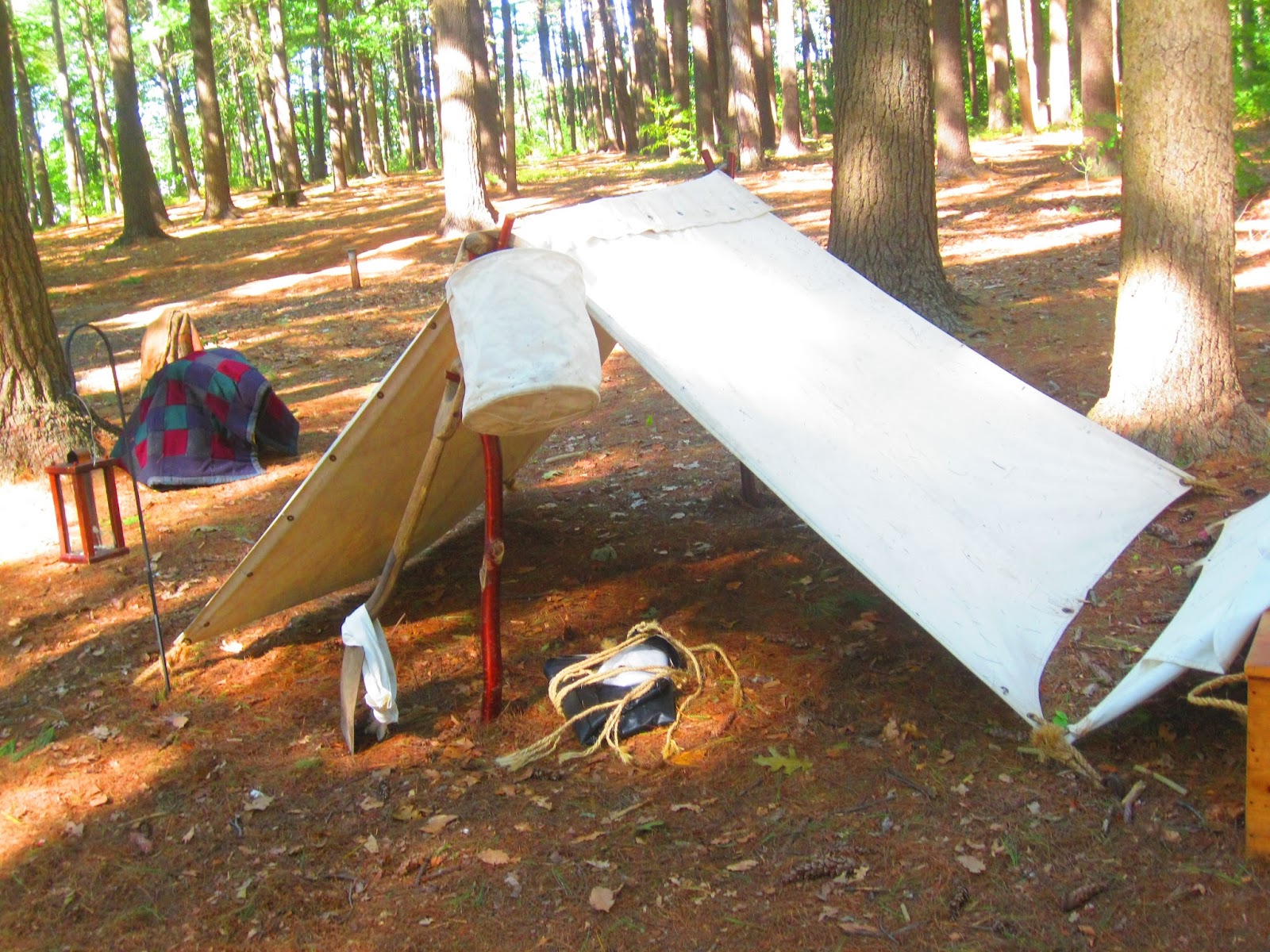
| The Boston Sanitation Commission Tent |
| I think this might have been an officer's tent. |
| My ancestor Asa Ellingwood may have slept in one like this. |
The fashion show ended and people began drifting back to the camp:
| The tailor. |
So while I didn't see any of the re-enactor soldiers what I saw gave me plenty
to think about as I headed home.
(For some great photos of the activities on Saturday, check out the gallery
here at the Quincy Patriot Ledger website.)
Thursday, September 27, 2012
THE SECOND AMERICAN CIVIL WAR BLOG CHALLENGE BLOGPOSTS
Welcome to the Second American Civil War Blog Challenge! The rules
for the challenge were these:
"Did you have ancestors in America during the Civil War? If so, where were
they and what were their circumstances? How did the Civil War affect them
and their family? Did the men enlist and did they perish in battle or die of
illness? On which side did they fight, or did you have relatives fighting on
BOTH sides? How did the women left at home cope, or did any of them find
ways to help the war effort? Were your ancestors living as slaves on Southern
plantations and if so when were they freed, or were they freemen who
enlisted to fight? Did any ancestor take part in a battle that took place in
1862?
Write a blogpost on these questions, or, if you think of another topic to do
with your family history and the Civil War, write about that. Send me the link
after you publish it on your blog by midnight September 15th and I'll publish
all the links here ..."
Twelve bloggers(counting myself) submitted fourteen blogposts with stories
that explored their families and the Civil War from various angles. All are well
worth your attention, so let's get started!
Denise Spurlock's ancestor fought on both sides of the Civil War. She tells us
how in "Ambrose B. Martindale, Confederate Conscript, Union Volunteer" at
Denise's Life in the Past Lane blog.
There was a third approach a man could take to the Civil War and Jacob Snider of
Waynesboro, Pennsylvania took it. Ed Hamilton discusses the consequences in
"A Third Side in the American Civil War" at My Old Ohio Home.
In September of 1861 author Robert Burns Clark's 2x great grandfather and
great grandfather posed for a picture before they left to fight for the
Confederacy. Robert tells us what became of them, and what he sees when
he looks at that picture in "Marching Off To War".
Fellow Massachusetts genealogist Sara Campbell contributes two posts inspired
by her research from her Remembering Those Who Came Before Us blog.
The first, "See the World" is the story of a man who served in the Union
Navy across the ocean in Europe.
The second," Civil War Research - Holyoke's Richard Wall" concerns the history
of a family from Holyoke, Ma, that Sara has "adopted"
Thousands of Irish immigrants to America fought in the Civil War, some for the
Confederacy but most for the Union. Richard Billies' ancestor was one and Richard
writes about him in "Michael Patrick Murphy" at North Against South.
For some time now, TransylvanianDutch blogger John Newmark has been
transcribing records pertaining to the part his and his wife's ancestors played
during the War. He describes them and provides links to the transcriptions
with his "Second American Civil War Blog Challenge" post.
80,000 men from Maine served in the Civil War, including Pam Seavey Schaffner's
3x great grandfather and other members of his family. Pam writers about three
of them in "Oh Brave Brackley Boys of Freeman" at Digging Down East.
Like John Newmark, Dear Myrtle has written a number of posts over the years about
four Civil War ancestors. She gives a brief summary of those posts along with the
links at "2nd American Civil War Blog Challenge". (I found the first one about the
widow claiming a pension especially interesting!)
Holly Timm also contributed two posts. The first, "brother against brother ... "
describes the havoc the war brought to Harlan County, Kentucky.The other tells
about the roles three of Holly's relatives played at Gettysburg and asks the
question, "who were they ... ". You can find both posts at her genealogy musings
blog.
At Bits And Pieces Les Larrabee recounts the sad tale of one his wifes's relatives
in "Gideon Barnes Came Home to Die" and tells us how a fellow geneablogger
helped with his research!
Over at Genea-Musings, Randy Seaver uses information from a Civil War Pension
File and online sources to fill in the blanks in "Isaac Seaver - My Only Civil War Soldier"
Russ Worthington takes a different tack on the challenge at his Family Tree Maker
User blog and shows us how he used the FTM Timeline Feature to help research
his ancestor's Union Army service. Even if you don't use Family Tree Maker, check
out his "The 2nd Americal Civil War Blog Challenge - and FTM2012 Timelines ."
It might give you some ideas.
Finally, my own 2x great grandfather Asa Freeman Ellingwood returned to the
Union Army after having already served and been discharged for medical reasons.
Find out how in "ASA ELLINGWOOD IN THE VETERANS RESERVE CORPS" here
on West in New England.
That concludes this year's edition of the Civil War Challenge. My thanks to all
the bloggers who took part!
I'll be holding three more of these to coincide with the observance of the 150th
Anniversary of the War, so you all have advanced notice and hopefully find something
in your own family's experiences that you can write a post about for next year,
I look forward to reading it!
for the challenge were these:
"Did you have ancestors in America during the Civil War? If so, where were
they and what were their circumstances? How did the Civil War affect them
and their family? Did the men enlist and did they perish in battle or die of
illness? On which side did they fight, or did you have relatives fighting on
BOTH sides? How did the women left at home cope, or did any of them find
ways to help the war effort? Were your ancestors living as slaves on Southern
plantations and if so when were they freed, or were they freemen who
enlisted to fight? Did any ancestor take part in a battle that took place in
1862?
Write a blogpost on these questions, or, if you think of another topic to do
with your family history and the Civil War, write about that. Send me the link
after you publish it on your blog by midnight September 15th and I'll publish
all the links here ..."
Twelve bloggers(counting myself) submitted fourteen blogposts with stories
that explored their families and the Civil War from various angles. All are well
worth your attention, so let's get started!
Denise Spurlock's ancestor fought on both sides of the Civil War. She tells us
how in "Ambrose B. Martindale, Confederate Conscript, Union Volunteer" at
Denise's Life in the Past Lane blog.
There was a third approach a man could take to the Civil War and Jacob Snider of
Waynesboro, Pennsylvania took it. Ed Hamilton discusses the consequences in
"A Third Side in the American Civil War" at My Old Ohio Home.
In September of 1861 author Robert Burns Clark's 2x great grandfather and
great grandfather posed for a picture before they left to fight for the
Confederacy. Robert tells us what became of them, and what he sees when
he looks at that picture in "Marching Off To War".
Fellow Massachusetts genealogist Sara Campbell contributes two posts inspired
by her research from her Remembering Those Who Came Before Us blog.
The first, "See the World" is the story of a man who served in the Union
Navy across the ocean in Europe.
The second," Civil War Research - Holyoke's Richard Wall" concerns the history
of a family from Holyoke, Ma, that Sara has "adopted"
Thousands of Irish immigrants to America fought in the Civil War, some for the
Confederacy but most for the Union. Richard Billies' ancestor was one and Richard
writes about him in "Michael Patrick Murphy" at North Against South.
For some time now, TransylvanianDutch blogger John Newmark has been
transcribing records pertaining to the part his and his wife's ancestors played
during the War. He describes them and provides links to the transcriptions
with his "Second American Civil War Blog Challenge" post.
80,000 men from Maine served in the Civil War, including Pam Seavey Schaffner's
3x great grandfather and other members of his family. Pam writers about three
of them in "Oh Brave Brackley Boys of Freeman" at Digging Down East.
Like John Newmark, Dear Myrtle has written a number of posts over the years about
four Civil War ancestors. She gives a brief summary of those posts along with the
links at "2nd American Civil War Blog Challenge". (I found the first one about the
widow claiming a pension especially interesting!)
Holly Timm also contributed two posts. The first, "brother against brother ... "
describes the havoc the war brought to Harlan County, Kentucky.The other tells
about the roles three of Holly's relatives played at Gettysburg and asks the
question, "who were they ... ". You can find both posts at her genealogy musings
blog.
At Bits And Pieces Les Larrabee recounts the sad tale of one his wifes's relatives
in "Gideon Barnes Came Home to Die" and tells us how a fellow geneablogger
helped with his research!
Over at Genea-Musings, Randy Seaver uses information from a Civil War Pension
File and online sources to fill in the blanks in "Isaac Seaver - My Only Civil War Soldier"
Russ Worthington takes a different tack on the challenge at his Family Tree Maker
User blog and shows us how he used the FTM Timeline Feature to help research
his ancestor's Union Army service. Even if you don't use Family Tree Maker, check
out his "The 2nd Americal Civil War Blog Challenge - and FTM2012 Timelines ."
It might give you some ideas.
Finally, my own 2x great grandfather Asa Freeman Ellingwood returned to the
Union Army after having already served and been discharged for medical reasons.
Find out how in "ASA ELLINGWOOD IN THE VETERANS RESERVE CORPS" here
on West in New England.
That concludes this year's edition of the Civil War Challenge. My thanks to all
the bloggers who took part!
I'll be holding three more of these to coincide with the observance of the 150th
Anniversary of the War, so you all have advanced notice and hopefully find something
in your own family's experiences that you can write a post about for next year,
I look forward to reading it!
Monday, September 17, 2012
ELISHA HOUGHTON'S PENSION FILE PT 6
In the last entry in this series about Elisha Houghton's Revolutionary War
Pension file, I posted the transcription of Elisha's request to be transferred
from the Massachusetts Veterans Roll to that of Vermont where he had
relocated.He made the request in January of 1823 and it was granted by
September of the same year. The final image from his file in a combination
of printed and handwritten information from both 1818, the year of the
original pension filing, and 1823 when the transfer was made:
"4.189 From
Massachusetts
_______________________
to Vermont
Elisha Houghton
Capt Brown
private,
Massachusetts line 1778 3 years
in the army of the United States during the Revolutionary War
________________________________________________
Subscribed on the Roll of Massachusetts
at the rate of -8- Dollars per month to commence on
the 6th of May, 1818.
_________________________________________________
Certificate of Pension issued the 17th of Nov. 1818,
and sent to Jo. Woodbridge, Esq
Stockbridge, Ma.
_________________________________________________
Arrears to the 4th of Sept. 1818 31.76
Semi-anl. all'ce ending 4th Mar 1819 48.00
_______
Continued $79.76
_______
{Revolutionary claim)
Act 18th March, 1818
He died Nov 1826
Adams,
Berkshire Co"
On the right hand side of the sheet are three oval shapes that probably were
left by wax seals. There are also two handwritten items. One is written along
the left hand side of the fold the length of the paper from top to bottom and
reads:
"Notification sent September 6th 1823
Parker L. Hall, Lenox, Massachusetts "
To the right of that is another notation:
"Date of death on
other side
from AB."
The added notes are a little confusing. The "He died Nov 1826" was added
later but because of where it was placed it makes it appear Elisha died in
Adams, Berkshire County, Ma. when he actually died in Vermont. Also there
are some figures just to the left of sum of 31.76 that I couldn't decipher.
So my 5x great grandfather collected $96 dollars a year for eight years from
1818 until his death at age eighty in Vermont in 1826. Why he had moved to
Vermont, and who he was lving with. is something I need to investigate further.
Pension file, I posted the transcription of Elisha's request to be transferred
from the Massachusetts Veterans Roll to that of Vermont where he had
relocated.He made the request in January of 1823 and it was granted by
September of the same year. The final image from his file in a combination
of printed and handwritten information from both 1818, the year of the
original pension filing, and 1823 when the transfer was made:
"4.189 From
Massachusetts
_______________________
to Vermont
Elisha Houghton
Capt Brown
private,
Massachusetts line 1778 3 years
in the army of the United States during the Revolutionary War
________________________________________________
Subscribed on the Roll of Massachusetts
at the rate of -8- Dollars per month to commence on
the 6th of May, 1818.
_________________________________________________
Certificate of Pension issued the 17th of Nov. 1818,
and sent to Jo. Woodbridge, Esq
Stockbridge, Ma.
_________________________________________________
Arrears to the 4th of Sept. 1818 31.76
Semi-anl. all'ce ending 4th Mar 1819 48.00
_______
Continued $79.76
_______
{Revolutionary claim)
Act 18th March, 1818
He died Nov 1826
Adams,
Berkshire Co"
On the right hand side of the sheet are three oval shapes that probably were
left by wax seals. There are also two handwritten items. One is written along
the left hand side of the fold the length of the paper from top to bottom and
reads:
"Notification sent September 6th 1823
Parker L. Hall, Lenox, Massachusetts "
To the right of that is another notation:
"Date of death on
other side
from AB."
The added notes are a little confusing. The "He died Nov 1826" was added
later but because of where it was placed it makes it appear Elisha died in
Adams, Berkshire County, Ma. when he actually died in Vermont. Also there
are some figures just to the left of sum of 31.76 that I couldn't decipher.
So my 5x great grandfather collected $96 dollars a year for eight years from
1818 until his death at age eighty in Vermont in 1826. Why he had moved to
Vermont, and who he was lving with. is something I need to investigate further.
Saturday, September 15, 2012
ASA ELLINGWOOD IN THE VETERANS RESERVE CORPS
Last year I posted transcriptions of the Civil War Pension File of my 2x
great grandfather Asa F Ellingwood. Asa had enlisted in the 5th Maine
Volunteer Regiment in June, 1861 and had been present at the First
Battle of Bull Run. He was injured in the Union retreat with a hernia
when he was knocked over by the horse of a Union officer and then
developed nephritis after falling ill from the alternating heat and rain.
He was discharged with a Certificate of Disability on Dec 23 1861.
But not quite three years later he reenlisted by joining the Veterans
Reserve Corps as described in his Pension File:
"Asa Ellingwood. Reenlisted Sept 3" 1864
at West Lebanon N.H. in V.R.C. for 3 years
Muster Roll of Unassigned Det V.R.C.
(to which assigned) from Oct 31" 1864 to Apl
30" 1865 Present. Muster Roll of 243 Co 1" Batt
V.R.C. (to which transferred) June 26" 1865,
for May & June, 1865 Present same to Augt,
31" 1865. Muster Roll of Co A 9" V.R.C. (to which
transferred Sept 22" 1865) for Sept & Oct, 1865
Present. He was mustered out on Det M.O.R.
Nov. 16 " 1865 as Private at Washington, D.C.
by reason of G.O. No 155 A.G.O. Oct .26" 1865.
Disability at date of enlistment "Right
Inguinal Hernia"
The Veterans Reserve Corps was organized in April 1863 to have injured
or wounded soldiers perform duties that would free up able bodied soldiers
for the front lines, The Reserves were divided into two battalions: the First
Battalion, made up of men who were able to bear arms and serve as pickets,
sentries, and prison guards, and the Second, made up of more seriously
injured men who were able to perform as cooks and other light duty.
Asa seems to be the exception to the rule, because even though he was in
the First Battalion, he worked as a cook.
I can think of two reasons why this might have happened: first, the nature of
his disability. I won't go into the details of what a Inguinal Hernia is because it's
not for the squeamish, and, frankly, I'm squeamish. But obviously it was
serious enough to keep him from the usual assignments for members of the
First Battalion V.R.C.. The second reason might be that he'd might have had
experience in civilian life cooking at a lumber camp in Maine or over in
New Hampshire.
As a cook, Asa would have been assigned to some permanent
installation since troops in the field cooked their own meals from their
field rations. I haven't as yet discovered where he might have been
stationed when he was marked as "Present" in the Muster Rolls listed in
the above image. Perhaps the location of where he was mustered out is
a clue, Washington, D.C. There were a large number of V.R.C. troops on
duty in the capital and they would after all have to be fed. If that was the
case, Asa would have been there at the time of Lincoln's assassination and
the period after. He might have witnessed the execution of John Wilkes
Booth's co-conspirators in July of 1865 when members of the V.R.C. helped
with the hangings.
While I was learning all this I was brought back to the matter of the inquiry
into Asa's pension. He was given a medical discharge from his first period
in the Union Army with the 5th Maine. The procedure to enlist in the V.R.C.
required a medical examination to determine fitness for duty. So why the
hearing and questioning when he applied for an adjustment to the amount
of his pension? All I can think of is that there were a greater number of men
applying for pension money and some might have been "working the system".
The War Department would have become a bit more thorough in making
sure the disability claims were real.
But Asa Ellingwood did his duty twice, and returned home to his wife Florilla
and to the daughter Clara Ellingwood, my great grandmother, who had been
born while he was away.
great grandfather Asa F Ellingwood. Asa had enlisted in the 5th Maine
Volunteer Regiment in June, 1861 and had been present at the First
Battle of Bull Run. He was injured in the Union retreat with a hernia
when he was knocked over by the horse of a Union officer and then
developed nephritis after falling ill from the alternating heat and rain.
He was discharged with a Certificate of Disability on Dec 23 1861.
But not quite three years later he reenlisted by joining the Veterans
Reserve Corps as described in his Pension File:
"Asa Ellingwood. Reenlisted Sept 3" 1864
at West Lebanon N.H. in V.R.C. for 3 years
Muster Roll of Unassigned Det V.R.C.
(to which assigned) from Oct 31" 1864 to Apl
30" 1865 Present. Muster Roll of 243 Co 1" Batt
V.R.C. (to which transferred) June 26" 1865,
for May & June, 1865 Present same to Augt,
31" 1865. Muster Roll of Co A 9" V.R.C. (to which
transferred Sept 22" 1865) for Sept & Oct, 1865
Present. He was mustered out on Det M.O.R.
Nov. 16 " 1865 as Private at Washington, D.C.
by reason of G.O. No 155 A.G.O. Oct .26" 1865.
Disability at date of enlistment "Right
Inguinal Hernia"
The Veterans Reserve Corps was organized in April 1863 to have injured
or wounded soldiers perform duties that would free up able bodied soldiers
for the front lines, The Reserves were divided into two battalions: the First
Battalion, made up of men who were able to bear arms and serve as pickets,
sentries, and prison guards, and the Second, made up of more seriously
injured men who were able to perform as cooks and other light duty.
Asa seems to be the exception to the rule, because even though he was in
the First Battalion, he worked as a cook.
I can think of two reasons why this might have happened: first, the nature of
his disability. I won't go into the details of what a Inguinal Hernia is because it's
not for the squeamish, and, frankly, I'm squeamish. But obviously it was
serious enough to keep him from the usual assignments for members of the
First Battalion V.R.C.. The second reason might be that he'd might have had
experience in civilian life cooking at a lumber camp in Maine or over in
New Hampshire.
As a cook, Asa would have been assigned to some permanent
installation since troops in the field cooked their own meals from their
field rations. I haven't as yet discovered where he might have been
stationed when he was marked as "Present" in the Muster Rolls listed in
the above image. Perhaps the location of where he was mustered out is
a clue, Washington, D.C. There were a large number of V.R.C. troops on
duty in the capital and they would after all have to be fed. If that was the
case, Asa would have been there at the time of Lincoln's assassination and
the period after. He might have witnessed the execution of John Wilkes
Booth's co-conspirators in July of 1865 when members of the V.R.C. helped
with the hangings.
While I was learning all this I was brought back to the matter of the inquiry
into Asa's pension. He was given a medical discharge from his first period
in the Union Army with the 5th Maine. The procedure to enlist in the V.R.C.
required a medical examination to determine fitness for duty. So why the
hearing and questioning when he applied for an adjustment to the amount
of his pension? All I can think of is that there were a greater number of men
applying for pension money and some might have been "working the system".
The War Department would have become a bit more thorough in making
sure the disability claims were real.
But Asa Ellingwood did his duty twice, and returned home to his wife Florilla
and to the daughter Clara Ellingwood, my great grandmother, who had been
born while he was away.
Thursday, September 13, 2012
ELISHA HOUGHTON'S PENSION FILE PT 5
Sometime between 1820 and 1823 my ancestor Elisha Houghton moved to
Vermont from Western Massachusetts. So far I haven't been able to find out
why he went there instead of to Oxford County Maine where his children
now lived. Perhaps there were relatives or old friends living in Vermont.
In any case when he left Massachusetts he had to apply to have his pension
payments transferred to his new place of residence. The remaining images
in Elisha's file deal with that transfer.
The first image is a folded sheet of paper. On the left hand side is a hand-
written note:
"Elisha Houghton must make a new affidavit agreeably to the within form
and transmit it to the War Department before his name can be transferred.
10 Jan 1823"
On the right is the following (I'm not sure that the date is the 10th or 15th):
"Transferred from Massachusetts to Vermont on the 10th(? ) Feby 1823
from 4th Sept. 1823.
Elisha Houghton
Mar 19"
Next is the actual transfer application. It's another preprinted form with
information filled "in the blanks" which I've designated with italicized print:
APPLICATION FOR A TRANSFER
____________________
"State of Vermont
County of Bennington ss.
On this 21st day of January 1823, before me, the subscriber, a Justice of the
Peace for the said county of Bennington, personally appeared Elisha Houghton
who, on his oath, declares that he is the same person who formerly belonged
to the company commanded by Captain Joshua Brown in the regiment
commanded by Colonel Timothy Bigelow in the service of the United States;
that his name was placed on the pensions roll of the state of Massachusetts
from whence he has lately removed; that he now resides in the state
(district, or territory) of Vermont where he intends to remain, and wishes his
pension to be there payable, in the future. That at present receives eight
dollars per month.
his
Elisha X Houghton
mark
Sworn and subscribed to, before
me. the day and year aforesaid } O.C. Merrill, Justice of Peace.
NOTE. The oath to be taken before a duly qualified magistrate, whose
official character and signature must be properly authenticated."
Then on the back is a handwritten note:
"State of Vermont
I, Joel Pratt Clerk of Bennington County Court do hereby certify that Orsamus
C Merrill Esquire is a Justice of the peace acting under the Authority of this
State & that the within signature is his.
In testimony whereof I hereto set my hand & affix the seal of said county
court this 28th day of January AD1823-
Joel Pratt Clerk"
Next we'll see if Elisha's transfer was allowed and the amount of his pension.
Vermont from Western Massachusetts. So far I haven't been able to find out
why he went there instead of to Oxford County Maine where his children
now lived. Perhaps there were relatives or old friends living in Vermont.
In any case when he left Massachusetts he had to apply to have his pension
payments transferred to his new place of residence. The remaining images
in Elisha's file deal with that transfer.
The first image is a folded sheet of paper. On the left hand side is a hand-
written note:
"Elisha Houghton must make a new affidavit agreeably to the within form
and transmit it to the War Department before his name can be transferred.
10 Jan 1823"
On the right is the following (I'm not sure that the date is the 10th or 15th):
"Transferred from Massachusetts to Vermont on the 10th(? ) Feby 1823
from 4th Sept. 1823.
Elisha Houghton
Mar 19"
Next is the actual transfer application. It's another preprinted form with
information filled "in the blanks" which I've designated with italicized print:
APPLICATION FOR A TRANSFER
____________________
"State of Vermont
County of Bennington ss.
On this 21st day of January 1823, before me, the subscriber, a Justice of the
Peace for the said county of Bennington, personally appeared Elisha Houghton
who, on his oath, declares that he is the same person who formerly belonged
to the company commanded by Captain Joshua Brown in the regiment
commanded by Colonel Timothy Bigelow in the service of the United States;
that his name was placed on the pensions roll of the state of Massachusetts
from whence he has lately removed; that he now resides in the state
(district, or territory) of Vermont where he intends to remain, and wishes his
pension to be there payable, in the future. That at present receives eight
dollars per month.
his
Elisha X Houghton
mark
Sworn and subscribed to, before
me. the day and year aforesaid } O.C. Merrill, Justice of Peace.
NOTE. The oath to be taken before a duly qualified magistrate, whose
official character and signature must be properly authenticated."
Then on the back is a handwritten note:
"State of Vermont
I, Joel Pratt Clerk of Bennington County Court do hereby certify that Orsamus
C Merrill Esquire is a Justice of the peace acting under the Authority of this
State & that the within signature is his.
In testimony whereof I hereto set my hand & affix the seal of said county
court this 28th day of January AD1823-
Joel Pratt Clerk"
Next we'll see if Elisha's transfer was allowed and the amount of his pension.
Tuesday, September 11, 2012
SEPTEMBER 11TH, 2001
((The majority of this post was first published on 11Sep 2008. I've
changed the ending to reflect that bin Laden was found.))
Sept 11th 2001
I was on my way to work at the Borders bookstore which opened
at 9:00. As usual I was listening to WBZ AM, the Boston news radio
station, and I was somewhere on Rte 37 in Braintree when the news
bulletin came about the first plane hitting the South Tower of the
World Trade Center in New York. At first I thought it was some
terrible accident as I listened to the report. I remember at one traffic
stop the light turned green and the first car in line didn't move right
away. Nobody honked their horn at the driver. They were all listening
to the news.
I was running a few minutes late already and so I was just pulling into
a parking space when news came at 9:02 of the second crash. Now I
and the rest of America knew the first crash had not been a mistake.
We were under attack. I went into the store and punched in, then
knocked on the Cash Office door. Linda, the office manager
at the time, was listening to the radio. Given that there had been a
previous attack on the Twin Towers by terrorists we realized this must
be another by the same group or another like it. We talked about it for
a few minutes but the store was about to open and I needed to be out
on the sales floor.
It was a surreal day. Linda would relay the news to the staff about the
collapse of the Towers and the other two planes crashing into the
Pentagon and the field in Pennsylvania. We heard that the planes had
come from our own Logan Airport and had many New Englanders
aboard them, which made it even harder to hear. One of the passengers
lived in my town of Abington. Work went on as it did for so many
other Americans that day even though our minds and hearts weren't
into doing our jobs.
That night when I got home the networks kept showing the same
images over and over of the planes crashing, the Towers falling and
of the people running ahead of the looming cloud. I was angry at
whoever had done this to so many innocent people, and I wanted
them caught and punished for it.
Today, it's a different world. September 11th changed it forever.
We no longer wait now for Osama bin Laden to be caught and punished.
Justice has been done.
But we still mourn, and we will never forget.
changed the ending to reflect that bin Laden was found.))
Sept 11th 2001
I was on my way to work at the Borders bookstore which opened
at 9:00. As usual I was listening to WBZ AM, the Boston news radio
station, and I was somewhere on Rte 37 in Braintree when the news
bulletin came about the first plane hitting the South Tower of the
World Trade Center in New York. At first I thought it was some
terrible accident as I listened to the report. I remember at one traffic
stop the light turned green and the first car in line didn't move right
away. Nobody honked their horn at the driver. They were all listening
to the news.
I was running a few minutes late already and so I was just pulling into
a parking space when news came at 9:02 of the second crash. Now I
and the rest of America knew the first crash had not been a mistake.
We were under attack. I went into the store and punched in, then
knocked on the Cash Office door. Linda, the office manager
at the time, was listening to the radio. Given that there had been a
previous attack on the Twin Towers by terrorists we realized this must
be another by the same group or another like it. We talked about it for
a few minutes but the store was about to open and I needed to be out
on the sales floor.
It was a surreal day. Linda would relay the news to the staff about the
collapse of the Towers and the other two planes crashing into the
Pentagon and the field in Pennsylvania. We heard that the planes had
come from our own Logan Airport and had many New Englanders
aboard them, which made it even harder to hear. One of the passengers
lived in my town of Abington. Work went on as it did for so many
other Americans that day even though our minds and hearts weren't
into doing our jobs.
That night when I got home the networks kept showing the same
images over and over of the planes crashing, the Towers falling and
of the people running ahead of the looming cloud. I was angry at
whoever had done this to so many innocent people, and I wanted
them caught and punished for it.
Today, it's a different world. September 11th changed it forever.
We no longer wait now for Osama bin Laden to be caught and punished.
Justice has been done.
But we still mourn, and we will never forget.
Monday, September 10, 2012
DOWN MEXICO (MAINE) WAY
I was searching Google's News Archive for old newspaper articles on my
Ellingwood family when I found this from The Lewiston (Me.) Evening Journal
for 12Sep 1898. It's an article with bits of news and gossips from the small towns
surrounding Lewiston:
"FROM MANY MAINE TOWNS
__________________
MEXICO
John Mason has moved from Ridlion-
ville into the Babb House on the Harlow
Hill road, Mexico.
Horace Ellingwood of the 1st Maine
regiment is in town. He was one of the
number detailed for hospital service sev-
eral months ago. He was in fairly good
health until early in August when he
was laid up by measles and is now forty
pounds lighter than when he enlisted
Asa West from Andover, Hiram West
from Upton and several others, eighteen
in all, passed through here recently on
their return from the eastern part of the
State where they have been to visit the
mother of Asa and Hiram West, who is
nearly 100 years old. During their visit
they corraled horses at night, set up
tents, cooked their own food and took
time leisurely...."
Now this is what I'd call a 2 for 1 deal! . Going by the 1898 date, Horace was a
soldier during the Spanish-American War, It's ironic that he had been assigned
to hospital service and then fallen ill himself, since the same thing happened
to my grandfather during WW1. Now I need to figure out how he's related to me.
I'd thought he was my first cousin twice removed Horatio Ellingwood but I
realized that Horatio was only a year old in 1898.
The third section is a real find though. Asa and Hiram West are my 2x great
granduncles, brothers to my 2x great grandfather Jonathan Phelps West. Asa would
have been 68 years old on this horseback trip, and Hiram 60. Now their mother
Arvilla (Ames) West died in Hermon Maine in 1907 where she was living with one
of her daughters. But in 1898 she wasn't as close to 100 as the article claims. She
was actually 88years old.
I checked and depending on which route you'd use on modern highways distance
between Upton and Hermon Maine is between 135 to 155 miles through terrain
that is wooded and mountainous. Given their ages, I'm in awe of Asa and Hiram's
energy and durability traveling that distance not by train or stagecoach but by
riding it horseback and camping out instead of staying at hotels or inns. Perhaps
when they made this trip 114 years ago this week the brothers were making their
last hurrah, knowing it might well be the last time they'd be able to do such a
thing. (Asa would die in 1907, Hiram seve years later in 1914).
I wonder what Arvilla thought about two "boys" when they rode up to the house in
Hermon? Did she scold them over risking getting a chill coming all that way, or did
she enjoy a good long visit with them for perhaps the last time?
I'd like to think she did both things.
Ellingwood family when I found this from The Lewiston (Me.) Evening Journal
for 12Sep 1898. It's an article with bits of news and gossips from the small towns
surrounding Lewiston:
"FROM MANY MAINE TOWNS
__________________
MEXICO
John Mason has moved from Ridlion-
ville into the Babb House on the Harlow
Hill road, Mexico.
Horace Ellingwood of the 1st Maine
regiment is in town. He was one of the
number detailed for hospital service sev-
eral months ago. He was in fairly good
health until early in August when he
was laid up by measles and is now forty
pounds lighter than when he enlisted
Asa West from Andover, Hiram West
from Upton and several others, eighteen
in all, passed through here recently on
their return from the eastern part of the
State where they have been to visit the
mother of Asa and Hiram West, who is
nearly 100 years old. During their visit
they corraled horses at night, set up
tents, cooked their own food and took
time leisurely...."
Now this is what I'd call a 2 for 1 deal! . Going by the 1898 date, Horace was a
soldier during the Spanish-American War, It's ironic that he had been assigned
to hospital service and then fallen ill himself, since the same thing happened
to my grandfather during WW1. Now I need to figure out how he's related to me.
I'd thought he was my first cousin twice removed Horatio Ellingwood but I
realized that Horatio was only a year old in 1898.
The third section is a real find though. Asa and Hiram West are my 2x great
granduncles, brothers to my 2x great grandfather Jonathan Phelps West. Asa would
have been 68 years old on this horseback trip, and Hiram 60. Now their mother
Arvilla (Ames) West died in Hermon Maine in 1907 where she was living with one
of her daughters. But in 1898 she wasn't as close to 100 as the article claims. She
was actually 88years old.
I checked and depending on which route you'd use on modern highways distance
between Upton and Hermon Maine is between 135 to 155 miles through terrain
that is wooded and mountainous. Given their ages, I'm in awe of Asa and Hiram's
energy and durability traveling that distance not by train or stagecoach but by
riding it horseback and camping out instead of staying at hotels or inns. Perhaps
when they made this trip 114 years ago this week the brothers were making their
last hurrah, knowing it might well be the last time they'd be able to do such a
thing. (Asa would die in 1907, Hiram seve years later in 1914).
I wonder what Arvilla thought about two "boys" when they rode up to the house in
Hermon? Did she scold them over risking getting a chill coming all that way, or did
she enjoy a good long visit with them for perhaps the last time?
I'd like to think she did both things.
Wednesday, August 29, 2012
REMINDER ABOUT THE SECOND AMERICAN CIVIL WAR BLOG CHALLENGE DEADLINE
Just a reminder that there is a little over two weeks left until the
September 15th deadline for submissions to the Second American Civil
War Blog Challenge
Did you have ancestors in America during the Civil War? If so, where were
they and what were their circumstances? How did the Civil War affect them
and their family? Did the men enlist and did they perish in battle or die of
illness? On which side did they fight, or did you have relatives fighting on
BOTH sides? How did the women left at home cope, or did any of them find
ways to help the war effort? Were your ancestors living as slaves on Southern
plantations and if so when were they freed, or were they freemen who
enlisted to fight? Did any ancestor take part in a battle that took place in
1862?
Write a blogpost on these questions, or, if you think of another topic to do
with your family history and the Civil War, write about that. Send me the link
after you publish it on your blog by midnight September 15th and I'll publish
all the links here on September 30th.
September 15th deadline for submissions to the Second American Civil
War Blog Challenge
Did you have ancestors in America during the Civil War? If so, where were
they and what were their circumstances? How did the Civil War affect them
and their family? Did the men enlist and did they perish in battle or die of
illness? On which side did they fight, or did you have relatives fighting on
BOTH sides? How did the women left at home cope, or did any of them find
ways to help the war effort? Were your ancestors living as slaves on Southern
plantations and if so when were they freed, or were they freemen who
enlisted to fight? Did any ancestor take part in a battle that took place in
1862?
Write a blogpost on these questions, or, if you think of another topic to do
with your family history and the Civil War, write about that. Send me the link
after you publish it on your blog by midnight September 15th and I'll publish
all the links here on September 30th.
Monday, August 27, 2012
ELISHA HOUGHTON'S PENSION FILE PT 4
This image from Elisha's pension file is one of my favorite family
documents for the reasons that it was the first time I'd ever
heard of the word "firkin". (cousin Chris Dunham explained it to me).
The preprinted part is in bold face, the filled in parts are italicized.
"District of Massachusetts,ss1
On this day Sixth day of July 1820:Personally appeared in open
Court before the circuit Court of Common Pleas, begun and holden
in Lenox ,within and for County of Berkshire ,in the Western Circuit,
on the 4th Monday of June 1820, the same Court, being a Court
of record for said Circuit; preceeding according to the course of the
common Law, with a jurisdiction, unlimited in point of amount,
kereping a record of its proceedings, and having the power of fine
and imprisonment,
Elisha Houghton aged 71 years, resident in Adams in the County
of Berkshire aforesaid, who being first duly sworn, according to
law,doth on his oath declare, that he served in the revolutionary
war as follows; that he enlisted in the company commanded by
Captain Brown in the regiment commanded by Colonel Bigelow
in the line of the State of Massachusetts on the Continental
establishment. That his original declaration is dated May 6th
1818 and that his pension certificate is numbered 4,189.
And I do solemnly swear, that I was a resident Citizen of the
United States, on the 18th day of March, 1818, and I have not
since that time, by gift, sale or in any manner disposed of my
property, or any part thereof with intent, thereby to diminish it,
as to bring myself within the provisions of an Act of Congress
entitled "An Act to provide for certain persons, engaged in
the land and naval services of the United States, in the
Revolutionary war," passed on the 18th day of March, 1818,
and that I have not, nor has any person in trust for me any
property or securities, contracts, or debts, due to me, nor
have I any income, other than what is contained in the schedule,
hereto annexed, and by me subscribed-schedule of property,
necessary clothing and bedding excepted-to wit:
1 Tub and firkin --------.33
1 Iron pot--------------- -.75
1 Salt mortar-------------.12
1 Tea kettle--------------.75
1 Sugar box of Plates---.19
1 Tin tumbler ------------.6
1 Old Pail------------------.13
_______
2.33
That I am by occupation a Labourer that I am not able to labor,
that the number of my family residing with me is none.
(signed) Elisha Houghton
Sworn to, and declared on the Five day of July 1820, before the
said Court
Parker L Hall (illegible) pro tem
I Parker L Hall Clerk of the Circuit Court of Common Pleas
within and for the County of Berkshire do hereby certify, that the
foregoing oath and the schedule thereto annexed, are truly copied
from the record of said Court; and I do further certify,that it is the
opinion of the said Court, that the total amount in value of the
property exhibited in the aforesaid schedule is two dollars and
thirty three cents.
In testimony whereof, I have hereunto set my hand, and affixed
the seal of said Court on this ninth day of August 1820.
Parker L Hall }Clerk of the Court for the County of Berkshire."
Subscribe to:
Posts (Atom)