I'm behind on Randy Seaver's Saturday Night Genealogy Fun challenges on
his Genea-Musings Blog. This is the challenge from a week ago Saturday:
Here is your assignment if you choose to play along (cue the Mission Impossible music):
1) Using your ancestral lines, how far back in time can you go with two degrees of separation? That means "you knew an ancestor, who knew another ancestor." When was that second ancestor born?
2) Tell us about it in a blog post of your own, in a comment to this blog post, in a status line on Facebook or a stream post on Google Plus.
I've done two earlier blogposts on this topic so I'm sort of running out of ancestors I knew who knew someone. For this one, I remembered this picture:
The dark haired little boy closest to the adults is my paternal grandfather Floyd
West. The adults are my 2x great grandparents Jonathan Phelps West and Louisa
(Richardson) West. Jonathan was born in 1834, Louisa in 1837. I knew my grandfather
so through him I have two degrees of separation from Jonathan and Louisa!
A blog about genealogy and thoughts about the various roots and branches of my family tree as well as the times in which my ancestors lived.Included are the West, White,and McFarland families.WARNING:DO NOT TAKE ALL OF MY FAMILY RECORDS AS GOSPEL. ALWAYS CONFIRM YOUR OWN RESEARCH!
Sunday, August 31, 2014
Thursday, August 28, 2014
BACK TO BLOGGING!
My blogging has fallen off a bit the past few weeks, but I was busy with other
genealogical matters: There was the First World War and Civil War Challenge
summaries that needed to be finished. I was doing some research for a friend and
sending him what I found (and I'm still working on that). So I fell behind on the
52 Ancestors in 52 Weeks meme, and was just about to start blogging to catch up
when fellow geneablogger Randy Seaver of Genea-Musings did a blog post that the
Middlesex County, Massachusetts Probate Records, 1648-1871, were now up at the
NEHGS website. Well, I have Middlesex County ancestors, so I went over to check
and see what I could find and...
...I was lost. I always felt that most of my ancestors were from Essex and Plymouth
counties, but as I kept finding file after file I realized I have more Middlesex county
ancestors than those from Plymouth County. I spent four days downloading wills
and probates, and I'm sharing what I've found with my aunt and cousin in Ohio who
got me started in genealogy. Next I will send copies to some of my distant cousins.
And there will be plenty of blogposts on what I've found, such as:
- Proof of the identity of the parents of my 5x great grandmother Lydia Phelps.
-The file that proves I have Nutts in my family tree.
- The setting aside of ancestor John Nutting's will by a judge due to what seems
like a bit of hanky-panky.
So thanks Randy for leading me to these goodies!
Tuesday, August 26, 2014
52 ANCESTORS IN 52 WEEKS#31:WILLIAM JOHNSON OF CHARLESTOWN, MA. PT2
Continuing G.W.Johnson's article from the The New England Historical and Genealogical Register, Volume 33, January 1879 on our mutual ancestor William Johnson, in which more of his florid prose is displayd. This first part has his fanciful description of the physical appearance of William Johnson's six sons, based on the appearance of their descendants some two centuries later.(one of whom was himself):
William had but one wife, whose first name was Elizabeth, though a recent genealogist generously but erroneously gives him another. I have not Elizabeth's maiden name,
nor her birth-date, nor the date of their marriage, which must have taken place before
they left England. By this sole wife William had six sons—John. Joseph, Jonathan,
Nathaniel, Zachariah and Isaac; and two daughters—Ruhamah and Elizabeth ; all of whom, except the oldest, were born in Charlestown. The daughters resided there and married young and well—Ruhamah, John Knight, Jr., and Elizabeth (" bro. Johnson's daughter," as the record designates her), Edward Wier or Weare, and both left issue.
In his six sons the colony had, in emergencies, six soldiers to defend it against the
savage foe, by whose hands John, in his old age, his last wife and a granddaughter-in-law, and a son of Joseph, fell. They were all thrifty and well-to-do, all except Isaac church members, all married, all left issue, most of them numerous issue, and all except Nathaniel executed wills, which are of record. On a careful examination of the unsparing church and court records down to the fourth generation of their descendants, the writer found not therein a blot on the good name of the race. (p83)
....These six sons were large-limbed, tall and muscular, but not corpulent, if their size
may be inferred from that of most of their descendants. William lived to see all his eight children well married and settled, and to be the grandfather of over forty grandchildren, and a great-grandfather. His sons and daughters, before and after his death, had in all sixty-four children; "a certaine sign," to use the words of an early writer, "of the Lord's intent to people this vaste wildernesse." (p84)
In this section, I had to delete a sentence at the end of the paragraph about the fate of
the missing gravestones that was anti-Semitic in nature:
His wife survived him nearly seven years, and died Oct. 6, 1684. She married again if
she was the "Elizabeth Johnson, widow," who, Oct. 24, 1679, married Thomas Carter,
of which there is some doubt, as our Elizabeth in subsequent conveyances, and in the settlement of William's estate, signs her name Elizabeth Johnson. William and his wife
must have been buried in the old Charlestown cemetery; but in 1862, after diligent
search, their gravestones could not be found. Doubtless they were near his son Isaac's,
which remain. (p84)
He then gives a list of the children of William Johnson:
Children of William and Elizabeth Johnson:
2. i. John, b. 1633.
3. ii. Ruhamah, bapt. Feb. 21. 1634-5.
4. iii. Joseph, bapt. Feb. 12, 1636-7.
5. iv. Elizabeth, bapt. March 17, 1639-40.
6. v. Jonathan, bapt. Aug. 14, 1641.
7. vi. Nathaniel, b. about 1643.
8. vii. Zachariah, b. about 1646.
9. viii. Isaac, b. 1649.(p85)
I'm descended from Jonathan Johnson who married Mary Newton at Marlboro, Ma. on
14Oct 1663.
Friday, August 15, 2014
THE FOURTH AMERICAN CIVIL WAR BLOGPOST CHALLENGE ROUNDUP
Welcome to the blogpost roundup for the Fourth Annual American Civil War BlogpostChallenge. These were the suggestions for possible topics I thought
my fellow geneabloggers might want to write about for this year's Challenge:
Did you have ancestors in America during the Civil War? If so, where were they
and what were their circumstances? How did the Civil War affect them and
their family? Did the men enlist and did they perish in battle or die of illness?
On which side did they fight, or did you have relatives fighting on BOTH sides?
How did the women left at home cope, or did any of them find ways to help
the war effort? Were your ancestors living as slaves on Southern plantations
and if so when were they freed? Or were they freemen of color who enlisted
to fight?
Have you visited a Civil War battlefield or monument to those who fought?
It could be connected to your family history, or just one that you've visited
at some point.
If your ancestors had not emigrated to America as yet, what was their life
like around the time of the Civil War?
I didn't get many entries this year but I life to think the quality of the submissions
more than makes up for the lack of quality. I've also added some photos I've
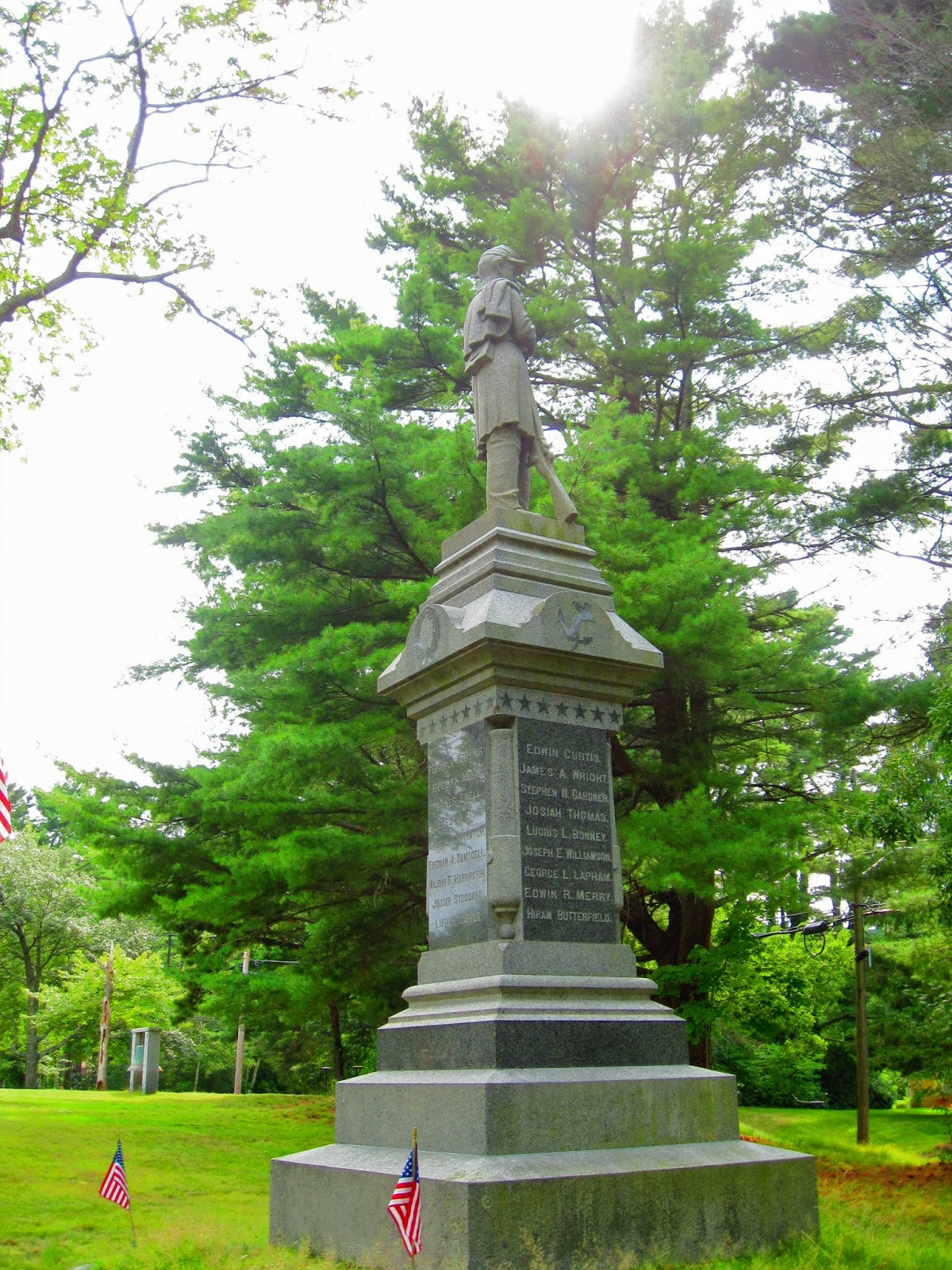
taken over the years of Civil War monuments here in southeastern Massachusetts.
So let's get started!
| Marshfield Hills Cemetery. Marshfield, Ma. |
The Civil War took a terrible toll on families on both sides, with most or
all of their male family members killed. Ray Nichols tells the story of
one such Southern family over at his Growing The Family Tree blog in
the post Civil War: the Richards family tragedy
| Civil War Veterans' Plot, Mt.Vernon Cemetery, Abington, Ma. |
Amanda the Librarian of the ABT UNK blog is one of those who had
ancestors on both side of the conflict. Some survived, some didn't. You
can find their story and some pictures as well in Military Monday:
My Civil War Ancestors.
| Mt. Pleasant Cemetery, Abington, Ma. |
After the war, monuments were built all over the country to honor those
who had fought and those who'd died in the war. Doreen from Ohio
of the Graveyard Rabbit of Sandusky Ohio shares photos of one in her
Civil War Soldiers and Sailors Monument in Milan, Ohio post.
| Civil War Memorial Arch, Abington, Ma. |
The Fold3 website is a great place to find documents relating to the
wartime service of ancestors. John Newmark recently found one that
gave the reason his wife's ancestor joined the Confederate Army and
has published the transcript in Amanuensis Monday: Reasons for
taking up arms on his TransylvanianDutch blog.
| Civil War Monument, Mayflower Cemetery, Duxbury, Ma. |
My 5x great grandmother Lydia Phelps was the young widow of a
Revolutionary War soldier with three small children when she
married my 5x great grandfather John Ames. One of the descendants
of her son Sampson Reid fought for the Union in the War and was one
of those awarded a high honor for his service. I wrote about it here
on West in New England in AXEL REED, CHICKAMAUGA &
CEMETERY RIDGE.
| Lincoln Statue, Hingham, Ma. |
talented geneabloggers who took part this year, and urge my readers to leave
comments for them after you read their posts.
Next year will mark the fifth and final year of the Civil War 150th Anniversary
so if you haven't taken part in the Challenge yet, next year will be your last chance.
Or you can wait until 2036 when I run another Civil War Challenge to mark the
175th Anniversary!
Tuesday, August 12, 2014
52 ANCESTORS IN 52 WEEKS#31:WILLIAM JOHNSON OF CHARLESTOWN, MA. PT1
Fellow geneablogger Amy Johnson Crow of No Story Too Small has issued the
52 Ancestors in 52 Weeks Challenge. Basically, we have to post something every
week on a different ancestor, whether a story, picture, or research problem. For
this prompt I've tried to concentrate on ancestors I haven't researched as much
as I have others in my family tree. I thought I'd explore my Johnson line, starting
with William Johnson, my 11x great grandfather and one of my immigrant ancestors
who came to Charlestown, Ma.
I found a great article on Google books written by G.W.Johnson. It's from the The New England Historical and Genealogical Register, Volume 33 published in January 1879 and
is one of those old style genealogies, where, for example, the physical appearance of
the Johnson men is judged to have been similar to those descendants living two centuries
later:
WILLIAM JOHNSON, one of the early settlers of Charlestown, Mass., was born in England a little after 1600, was made freeman of Massachusetts Colony, March 4, 1634-5, and the year before became an inhabitant of Charlestown, and continued such over forty-two years, till his death, Dec. 9, 1677, at the age of over 70 years. Charlestown began to be settled in 1628, was laid out as a town in 1629, and, Salem excepted, is the oldest town in the colony, older than even Boston. I have not William's birth date; nor do I know in what part of England he was born; nor what relationship, if any, he bore to contemporary Johnson stocks in the colony
p81.
The author then speculates on which other colonists named Johnson might have been
related to William before getting back to him:
William was a Puritan of good parts and education, and brought with him from England a wife and child and means. He with his wife Elizabeth joined the Charlestown church, Feb. 13, 1634-5, of which they continued members in good standing till their death, over half a century. They probably belonged to a Puritan church in England. In order to be made a freeman of the colony, which entitled him to vote and hold office, it was required that the settler be a member of a congregational church, and be correct in doctrine and conduct. Feb. 10 of the same year he signed, with others, "An order made by the inhabitants of Charlestown at a full meeting for the government of the Town," which order the writer saw among the records of Charlestown many years ago. In his signature thereto we have his autograph. It is one of the fairest, and that of a practical penman. "The inhabitants of this town," says Mr. Frothingham in his History of Charlestown, "for a few years transacted all their local business in town meeting. * * * But their local government was not yet to their minds: 'by reason of many men meeting, things were not so easily brought unto joynt issue.' * * * The original proceeding on board the May Flower was imitated, providing for the government of the town by Selectmen. * * * No town has a more perfect history of its local government than is here presented." Within the first four years of his residence, William was assessed for ten separate parcels of land, which he cultivated. By profession he was a farmer, or, as he sometimes calls himself in conveyances, a "planter." This was his leading business, and it is by his leading or principal business a man is to be designated. His secondary employment was brick-making; and if he was called brick-maker in the record of his death, it was to distinguish him from William, son of Capt. Edward Johnson, who was also a farmer. From the start almost he appears to have been a well-to-do, thriving farmer. There were no large estates in the infant town, nor indeed in the colony. In 1658, twenty-four years after he became a resident, a division of town land was made among the two hundred and three heads of families and others of the township, in proportion to the possessions each one then had; and from this division it appears that after having considerably reduced his estate by portioning his children, over two-thirds of the townsmen stood below him in point of property, including Capt Edward Johnson; and many of the other third possessed but little more. His house-lot, on which there was a garden, fronted one hundred feet on "Greate" (Main) street, near the present Square, and was about one hundred and twenty feet deep. On this lot stood the house in which all his eight children, save the eldest, were born, and in which he died, and also stood two barns and two brick-making mills.
William discharged several of the town offices, but no colonial office except that of juror. In his time, office, except the highest, was regarded as a burden. Ill paid, it was not seldom imposed, subjecting him who refused it to a fine. At one time he was one of the five overseers " of ye houses and fields of ye towne," and at another one of the twelve special selectmen, comprising some of the principal settlers, his name standing third in the list, "to settle the rates of all workmen, labourers and servants' wages and for cart and boat hire," no one then being allowed to charge for his labor, &c, a higher sum than that prescribed by law. The judicial records show that William, with another man, was a witness to prove that a neighbor had Quaker books in his house; if a willing one, as probably he was, his sin was that of the entire community and the age in which he lived. pp82-83
WILLIAM JOHNSON AND HIS DESCENDANTS. By G. W. Jouxson, of Royalton, N. Y. The New England Historical and Genealogical Register, Volume 33 , Jan 1879 Boston,Ma.
Tuesday, August 05, 2014
AXEL REED, CHICKAMAUGA & CEMETERY RIDGE
I was contacted last week by a cousin about our mutual ancestor Lydia (Phelps)
Read West. While answering a question I was reminded of something I'd
discovered seven years ago when I first began this blog involving the Civil
War. I decided it was a better topic for the Civil War Challenge than the one
I'd originally intended, so I decided to write about it instead. And here we are.
My 5x great grandmother Lydia Phelps had married her first husband Sampson
Read on 18Mar 1773 in Westford, Ma. He joined the Continental Army in 1776
and died in 1777 at age 23. I haven't as yet been able to find out if he was killed
in battle or died of natural causes. He and Lydia had three children; a son, Sampson
Read, Jr. and two daughters, Lydia and Amy. Sometime between 1777 and 1779,
Lydia met and married my 5x great grandfather John Ames m a Revolutionary
War veteran and blacksmith. There would be seven Ames children, and the family
settled around Hartford, Oxford County, Me.
John Ames taught his step-son Sampson the blacksmith trade. Eventually the young
man married Jane Ellis. (she maybe a cousin through my Ellis line which I'll
have to research.) They had a large family of ten children, one of whom was Sampson
Read III. He in turn married Huldah Bisbee and had eight children. One of these
was Axel Hayford Reed. The youngest of the seven surviving children, he apparently
was not happy farming and when he reached adulthood he moved West, eventually
ending up in Glencoe, Minnesota where he was living when the Civil War broke out.
He enlisted in the Second Regiment of the Minnesota and became Sergeant of Company
K. Then in 1863 Axel got himself into trouble. In September of 1863 Axel's regiment
was part of Union General George Thomas' in the campaign along the Tennessee-Georgia
border. On 19Sep 1863 Axel Reed was under arrest at the reat of the lines when the
Battle of Chickamauga broke out. It seems he had written a letter to a newspaper that
had been critical of the food shortage of the army and was confined for it. When the
battle broke out, he either escaped or persuaded his guards to let him return to Company
K to fight with his men. The Second Minnesota helped stop a Confederate advance and
charges were dropped against Axel for his conduct on the field during the fighting.
Two months later Axel Reed was part of the Union advance up Missionary Ridge in
Tennessee on 25Nov 1863. During that he was wounded which caused his right arm to
be amputated. Despite losing his arm he stayed on with the 2nd Regiment and by the time
he was mustered out in July of 1865 he had risen to the rank of First Lieutenant.
After the war he returned home, raised a family, started a bank and farmed. A diary
he kept during the war is cited in several history books. He died in Glencoe, Minnesota
on 21January 1917.
For his actions at Chickamauga and at Missionary Ridge, my 2nd cousin 4x removed
Axel Hayford Reed was awarded the Congressional Medal of Honor. You can read the
official citation at the U.S. Army Center of Military History website, and more details
of the two battles where Axel distinguished himself at the website for the NationalMedal of Honor Museum of Military History, which includes his photograph.
Sunday, August 03, 2014
52 ANCESTORS IN 52 WEEKS#30: THOMAS HARRIS
Fellow geneablogger Amy Johnson Crow of No Story Too Small has issued the
52 Ancestors in 52 Weeks Challenge. Basically, we have to post something every
week on a different ancestor, whether a story, picture, or research problem. For
this prompt I've tried to concentrate on ancestors I haven't researched as much
as I have others in my family tree, This week I'm writing about my 10 x great grandfather
Thomas Harris.
Thomas is one of my immigrant English ancestors who settled in Charlestown near
Boston in the Massachusetts Bay Colony. My connection with him is through his
daughter Ann/Anna who married my ancestor Elias Maverick. I found the following
information about him in a Harris family genealogy written by William Samuel Harris:
Thomas Harris and his wife Elizabeth were among the early emigrants from England to Massachusetts. Thev were in Charlestown, Mass., in 1630. After the death of Thomas his widow married, 2, Dea. William Stilson, of Charlestown, and died Feb. 16, 1670. In 1680 Dea. Stilson testified that Thomas Harris kept the ferry from Boston to Winnisimet (now Chelsea) and Charlestown, 49 years before, and that he (Dea. S.) married the widow of Thomas Harris and continued the ferry. This is the oldest ferry in the United States-Thomas and Elizabeth Harris had sons Anthony and William, and Anthony in his will, in 1651, mentions brothers Daniel and Thomas, and brother-in-law Elias Maverick, who married his sister Ann.
John, Thomas, and William Harris were among the first settlers of Rowley, Essex Co., Mass., in 1644, and Daniel came soon after; each had a two-acre house-lot laid out to him. The lots being of two acres each, shows that they were all men of property and importance. These four house-lots were all adjoining each other, which would indicate that they may have been brothers: and Daniel and William were certainly brothers.
It is very probable that all the following early settlers of New England were Thomas and Elizabeth Harris's
CHILDREN. BORN IN ENGLAND.
1. Anthony, of Boston, Mass.. was son of Thomas and Elizabeth; belonged Ui the artillery company,1644; was in Ipswich. 1648: died in Chelsea. Mass.. 1651: mentions no children in his will.
2. Daniel, of Rowley. Mass.. about 1645, is supposed to have been the brother of Anthony. About 1652 he removed to Middletown. Conn., and died 1701. lie had ten children, the oldest born in 1651.
3. John, of Rowlev. Mass.. in 1644; may have come from London in 1635. aged 28. He is supposed to have been brother of Anthony. He had six children [see page 18, foot-note]: died in Rowley. 1695.
4. Thomas, of Ipswich. Mass.. in is supposed to have been the brother of Anthony, Hie married, 1647. Martha Lake: died 1687. He was the ancestor of the Harrises mentioned in this book. See Chapter II.
5. William, of Charlestown. Mass.. in 1642, was the brother of Anthony and Daniel, and was probably brought in youth to Massachusetts by his parents,He had five daughters, the second born in 1646, he afterwards removed to Middletown. Conn., and died in 1717.
6. Ann. the sister of Anthony, married Elias Maverick before 1651.
-pp7-8 The Harris Family: Thomas Harris in Ipswich, Mass, in 1636, and Some of His Descendents, Through Seven Generations, to 1883 (Google eBook) Barker & Bean,
Nashua N.H. 1883
An entry for John Maverick on page 1242 of The Great Migration Begins says Elias
Maverick, John Maverick's son, married Anna Harris, daughter of Thomas Harris of
Charlestown sometime before 1635.
Saturday, August 02, 2014
THE GENEABLOGGERS' FIRST WORLD WAR CHALLENGE :THE BLOGPOSTS PT2
Welcome to Part2! Several contributors submitted lists of blogposts they'd
done on World War One which necessitated my splitting the roundup into
two parts. I wish I could write an intro for each one of these posts but
time doesn't permit it. I urge you to visit them because there are some incredible
stories in them:
Schalene Dagutis of Tangled Roots and Trees put together a page for her
World War One blogposts:
Genealogy blog:
series about the service records of her four great grandfathers:
Olive Tree Genealogy blog:
The other three are profiles from the Canadian Military Heritage Project:
PHILIP EDGAR PEER
A portrait trimmed in black crepe: William Francis Pell: 1891-1915
William Dunne & William Pell: Following the road of my two Williams
`Too many names upon these walls': World War One Commemoration
Sepia Saturday #187: A very special journey with a remarkable book of poetry
Commemoration in the landscape: The Irish National War Memorial Gardens
And that concludes the Geneabloggers' First World War Challenge.
I want to thank all those who participated with such a great collection
of stories. I hope that those reading this post roundup will remember to
leave a comment of appreciation on these blogposts when you read them!
done on World War One which necessitated my splitting the roundup into
two parts. I wish I could write an intro for each one of these posts but
time doesn't permit it. I urge you to visit them because there are some incredible
stories in them:
Schalene Dagutis of Tangled Roots and Trees put together a page for her
World War One blogposts:
Living in War-torn Europe
Odessa to Vancouver the Long Way via Vladivostok
A Soldier Boy's Creed
Wordless Wednesday: Twelve Tree Copse Cemetery, Turkey
52 Ancestors #26: "Not Likely to Become an Efficient Soldier"
52 Ancestors #29 -- He Died on a Flanders Field
52 Ancestors #30: Disabled in World War I
Paul Milner has done posts dealing with the war records for British soldiers and then used them to do case studies of his relatives who served in the War on his Paul Milner
Genealogy blog:
WWI Soldiers – Online Records – pt1 Introduction
WWI Soldiers – Online Records – pt 2 case study Albert William Alfred Milner
WWI Soldiers – Online records – pt3 case study William Henry Milner
WWI – Finding the Dead – Commonwealth War Graves Commission part 1
WWI – Finding the Dead – Commonwealth War Graves Commission part 2
WWI – Finding the Dead – Commonwealth War Grave Commission part 3
Scottish Military Wills – Tips for Searching, Using the Results and Workarounds
Kathleen Scarlett O'Hara Naylor of You Are Where You Came From did a
series about the service records of her four great grandfathers:
John Joseph O'Hara's WWI Service Record and a Plea for Help
Joseph E. Mulcahy's WWI Service Records
Domenico Gatto's WWI Service Records
Carmine "Charlie" Lanzillotto's WWI Service Record
Lorine McGinnis Schulze sends us seven links. The first four are from her
Olive Tree Genealogy blog:
Displaying Family Heirlooms - WW1 Medals and Photo
The Value of Military Records
Military Records: Looking Under a Stone, not just peeking behind it...
Remembering WW1 Soldier W. J. P. Bullock
The other three are profiles from the Canadian Military Heritage Project:
PHILIP EDGAR PEER
Jack Chapman
David Russell Hearns
Blogger irisheyesjennifer has chosen seven of her blogposts on World War 1and her family. You can see the list in 'The big guns are coughing...': Commemorating the Losses of World War One at 'On a flesh and bone foundation': An Irish History:
`On a celtic cross, a young man in a photograph':World War One
It all began with a bronze plaque: Remembering William Dunne 1880-1914A portrait trimmed in black crepe: William Francis Pell: 1891-1915
William Dunne & William Pell: Following the road of my two Williams
`Too many names upon these walls': World War One Commemoration
Sepia Saturday #187: A very special journey with a remarkable book of poetry
Commemoration in the landscape: The Irish National War Memorial Gardens
Finally, I did a series of posts here on my grandfather Floyd E West Sr :
ENLISTMENT RECORD OF FLOYD E. WEST SR.
FURLOUGH FOR MY GRANDFATHER, PART1
FURLOUGH FOR MY GRANDFATHER, PART2
THE HONORABLE DISCHARGE OF FLOYD E. WEST
FLOYD E. WEST SR. AT CAMP DEVENS, SEPT,1918
And that concludes the Geneabloggers' First World War Challenge.
I want to thank all those who participated with such a great collection
of stories. I hope that those reading this post roundup will remember to
leave a comment of appreciation on these blogposts when you read them!
THE GENEABLOGGERS' FIRST WORLD WAR CHALLENGE :THE BLOGPOSTS PT1
Welcome to the Geneablogger's First World War Challenge blogposts
roundup! I received a number of posts for the Challenge, so many in
fact that it's going to take two posts here to share them with you all.
It's a wonderful collection of posts, with submissions from Australia,
New Zealand, Ireland, Canada, and the United States. Some are new,
some are old; some are from familiar blogs, and some from blogs new
to me. They are all fascinating.
So let's get started with Part One!
When Jill Ball researched about her grandmother's first husband for an
ANZAC Day challenge, she discovered a story that started in England,
moved to Australia, and ended on a battlefield in France. Her post on
GeniAus is entitled ANZAC Day Blog Challenge @Kintalk
Alona Tester shares with us a wonderful picture of her great grandfather
Otto Rafael Winter a Finnish born immigrant who was proud of his
new country and joined the army when the War came. See it in the
post Anzac Day Blog Challenge: He Was Proud to be Australian on the
lonetester HQ blog.
Irish support for the Allied side in the War was complicated by the issues
of Irish independence and British rule. I'm Irish-American on my Mom's side
so I was fascinated when I read Dora's recounting of the predicament of
her relative Frank McGrane in Conscription Into The Great War- An
Irishman's Story at her Black Raven Genealogy blog.
World War One ushered in the age of modern warfare with trench warfare
and gas attacks.Christine Blythe of Empty Nest Genealogy writes about two
granduncles whose bodies were never recovered while serving in France
in WWI War Stories.
Brenda Dougall Merriman's father was a pilot for the Royal Flying Corps and
kept a diary of his experiences. I think they'd make a great movie! See for
yourself in "Fell about a thousand feet" at Brenda's blog.
Some of us had relatives in several countries who fought in the War.Schalene
Dagutis had one from the U.S. and another from New Zealand, and honors
them in a Memorial Day post, Honoring those Who Died in the Service of
Their Countries at her Tangled Roots and Trees blog.
When Kathryn Creeden ordered the service record of her great grandfather's
brother from the NARA, she discovered a fascinating story of a man who
joined the U.S. Army shortly after deserting from the Marines. Eventually
he ended up fighting in the War in the Canadian army. Kathryn details his
journey on her blog Kathryn's Quest in the post Military Monday - Deserter
Becomes WWI Hero
Amanda Pape's blog is the wonderfully named ABT UNK. Her contribution
to the Challenge is a picture of her grandfather and his two brothers, all of
whom served in WWI. You can see it at her post Wordless Wednesday: "3
service stars in the window."
In Guy W. House, "Dorene from Ohio" of the Graveyard Rabbit of Sandusky
Ohio blog salutes the service of a cousin who died before she was born.
Donna Mierzejewski-McManus likes to research the people whose headstones
she's photographed in a Toledo cemetery and in her post Toledo’s World War I Veterans’ Experiences she tells the stories of two Polish-American soldiers.
The name of her blog is Toledo's Kuschwantz.
Shelley Bishop gives us the story of her granduncle who served in a heavy
artillery unit and survived the Battle of Argonne Forest over at her blog
A Sense of Family in Roy D. Eberhard, World War I Soldier: 52 Ancestors
Because of the infamous records fire of 1973, Jenny Lanctot had to resort to
other sources to find out about her great grandfather's WWI. Her persistence
paid off and she shows us what she found in Harold John Crowe – Indiana
National Guard (WWI) at Are My Roots Showing?
While actually hostilities broke out on 28Jul 1914, most cite the assassination
of Archduke Franz Ferdinand at Sarajevo a month earlier as the start of the War.
John Newmark of the TransylvanianDutch blog tells us where his ancestors
were on that fateful day, June 28, 1914.
North Dakotan Adolph Myren's story is typical of many American soldiers
in both World Wars. It's recounted by Mary P Nelson at Celebrating Family
Stories (Another great blog title!) in Military Monday: Adolph Myren.
Like Jenny Lanctot, Cheri Hudson Passey's research into her relative Frank
E. Sullivan Sr.'s World War 1 service was complicated by the 1973 NARA
records fire. She was able to find some information, though, in other
documents and she describes what she found in Military Monday - Clues
From WWI Discharge Certificates at Carolina Girl Genealogy.
Carol A. Bowen Stevens over at Reflections from the Fence had the same
problem as Jenny and Cheri as she researched her WW1 veteran relative:
a lack of records. She turned to the newspaper collections at Ancestry.com
and through them shows us how a small Iowa town dealt with the draft
registration and enlistment of their young men. It's in World War I Soldier ::
Roscoe Clyde Lashbrook.
At her Heritage Zen blog, Cynthia Shennette's grandfather was a mechanic
in the fledgling U.S.Army Air Service. She uses pictures, postcards, and
records to construct a timeline of his military service in Over There!: My
Grandfather and World War I
Not many Americans know about a badly managed British expedition to Russia
during the War that included some American troops. Miriam Robbins' great
grandfather was one of the soldiers and she tells his story of that campaign
in A Polar Bear in North Russia at AnceStories: The Stories of My Ancestors.
Sara Campbell has a real treasure: the letters her grandfather sent home from
boot camp and then the front in France. They were sent to his sister and to
his future wife and give us a look at what a young soldier saw and thought
about in wartime. They're at Sara's post WWI Chronicles of Pvt. Will Coleman
on her Remembering Those Who Came Before Us blog.
Some soldiers lost their lives in battle, some from illness, and some died
from their injuries after they'd returned home. Wendy Grant Walter tells us
of one such cast on her blog From A to Zophar in her post Howard Mellor
Grant-Veteran of World War 1.
This concludes Part One. Some of the participants submitted lists of posts
they've written on the War, and those will be covered in Part Two.
Tuesday, July 29, 2014
52 ANCESTORS IN 52 WEEKS#29: ROBERT SWAN VS. STEPHEN WEBSTER, PT2
On the same day that Stephen Webster brought my ancestor Robert Swan to court
over stolen wheat, there was a second court case involving the two men. Apparently
Webster didn't take the theft of his wheat very well. From the Essex County Court records:
Stephen Webster was fined for speaking reproachful words to Robert Swan.*
*Robert Swan's complaint to the Worshipful Mr. Bradstreete against Stephen Webster : For saying that he would be the death of him, and for saying that Swan was a weak man and he could drive a dozen such as he before him through the town; also for threatening to burn said Swan's barn, which might be disastrous to himself, wife and children, for his dwelling house was very near the barn, etc. Elizabath Whiticker and Samuell Gile, jr., deposed that the same day that Robert Swan was charged with taking away the wheat, Stephen Webster said that if it had not been for Goody Swan, he would have knocked Robert in the head, etc. Sworn, Sept. 25, 1665, before Simon Bradstreete.f
Barthellme Heth deposed that Stephen Webster came to him with some neighbors to ask counsel, and soon after Robert Swan came for the same purpose. Webster desired counsel before his father Emiry and John Griffen, etc. Sworn in court. Abigale, wife of John Remington, deposed that being abroad in a hemp yard, she saw Webster go to her brother Swan's, and her sister Swan go with him to the barn. Webster said to Swan, "art thou a church Member, and dare to doe lyes," with which he stabbed at him with the fork he had in his hand, making a mark on his breast. Webster stood on the rails that were set up on the outside of the barn to fence in the mow, etc. Sworn, Sept. 22, 1665, before Simon Bradstreete.f
Robertt Swan deposed that they at first agreed about the wheat and shook hands and later Webster told him that he had played him a scurvy trick, sometimes he had put two sheafs together and Joseph Leigh, for many offences, was sentenced to pay a fine, to be severely whipped and bound to good behavior. He was to be imprisoned until the fine was paid, and upon his petition, the corporal punishment was changed to a fine and a fortnight's imprisonment.* again only one and a half. This he had done by taking some wheat out of the sheaf, putting it at the end of the band, drawing it up to the heads and twisting it together and made the band longer. Deponent told him that it was horrible wickedness for him to make deponent appear guilty when he was guilty himself, and he said it was good policy to use means to keep himself out of snares, etc. Elizabeth (her mark) Swan, wife of Robert Swan, deposed concerning the assault in the barn. She took the pitchfork from the men, and Webster told Swan that he would be the death of him if he hanged for it, etc. Sworn, 10 :6 :1665, before Simon Bradstreete.f
Elizabeth (her mark) Swan, daughter of Robert Swan, deposed. John Griffen deposed that being at the house of his father Sherred, etc.
p277 Records and Files of the Quarterly Courts of Essex County, Massachusetts: 1662-1667 (Google eBook) Essex Institute, 1913
And that's all there is. I hope that whatever Stephen Webster was fined offset the
treble damages 7x great grandfather Swan had to pay. Reading this, I could
picture the two men in the barn, Webster poking at my ancestor with the pitchfork
until Robert's wife Elizabeth (Acey)Swan marched in to take the pitchfork away
before something serious happened between the two fools.
I love these Essex County court records. They give me a glimpse of what my
ancestors did and said. In this case, it painted a picture of a day in Robert Swan's
life that could have ended badly.
Monday, July 28, 2014
52 ANCESTORS IN 52 WEEKS#29: ROBERT SWAN VS. STEPHEN WEBSTER, PT1
Fellow geneablogger Amy Johnson Crow of No Story Too Small has issued the
52 Ancestors in 52 Weeks Challenge. Basically, we have to post something every
week on a different ancestor, whether a story, picture, or research problem. For
this prompt I've tried to concentrate on ancestors I haven't researched as much
as I have others in my family tree, This week I'm writing about my 7x great grandfather
Robert Swan's dispute with one of his neighbors in Haverhill, Ma.
The story unfolds in the records of an Essex County, Ma. court session held at Ipswich
on September 26, 1665 :
Robert Swan, complained of by Stephen Webster for stealing wheat, was ordered to pay treble damages.*
*Stephen Webster deposed that upon Aug. 4, 1665, he and Robert Swan were in company with some of their neighbors, and they tried to agree about the wheat, etc. Zeackriah Whitt, aged about twenty-three years, deposed that he was employed to shock his master Webster's wheat, which grew upon land near to Robert Swann's house, and the last day they were reaping said wheat, Joseph Johnson was helping him. The next morning much of the wheat was gone, etc. He also mowed wheat for Swan near his orchard. Sworn, 10 :6 : 1665, before Simon Bradstreete.f
John Heasellton, sr., testified that he and his son Samuell plowed the land for Steven Webster, which land adjoined the little river near the saw mill, etc. Sworn, Sept. 25, 1665, before Simon Bradstreete.f
John Griffen, aged about twenty-four years, deposed that Swan told him that he had the wheat in exchange, etc.
Joseph Johnson, aged twenty-seven years, deposed that he worked upon the land that Steven Webster sold to Robert Swan, etc. Sworn, 10 : 6 : 1665, before Simon Bradstreete.f
Samuell Heazellton deposed. Samuell Gilde (also Guill), aged about sixteen years, deposed that his master Swan's cart, etc. Sworn in court. John and Joseph Johnson deposed. Sworn in court. Thomas Davis deposed that part of the land was sown with "silpy" and the other part with wheat, etc. Sworn, Sept. 22, 1665, before Simon Bradstreete.f
Edward (his mark) Brummidge deposed that Steven Webster's lot was near Abraham Whittiker's house, etc. Sworn, Sept. 22, 1665, before Simon Bradstreete.f
John Hazeltine and Stephen Kent, sr., deposed that Samuell Guile, jr., etc. Sworn, Sept. 25, 1665, before Simon Bradstreete.f
Jno. Griffin, aged about twenty-four years, deposed. Sworn, 10 : 6 : 1665, before Simon Bradstreete.f
-pp276-277 Records and Files of the Quarterly Courts of Essex County, Massachusetts: 1662-1667 (Google eBook) Essex Institute, 1913
As usual when I find one of these things, there is the unanswered question of
exactly how much money was the "treble damages" Robert Swan had to pay?
But it didn't end there. Like all the best of these colonial court cases, there was
a counter suit against Stephen Webster. I'll go into what my ancestor accused him
of doing in the next part.
To be continued.
Saturday, July 26, 2014
FLOYD E. WEST SR. AT CAMP DEVENS, SEPT,1918
((First posted in January 2008. I've done a little editing of the
original))
When journalists talk about a possible “bird flu” epidemic, the
historical event they draw parallels to is the Great Influenza
outbreak of 1918. It first appeared near Fort Riley Kansas in
January and by March had reached New York. Soldiers in crowded
barracks fell victim to it easily and troop movements helped spread
it quickly.
And in the midst of this my grandfather enlisted in the Army in April,
1918.
Then on 8 Sept. 1918 the first case of a new, more virulent strain was
reported at Camp Devens in Ayer, Massachusetts. By the end of the month
there were 14,000 cases of the illness and over 700 deaths attributed to it.
Camp Devens was placed under quarantine but the whole state of Massachusetts
was already swept by the disease as the figures on this site show. My
grandfather was one the troops assigned to a medical detachment working
at the Camp Hospital.
Camp Devens’ hospital surely was not meant to deal with such a
catastrophic event and the accounts I’ve read while horrific must
pale in comparison to what my grandfather must have seen and
experienced. I wonder what he must have thought as he went
about his duties at the hospital? Growing up he must have heard
about the diptheria outbreak that had caused the deaths of six
relatives forty years before. Now he was in the midst of
something much worse where hundreds could die in a single night.
Did he wonder when he himself might begin to show symptoms
and end up a patient himself?
But he survived and was given a furlough at the end of November.
From what I’ve read, the epidemic began and expanded quickly
but subsided within a month and a half. By the end of October it
was over for the most part and by November the authorities must
have felt it was safe enough to allow Private West a furlough to
visit home in early December.
I can’t imagine they would have allowed it if he’d been stricken
with pneumonia during the height of the epidemic, so my guess is
that he came down with it sometime after he returned to
Camp Devens. The Army doctors must have felt the damage to his
lungs was sufficient to keep him from his duty as a hospital
orderly and so my grandfather was given an honorable discharge
on 12Mar 1919, less than a year after he'd enlisted.
Some soldiers in World War 1 saw hell on a battlefield.
Others, such as my grandfather, saw another sort of hell in
hospital wards full of comrades racked with the Spanish Influenza.
I used a variety of sources researching this post. One of them is
“Fever of War: The Influenza Epidemic in the U.S. Army During
World War I” by Carol R. Byerly, (NYU Press, 2005) which you
can preview at GoogleBooks.
Friday, July 25, 2014
THE HONORABLE DISCHARGE OF FLOYD E. WEST
(First posted in December 2007)

An earlier post was on the Enlistment document of my
“Honorable Discharge from the United States Army
TO ALL WHOM IT MAY CONCERN:
This is to certify that Floyd E. West
Private First Class Hospital Detachment
THE UNITED STATES ARMY, is hereby HONORABLY
DISCHARGED from the military service of the United States by
reason of Pursuant to W. D. Cir.I77 A.G. O. Nov.21/1918.
Said Floyd E. West was born in South Paris, in the State of
Given under my hand at Camp Devens Mass. this twelfth day of
March, one thousand nine hundred and nineteen.
A. O. Davis(?)
Lt. Col. M.C. U.S.A.commanding.”

An earlier post was on the Enlistment document of my
grandfather Floyd Earl West Sr. Thanks to my Aunt Dot I have
a copy of it and also of his Discharge. The second line with his rank
is smudged here but by holding the paper up before a light I could
make out most of the writing. Also, I’m not sure if the
commandant’s last name is correct but it is the best guess I
could come up with in trying to read it.
I’m grateful my to Aunt Dot for giving me these copies and for
all the other items she’s sent along! I don’t know how difficult it
might be to obtain these elsewhere, but the information on them
is invaluable to someone researching their family history and
genealogy.
might be to obtain these elsewhere, but the information on them
is invaluable to someone researching their family history and
genealogy.
“Honorable Discharge from the United States Army
TO ALL WHOM IT MAY CONCERN:
This is to certify that Floyd E. West
Private First Class Hospital Detachment
THE UNITED STATES ARMY, is hereby HONORABLY
DISCHARGED from the military service of the United States by
reason of Pursuant to W. D. Cir.I77 A.G. O. Nov.21/1918.
Said Floyd E. West was born in South Paris, in the State of
Maine. When enlisted he was 25 years of age and by occupation
a Farmer. He had Blue eyes, Brown hair, Medium complexion,
and was 5 feet 5 1/2 inches in height.
Given under my hand at Camp Devens Mass. this twelfth day of
March, one thousand nine hundred and nineteen.
A. O. Davis(?)
Lt. Col. M.C. U.S.A.commanding.”
Thursday, July 24, 2014
FURLOUGH FOR MY GRANDFATHER, PART2
Continuing with posts about my grandfather Floyd E West's WW1 service:
There's not much more information on these images but it does tell me that
Pop was back on base on December 6, 1918. The form is signed by
Capt. John E Tracy who was commanding the soldiers of the medical
detachment.
There's not much more information on these images but it does tell me that
Pop was back on base on December 6, 1918. The form is signed by
Capt. John E Tracy who was commanding the soldiers of the medical
detachment.
Wednesday, July 23, 2014
FURLOUGH FOR MY GRANDFATHER, PART1
I first blogged about my grandfather's WW1 furlough papers back in 2007 but didn't discuss their
content. So in commemoration of the start of WW1,I'm doing so now.
These are furlough papers for my grandfather Floyd E West, issued while he was serving at Camp Devens, Ma. during
World War 1. It was granted on Nov. 29 1918 and on the
front side gives his rank as "Private 1st C Det Med Dep Base Hospital. The date he
was expected to report back is smudged and unreadable.
On the back side, there is a section on Pay and Rations I don't really understand, but
looking at the two dates in December I think he was supposed to be back from his
visit to Upton, Maine by December 10, 1918.
Lastly is the physical description, which says he is 25 years old, 5ft 5 1/2 inches tall
with "medium" complexion, blue eyes and brown hair. One of the things I was struck
by was that his signature was very much like that of my Dad, Floyd E West, Jr!
Tuesday, July 22, 2014
ENLISTMENT RECORD OF FLOYD E. WEST SR.
In observance of the start of World War 1, this week I'll be reposting a series I did back in 2007
on my grandfather Floyd E West Sr's World War 1 service. This was posted on 17Dec 2007.


I mentioned back in July that Aunt Dot and I exchanged some
family research at my nephew Paul’s wedding. One of the items
she gave me was her childhood memories of my Dad. Another
item was a photocopy of my Grandfather West’s WW1 discharge
and his enlistment record as shown above.
I think the two papers were folded together which would explain
the dark lines across the pages. In the transcription below, I’ve
put a question mark after any entry I’m not certain about. I’ve
also italicized the handwritten information.
I received an email from my cousin Diana tonight as I was typing
this and in it she passed along information from Aunt Dot that
Pop was an orderly at the Camp Devens base hospital, that he
was only in for a short period before contracting double
pneumonia and that he was shipped home after his recovery.
I’ll have more to say on that after I’ve posted the transcription
of his discharge form.
In my reply to Diana, I remarked that today I realized that
between the service records and the memoir that Aunt Dot
gave me earlier this year I have learned more about Pop than
I ever knew before, and much more than I know about my
other grandfather!
ENLISTMENT RECORD
Name: West, Floyd E. #2722093 Grade: Private First Class
Enlisted, or Inducted, Apr.29, 1918 , at So. Paris, Me.
Serving in First enlistment period at date of discharge.
Prior service:* none
Noncommissioned officer: none(?)
Marksmanship, gunner qualification or rating: not armed
Horsemanship: not mounted(?)
Battles, engagements, skirmishes, expeditions: (left blank)
Knowledge of any vocation: Farmer
Wounds received in service: none
Physical condition when discharged: Good
Typhoid prophylaxis completed: ---------------
Paratyphoid prophylaxis completed: June 27/18
Married or single : Single
Character: Excellent
Remarks: No A.W.O.L. or absences under G.O. 45/1914.
This soldier entitled to travel pay.
Signature of soldier: Floyd E. West
John Burnette (?)1st St. M.C. U.S.A.Commanding Detachment
Friday, July 18, 2014
A REMINDER: THE FOURTH AMERICAN CIVIL WAR BLOGPOST CHALLENGE DEADLINE
Just a reminder for the Fourth Annual American Civil War Blogpost
Challenge that the submission deadline is August 2nd to honor the Battle
of Mobile Bay, Alabama, that began on 2Aug, 1864.
These are some ideas you could write about:
Did you have ancestors in America during the Civil War? If so, where were they
and what were their circumstances? How did the Civil War affect them and
their family? Did the men enlist and did they perish in battle or die of illness?
On which side did they fight, or did you have relatives fighting on BOTH sides?
How did the women left at home cope, or did any of them find ways to help
the war effort? Were your ancestors living as slaves on Southern plantations
and if so when were they freed? Or were they freemen of color who enlisted
to fight?
Have you visited a Civil War battlefield or monument to those who fought?
It could be connected to your family history, or just one that you've visited
at some point.
If your ancestors had not emigrated to America as yet, what was their life
like around the time of the Civil War?
The 150 year celebration of the Civil War is a great source for those of us
blogging about our family history. So, let's do a little research over the coming
weeks between now and August 2nd. Find out the answers to the questions
I asked and write about them. Or if you think of another topic to do with your
family history and the Civil War, write about that. Send me the link when you
publish it on your blog and I'll post all the links here on August 15th.
Tuesday, July 15, 2014
52 ANCESTORS IN 52 WEEKS#28: THOMAS TAYLOR
Fellow geneablogger Amy Johnson Crow of No Story Too Small has issued the
52 Ancestors in 52 Weeks Challenge. Basically, we have to post something every
week on a different ancestor, whether a story, picture, or research problem. For
this prompt I've tried to concentrate on ancestors I haven't researched as much
as I have others in my family tree. This week my subject is my 10x great grandfather
Thomas Taylor.
Up until now I had no information about Thomas Taylor ither than the fact his wife
was named Elizabeth and that they were the parents of my ancestor, the exotically
named Seabred Taylor. I took note of the anniversary Seabred's death (14Jul 1714)
yesterday as part of my daily On This Date post on Facebook. I decided to see what
I could discover on the internet about Thomas. Regrettably, most of the hits I found
on Googlebooks were "Snippet" views. I did find this, though, in a family genealogy
of another family descended from him:
Thomas1 Taylor was b. about 1620 and first appears in New England at Charlestown where his wife Elizabeth was admitted to the First Church 8 Jan. 1638/9. He lived in Watertown, 1641-1649. He purchased a house and land in Reading (the part now Wakefield) of Sara, the daughter of Ralph Roote who received it by gift from Edward Whitfield of Reading and the General Court confirmed his title to it, 19 Oct. 1649. (Massachusetts Bay Records, 2: 283 and 3: 181.) His wife Elizabeth d. at Reading, 18 Jan. 1650. He called himself 36 yrs. of age in 1655/6 and d. at Reading, 29 Jan. 1690/1. His son (1) Seabred Taylor, b. at Watertown, 11 March 1642. (2) Thomas2 Taylor, Jr., b. before 1650; d. at Reading, 4 April 1691. (3) Benoni Taylor, d. at Reading, 18 Feb. 1650. The father was made a freeman of the Massachusetts Bay Colony, 26 May 1647. His Watertown homestall he sold to Justinian Holden of Cambridge, 9 Nov. 1660.
-p92
Descendants of Thomas Wellman of Lynn, Massachusetts By Joshua Wyman Wellman, George Walter Chamberlain, Arthur Holbrook Wellman
So now I at least know he lived and died in Reading, Ma, and I now have a death
date that I verified at the Early Vital Records of Massachusetts website.
I discovered something else while Googling the family. As I said, I'm descended
from Seabred Taylor. I found this short entry:
According to the law establishing the Superior Court, it sat at Charlestown for Middlesex, on the 31st of January, 1693. Present, as appears by the record, all the justices.. The grand jury being sworn refused bills upon several presentments for witchcraft, and returned indictments against five only ; and these were called up and tried in the following order :—
Mary Toothaker, whose indictment has already been transcribed into these letters.
Mary Taylor, wife of Seabred Taylor of Reading. She was indicted for covenanting with the devil, and by writing her name upon a piece of birch bark in confirmation of said covenant.
Sarah Cole, wife of John Cole of Lynn ; indicted for afflicting one Mary Brown of Reading, on the 6th of September, 1692.
Lydia Dastin, of Reading. Indicted for afflicting Mary Marshall of Maiden, in May, the same year.
Sarah Dastin, of Reading ; indicted for tormenting Elizabeth Weston, a young woman of the same town.
-p188
Historical Letters on the First Charter of Massachusetts Government (Google eBook) by Abel Cushing J. N. Bang, printer, 1839 - Massachusetts
So I have another accused witch in my family tree!
Sunday, July 13, 2014
REMINDER FOR THE GENEABLOGGER WORLD WAR ONE CHALLENGE
There's about two weeks left until the submissions deadline for the first
Geneablogger's First World War Challenge. You can submit links to older
posts if you've already written about it. But if you haven't, here's some ideas
that might help:
Where your ancestors were in 1914, and what effect the war would have
on their families?
Did any of them see military action? Were any family members killed? Do you have any
photographs of them in uniform?
Did the War force your ancestors to leave their homes? Was it the reason they emigrated to another country? Where did they go?
Write a blogpost on any of the above, or something else about World War 1 and your family. When it's posted, send me the link. If you have already written a blogpost that you'd like to use, then send me the link to that post.
The deadline for submissions will be July29th, 2014. I'll publish the list of links here a week later on August 5th.
Wednesday, July 09, 2014
"AN ILL DESIGN":THE DEATH OFJOHN AMES, 9JUL 1724
((Today is the 290th anniversary of the death of my ancestor John Ames. First
posted 9Jul 2012))
During the period of the colonial New England Indian Wars, summer was the
season when raids and casualties increased on both sides. As a consequence,
I've several ancestors who died violently in the summer months. One such was
my 8x great grandfather John Ames of Groton, Ma. John was no stranger to
deaths caused by the wars: his wife was Priscilla Kimball whose father
been killed when she was a child and who had been taken captive. So John
probably took precautions but it didn't save him. The incident was described by
the historian Samuel Abbott Green in his book Groton in the Indian Wars.(He
quotes several sources which excerpts I've boldfaced since Green omits
the quotations marks for some of them):.
"It was on Thursday, July 9, 1724, that John Ames was shot by an Indian, one of
a small party that attacked his garrison in the northwesterly part of the town.
Ames lived on the north side of the Nashua River, a short distance below the
Hollingsworth paper-mills. He is said to be the last person killed by an Indian
within the township. The Indian himself was immediately afterward shot by
Jacob Ames, one of John's sons. "The Boston Gazette," July 13, 1724, thus refers
to the event: —
A Man was kill'd last Week at Groton, by the Indians, and 't is suppos'd one
Indian was kill'd by one of our Men in the Garrison; the Indians left their
Packs, 5 in number, which were taken and secur'd by the English.
In the Gazette of July 27, it is said that " An Indian Scalp was brought to Town
last Week from Groton."
"The New England Courant," July 13, 1724, reports that "Last week the Indians
kill'd a Man at Groton, and had one of their own Men very much wounded."
The same newspaper, in its issue of July 27, says that "The Scalp of an Indian
lately kill'd at Groton is brought to Town."
"The Boston News Letter," July 16, 1724, gives the following version: —
From Groton we are inform'd, That 5 Indians came into that Place, and kill'd
one Man, upon which one of our Men shot out of the Garrison and kill'd an
Indian and got his Scalp in order to bring to Town, and have likewise taken
the Indian Packs.
The same paper, of July 30, says that "An Indian Scalp from Groton was brought
in here last Week."
These accounts, taken in connection with Jacob Ames's petition, found in the
printed Journal of the' House of Representatives for November 20, 1724, and
herewith given, show conclusively that they relate to the assault in which
John Ames was killed. It is equally certain that Penhallow, in his History, refers
to the same attack when he speaks of the damage done at Groton in the
summer of 1724.
A Petition of Jacob Ames, shewing that he was one of the Weekly Scouts near
the Garrisons on the Westerly part of the Town of Groton; and on the Ninth Day
of July last, when it was the Petitioners Week to be on Duty, a Number of
Indians appeared at the Garrison of the Petitioners Father John Ames, and
killed him at the Gate, and then rush'd violently into the Garrison to surprise
the People there. And the Petitioner did with Courage and Resolution by
himself defend the Garrison, and beat off the Indians, Slew one of them and
Scalp'd him; praying, That altho' it happened to be his Week to be on Duty,
that this Court would take the Premises into their wise and serious
Consideration, and grant what other Allowance more than the Establishment
by Law, shall to them seem meet, for his aforesaid Service. Read, and in
Answer to this Petition. Resolved, That over and above the Fifteen rounds
due to the Petitioner by Law, for recovering the said Scalp, and the good
Services done this Province thereby, the Sum of Fifteen Pounds be allowed
and Paid out of the Publick Treasury to the said Jacob Ames for his good
Service as aforesaid.
Sent up for Concurrence.
Mr. Butler, in his History, gives the following version of this affair, which was
gathered largely from grandchildren of the Ezra Farnsworth mentioned in it.
The account was taken down in writing more than a hundred years after the
occurrence of the event, which will explain any inaccuracies due to tradition.
Mr. Butler refers the assault to a period much later than the actual fact: —
`An Indian had been seen, for several days, lurking about the town, it was
conjectured, upon some ill design. Mr. Ames, who lived on the intervale, on
the west side of Nashua river, now owned by John Boynton, Esq., went into
his pasture to catch his horse. Discovering the Indian, he ran for his house;
the Indian pursued and shot him as he entered his gate. The dead body
prevented the gate's closing, as it would otherwise have done of itself, and
the Indian pressed in to enter the house, where Ames had a son and daughter.
The son seized his gun, and shot at him, as he entered the gate. The ball,
striking the latch of the door, split, and one part of it wounded the Indian,
but not severely. As the son attempted to close the door against the enemy,
after the shot, the Indian thrust his foot in, and prevented. The son called
to his sister to bring his father's gun from the bedside, and at the same
time striking the Indian's foot with the breach of his gun, compelled him
to withdraw it, and closed the door. While the Indian was in the act of
reloading his gun, the young man found means to shoot through a
crevice and killed him. Two men, at work about a mile distant in a
mill, Ezra and Benjamin Farnsworth, hearing the reports of the guns,
and suspecting the cause thereof, were soon at the place, and found
the bodies of Ames and the Indian both weltering in their blood. This
is the last man killed by an Indian within the bounds of Groton.
(Pages no, 111.)'
Mr. Butler says, in his History (page 100), that "in the summer of 1723,
one man was killed at Groton." I am inclined to think that this allusion
is to John Ames, as I can find no other authority for the statement.
(Groton During the Indian Wars Samuel Abbott Green pp131-133).
John was the son of accused witch Rebecca Blake Eames. The family didn't
seem to have much luck in those early days but fortunately it improved in
later generations.
Subscribe to:
Posts (Atom)