Turning to the families of the women in the Perkins line, I'm beginning with Hannah (Long) Perkins' father, Robert Long. Robert is another of my immigrant ancestors and made the voyage tothe Massachusetts colony with his first wife and ten children.He settled in Charlestown where he became a prominent and wealthy man. Assuch, he became a member of the Militaty Company of Massachusetts which was a Boston militia company. It was chartered by Gov. John Wintrop in 1635 and still exists today nder the name of The Ancient and Honorable Artillery Company of Massachusetts. This makes it one of the oldest military organizations in the world. I found this entry for Robert Long in a history of the company written by Oliver Ayers Roberts:
Robert Long (1639), of Charlestown, came from Dunstable, England, in the "Defence," in 1635, at the age of forty-five years, bringing his wife, Elizabeth, and ten children. He had been an innholder at Dunstable, Bedford County, England, where Rev. Zechariah Symmes, of Charlestown, Mass., had formerly preached. He was an innkeeper in Charlestown, and his house was situated "on the south of Mill hill — his houselot being bounded by the market place, meeting house lane and High Street." He was licensed Sept. 3, 1635, "to keepe a house of intertainment att Charles Towne for horse and man." In 1640, Charlestown chose him to sell wine, and the General Court approved the choice. Dec. 11, 1648, Robert Keayne (1637) and James Penn, deputies of the General Court, and in behalf of said court, signed articles of agreement with William Phillips (1644), Robert Long (1639), Hugh Gunnison (1646), William Hudson (1640), and Robert Turner (1640), vintners, by which the latter had the exclusive right to sell and retail all kind of wines in Boston and Charlestown for five years, by paying to the treasurer of the jurisdiction of Massachusetts one hundred and sixty pounds yearly, in current money. He owned, according to the Book of Charlestown Land Records, twelve other pieces of real estate, containing above one hundred and fifty acres. He died Jan. 9, 1664.
"The Great House, first used as the official residence of the Governor, was purchased in 1633, by the town, of John Winthrop and other gentlemen, for ,£10, and used as a meeting-house until it was sold, for L30 to Robert Long [1639] in 1635, when it became a tavern or 'ordinary,' sometimes known as the 'Three Cranes' from its sign. It stood wholly in the market-place, in front of the building lately the City Hall, at the corner of Harvard Street. The tavern was kept by Mr. Long [1639] and his descendants till 1711, when it was sold to Eben Breed, in whose family it remained until the land was bought by the town to enlarge the Square after the Revolution." -p93
History of the Military Company of the Massachusetts, Now Called, the Ancient and Honorable Artillery Company of Massachusetts, 1637-1888 Volume 1 A.Mudge & Son Boston, Ma 1895
There has been an archaeological dig at the site of the Three Cranes Tavern and you can see some of the items recovered at this website of the Massachusetts Historical Commision
Four more children were born after Robert and his wife arrive in the colony, bringing the total number to fourteen. One of the four was my 8x great grandmother Hannah.
Sunday, April 28, 2019


Thursday, April 25, 2019
52 ANCESTORS IN 52 WEEKS 2019 WEEK 17 :MARK PERKINS OF NORTH BRIDGEWATER, MA.
My 6x great grandfather Mark Perkins was born in Beverly, Ma on 30Apr 1699. He was a blacksmith like his father and moved around a bit too. He married Dorothy Whipple in Ipswich on 4Jun 1721. Eventually they moved to North Bridgewater, which is now Brockton, Ma. Bradford Kingman gives this list of their children in his book, History of North Bridgewater: Plymouth County, Massachusetts, from Its First Settlement to the Present Time, with Family Registers :
1 MARK PERKINS was son of Luke; came from Ipswich, Mass., to
North Bridgewater in 1741; married Dorothy Whipple. Children : —
2 Dorothy, b. Feb. 4, 1721 ; married Jacob Packard.
3 Matthew, b. June 25, 1723; died June 25, 1724.
4 Sarah, b. March 27, 1725; married Ebenezer Packard.
5 Josiah, b. Jan. 4, 1727 [13]; married Abigail Edson, Aug. 17, 1755.
6 Jonathan, b. Jan. 5, 1720 [23]; married Abigail Packard, 1752.
7 Isaac, b. April 27, 1731 [36]; married Joanna Edson, May 2, 1754.
8 Martha, b. Dec. 30, 1733; married Nathan Packard, 1763.
9 Ebenezir, b. May 7,1736; died Nov. 9.1736.
10 Jemima, b. Feb. 17, 1738; married Levi Keith, Nov. 8, 1759.
11 Mary, b. Feb. 16, 1739; married Simeon Packard, July 6, 1761.
12 Jesse, b. Dec. 6, 1742 [41]; married Susanna Field, June 5, 1769.
The father died Dec. 20, 1756, aged 58. The widow married Solomon Packard, May 1, 1782.
-p619
History of North Bridgewater: Plymouth County, Massachusetts, from Its First Settlement to the Present Time, with Family Registers , Innes and Niles, Printers, Brockton, Ma 1866
Notice that the children married members of the Packard, Keith and Edson families. I'm descended from daughter Anne Perkins who married Reuben Packard,
1 MARK PERKINS was son of Luke; came from Ipswich, Mass., to
North Bridgewater in 1741; married Dorothy Whipple. Children : —
2 Dorothy, b. Feb. 4, 1721 ; married Jacob Packard.
3 Matthew, b. June 25, 1723; died June 25, 1724.
4 Sarah, b. March 27, 1725; married Ebenezer Packard.
5 Josiah, b. Jan. 4, 1727 [13]; married Abigail Edson, Aug. 17, 1755.
6 Jonathan, b. Jan. 5, 1720 [23]; married Abigail Packard, 1752.
7 Isaac, b. April 27, 1731 [36]; married Joanna Edson, May 2, 1754.
8 Martha, b. Dec. 30, 1733; married Nathan Packard, 1763.
9 Ebenezir, b. May 7,1736; died Nov. 9.1736.
10 Jemima, b. Feb. 17, 1738; married Levi Keith, Nov. 8, 1759.
11 Mary, b. Feb. 16, 1739; married Simeon Packard, July 6, 1761.
12 Jesse, b. Dec. 6, 1742 [41]; married Susanna Field, June 5, 1769.
The father died Dec. 20, 1756, aged 58. The widow married Solomon Packard, May 1, 1782.
-p619
History of North Bridgewater: Plymouth County, Massachusetts, from Its First Settlement to the Present Time, with Family Registers , Innes and Niles, Printers, Brockton, Ma 1866
Notice that the children married members of the Packard, Keith and Edson families. I'm descended from daughter Anne Perkins who married Reuben Packard,
Friday, April 19, 2019
THE SHOT HEARD `ROUND THE WORLD
Today is the 244th Anniversary of the Battles of Lexington & Concord which
started the American Revolution on 19Apr 1775. They were celebrated Monday in
Massachusetts on Patriots Day, the third Monday in April, when the Boston Marathon is run.
These are our colonial ancestors from our Dad's family lines for whom I have
so far been able to discover records that they took part in those battles and served in the
Revolution:
Jonathan Barker Jr. My 5x great grandfather
Was a Minuteman from Methuen Ma with rank of Sergeant.
He responded to Lexington and Concord with his sons
Served in Captain Samuel Johnson's Company in
Colonel Titcomb's Regiment for 2 months in 1777 in Rhode
Island and then with Nathaniel Gage's Company in Colonel
Jacob Gerrish's guards from Dec 1777 to l Apr 1778 guarding
the captured troops of General Burgoyne.
Jonathan Barker 3rd My 4x great grandfather
Enlisted on 19 Apr 1775 in Continental Army, Capt. John
Davis' Company, Col. James Frye's Regiment, in the
Massachusetts line for 8 months in Cambridge, Ma. At the
conclusion of the term, he reenlisted for another 3 months in
Capt John Allen's Company, Colonel John Waldron's Regiment,
General Sullivan's Brigade in the New Hampshire Brigade at
Charlestown, Ma. He then enlisted a third time in June 1778
at Methuen, Ma., joining Captain Samuel Carr's Company, Col.
James Weston's Regiment, in General Lerned's Brigade at
White Plains, N.Y. and serving for another 9 months.

John Ames My 5x great grandfather
Was a Minuteman under Capt. Asa Parker on April 19th,
1775. He then enlisted in the Continental Army under Captain
Oliver Parker, Col. William Prescott's Regiment and
in the Brigade that was commanded in turn by Generals
Putnam, Lee, and Washington and served for 8 1/2 months.

Asa Barrows My 4x great grandfather
A member of the militia from Middleborough , Ma. (south of
Boston) in the Company of Captain Joshua Benson, in Colonel
Cotton's Regiment, and General William Heath's Brigade for
8 months during the siege of Boston. In December 1776 he
joined a militia Company commanded by Captain Joshua
Perkins and marched to Barrington, R.I. and was stationed
there for 6 weeks. In July 1780 he again enlisted, this time
in a militia company commanded by Captain Perez Churchill
that marched to Tiverton, R.I. .

Moses Coburn My 4x great grandfather
Moses Coburn got into the War late and by reason of being
"hired by a certain class of men in the then town of Dunstable
to go into the Continental Army in the summer of 1781."
When he reached Phillipsburgh in New York he was placed in
Captain Benjamin Pike's Company, in the Regiment of the
Massachusetts line commanded by Lt. Colonel Calvin Smith in
which he served for nearly two years until it was broken up.
He then transferred to the Company of Judah Alden in the
Regiment commanded by Colonel Sprouts until his discharge
in 1783.

Samuel Haskell My 5x great grandfather
Samuel served in Captain Joseph Elliott's Company in Colonel
William Turner's Regiment and then under Captain Hezekiah
Whitney in Colonel Josiah Whitney's Regiment.
Amos Hastings My 5x great grandfather
Amos responded to the Lexington Alarm as part of
Captain Richard Ayer's Company and Colonel William
Johnson's Regiment. He later served in Captain Timothy
Eaton's Company in Colonel Edward Wigglesworth's Regiment
and was at the taking of the British General Burgoyne at
Ticonderoga.

Elisha Houghton 5x great grandfather
Enlisted at Harvard Ma as a Private in May of 1777 in the
Massachusetts militia and was at the Battles of Bunker Hill
and Stillwater. He then enlisted for three years in the infantry
company commanded by Captain Joshua Brown in Colonel
Timothy Bigelow's 15th Regiment of the Massachusetts line.
and took part in the Battles of Monmouth and Newport and
was at Valley Forge. He twice was promoted to Sergeant and
twice was busted back down to the ranks.

Amos Upton My 5x great grandfather
Responded to the Lexington Alarm and marched there from
his home in Reading. He later joined the militia company
commanded by Captain Asa Prince as an orderly sergeant
and then enlisted for eight months in the Continental Army
under Colonel Mansfield. He was at the Battle of Bunker Hill.
He was discharged in October of 1775.

John Griffith My 5x great grandfather
Enlisted in 1781 as a Matross (he swabbed out the barrel of
the cannons after they fired, or so I've been told) in Captain
William Treadwell's Company in Colonel John Crane's
Artillery Regiment.
Reuben Packard My 5x great grandfather
A Sergeant in Captain Josiah Hayden's Company in Colonel
Bailey's militia. They marched to Lexington at news of the
Alarm. He also responded several more times as a Minuteman
for a total of nearly 8 months duty.
Jonathan Abbott My 5x great grandfather
Served as a Sergeant in the Militia under Captain Henry
Abbott and responded to the Lexington Alarm
Samuel Stowe My 5x great grandfather
Minuteman from Sherborn, Ma. Served in Capt. Benjamin Bullard's
Company in Col. Asa Whitcomb's 5th Massachusetts Bay
Provincial Regiment.
Besides those direct ancestors, these other relatives fought
in the Revolution:
Moses Barrows, brother to Asa Barrows.
Samuel, Jesse, and Benjamin Barker, sons of Jonathan
Barker, Jr. and brothers to Jonathan Barker 3rd.
James Swan, brother in law to Jonathan Barker.
started the American Revolution on 19Apr 1775. They were celebrated Monday in
Massachusetts on Patriots Day, the third Monday in April, when the Boston Marathon is run.
These are our colonial ancestors from our Dad's family lines for whom I have
so far been able to discover records that they took part in those battles and served in the
Revolution:
Jonathan Barker Jr. My 5x great grandfather
Was a Minuteman from Methuen Ma with rank of Sergeant.
He responded to Lexington and Concord with his sons
Served in Captain Samuel Johnson's Company in
Colonel Titcomb's Regiment for 2 months in 1777 in Rhode
Island and then with Nathaniel Gage's Company in Colonel
Jacob Gerrish's guards from Dec 1777 to l Apr 1778 guarding
the captured troops of General Burgoyne.
Jonathan Barker 3rd My 4x great grandfather
Enlisted on 19 Apr 1775 in Continental Army, Capt. John
Davis' Company, Col. James Frye's Regiment, in the
Massachusetts line for 8 months in Cambridge, Ma. At the
conclusion of the term, he reenlisted for another 3 months in
Capt John Allen's Company, Colonel John Waldron's Regiment,
General Sullivan's Brigade in the New Hampshire Brigade at
Charlestown, Ma. He then enlisted a third time in June 1778
at Methuen, Ma., joining Captain Samuel Carr's Company, Col.
James Weston's Regiment, in General Lerned's Brigade at
White Plains, N.Y. and serving for another 9 months.
John Ames My 5x great grandfather
Was a Minuteman under Capt. Asa Parker on April 19th,
1775. He then enlisted in the Continental Army under Captain
Oliver Parker, Col. William Prescott's Regiment and
in the Brigade that was commanded in turn by Generals
Putnam, Lee, and Washington and served for 8 1/2 months.
Asa Barrows My 4x great grandfather
A member of the militia from Middleborough , Ma. (south of
Boston) in the Company of Captain Joshua Benson, in Colonel
Cotton's Regiment, and General William Heath's Brigade for
8 months during the siege of Boston. In December 1776 he
joined a militia Company commanded by Captain Joshua
Perkins and marched to Barrington, R.I. and was stationed
there for 6 weeks. In July 1780 he again enlisted, this time
in a militia company commanded by Captain Perez Churchill
that marched to Tiverton, R.I. .
Moses Coburn My 4x great grandfather
Moses Coburn got into the War late and by reason of being
"hired by a certain class of men in the then town of Dunstable
to go into the Continental Army in the summer of 1781."
When he reached Phillipsburgh in New York he was placed in
Captain Benjamin Pike's Company, in the Regiment of the
Massachusetts line commanded by Lt. Colonel Calvin Smith in
which he served for nearly two years until it was broken up.
He then transferred to the Company of Judah Alden in the
Regiment commanded by Colonel Sprouts until his discharge
in 1783.
Samuel Haskell My 5x great grandfather
Samuel served in Captain Joseph Elliott's Company in Colonel
William Turner's Regiment and then under Captain Hezekiah
Whitney in Colonel Josiah Whitney's Regiment.
Amos Hastings My 5x great grandfather
Amos responded to the Lexington Alarm as part of
Captain Richard Ayer's Company and Colonel William
Johnson's Regiment. He later served in Captain Timothy
Eaton's Company in Colonel Edward Wigglesworth's Regiment
and was at the taking of the British General Burgoyne at
Ticonderoga.
Elisha Houghton 5x great grandfather
Enlisted at Harvard Ma as a Private in May of 1777 in the
Massachusetts militia and was at the Battles of Bunker Hill
and Stillwater. He then enlisted for three years in the infantry
company commanded by Captain Joshua Brown in Colonel
Timothy Bigelow's 15th Regiment of the Massachusetts line.
and took part in the Battles of Monmouth and Newport and
was at Valley Forge. He twice was promoted to Sergeant and
twice was busted back down to the ranks.
Amos Upton My 5x great grandfather
Responded to the Lexington Alarm and marched there from
his home in Reading. He later joined the militia company
commanded by Captain Asa Prince as an orderly sergeant
and then enlisted for eight months in the Continental Army
under Colonel Mansfield. He was at the Battle of Bunker Hill.
He was discharged in October of 1775.
John Griffith My 5x great grandfather
Enlisted in 1781 as a Matross (he swabbed out the barrel of
the cannons after they fired, or so I've been told) in Captain
William Treadwell's Company in Colonel John Crane's
Artillery Regiment.
Reuben Packard My 5x great grandfather
A Sergeant in Captain Josiah Hayden's Company in Colonel
Bailey's militia. They marched to Lexington at news of the
Alarm. He also responded several more times as a Minuteman
for a total of nearly 8 months duty.
Jonathan Abbott My 5x great grandfather
Served as a Sergeant in the Militia under Captain Henry
Abbott and responded to the Lexington Alarm
Samuel Stowe My 5x great grandfather
Minuteman from Sherborn, Ma. Served in Capt. Benjamin Bullard's
Company in Col. Asa Whitcomb's 5th Massachusetts Bay
Provincial Regiment.
Besides those direct ancestors, these other relatives fought
in the Revolution:
Moses Barrows, brother to Asa Barrows.
Samuel, Jesse, and Benjamin Barker, sons of Jonathan
Barker, Jr. and brothers to Jonathan Barker 3rd.
James Swan, brother in law to Jonathan Barker.
Thursday, April 18, 2019
52 ANCESTORS IN 52 WEEKS 2019 WEEK 16 :LUKE PERKINS JR OF PLYMPTON, MA.
My 7x great grandfather moved around a bit. He was a blacksmith and farmer, and he had the
great good sense to marry the daughter of Roger Conant, one of the founding fathers of Salem, Ma.
Here's a brief biographical sketch from Volume 3 of Representative Men and Old Families of Southeastern Massachusetts :
(III) Luke Perkins (2), son of Luke, was born March 18, 1667. He married May 31, 1688, Martha, born Aug. 16, 1664, daughter of Lot and Elizabeth (Walton) Conant. Mr. Perkins lived in Marbleh£ad, Beverly, Wenham, Ipswich and Plympton. The family went to Plympton, Mass., about 1714. Mr. Perkias was a blacksmith, and it is said that a lot of eighteen acres of land was deeded him at Rock Run in Plympton as an inducement to settle there as a blacksmith. He received from his uncle David Perkins, of Bridgewater, the latter's lands in Abington—one third of the Solomon Leonard purchase and two thirds of the John Robbin purchase. Mr. Perkins died in Plympton Dec. 27, 1748, in his eightysecond year. His widow died Jan. 2, 1754, in her ninetieth year. Their children were: John, born April 5, 1689, at Marblehead; Martha, born Sept. 19, 1691; Hannah, born March 12, 1693; Luke, born Sept. 17, 1695; Mark, baptized April 30, 1699, in Beverly, Mass., and Josiah, born in 1700. pp1721'1722
Representative Men and Old Families of Southeastern Massachusetts Vol III
J.H. Beers & Company, Chicago, Il,, 1912
I was surprised to learn Luke had owned land here in the town of Abington.
Luke Perkins Jr.'s son Mark Perkins was my 6x great grandfather.
great good sense to marry the daughter of Roger Conant, one of the founding fathers of Salem, Ma.
Here's a brief biographical sketch from Volume 3 of Representative Men and Old Families of Southeastern Massachusetts :
(III) Luke Perkins (2), son of Luke, was born March 18, 1667. He married May 31, 1688, Martha, born Aug. 16, 1664, daughter of Lot and Elizabeth (Walton) Conant. Mr. Perkins lived in Marbleh£ad, Beverly, Wenham, Ipswich and Plympton. The family went to Plympton, Mass., about 1714. Mr. Perkias was a blacksmith, and it is said that a lot of eighteen acres of land was deeded him at Rock Run in Plympton as an inducement to settle there as a blacksmith. He received from his uncle David Perkins, of Bridgewater, the latter's lands in Abington—one third of the Solomon Leonard purchase and two thirds of the John Robbin purchase. Mr. Perkins died in Plympton Dec. 27, 1748, in his eightysecond year. His widow died Jan. 2, 1754, in her ninetieth year. Their children were: John, born April 5, 1689, at Marblehead; Martha, born Sept. 19, 1691; Hannah, born March 12, 1693; Luke, born Sept. 17, 1695; Mark, baptized April 30, 1699, in Beverly, Mass., and Josiah, born in 1700. pp1721'1722
Representative Men and Old Families of Southeastern Massachusetts Vol III
J.H. Beers & Company, Chicago, Il,, 1912
I was surprised to learn Luke had owned land here in the town of Abington.
Luke Perkins Jr.'s son Mark Perkins was my 6x great grandfather.
Monday, April 15, 2019
"THE WRECK OF RIVERMOUTH" BY JOHN GREENLEAF WHITTIER
I wanted to post a poem on my geneablog for National Poetry Month, one that I could use for the Genealogy Poetry Challenge later this year. So I looked and found one by cousin John Greenleaf Whittier again, this one about a legendary witch and a shipwreck at Hampton NH where my ancestor Abraham Perkins had lived. I found it on the Bartleby.com website:
New England: Hampton, N. H.
The Wreck of Rivermouth
John Greenleaf Whittier (1807–1892)
RIVERMOUTH Rocks are fair to see,
By dawn or sunset shone across,
When the ebb of the sea has left them free,
To dry their fringes of gold-green moss:
For there the river comes winding down
From salt sea-meadows and uplands brown,
And waves on the outer rocks afoam
Shout to its waters, “Welcome home!”
And fair are the sunny isles in view
East of the grisly Head of the Boar,
And Agamenticus lifts its blue
Disk of a cloud the woodlands o’er;
And southerly, when the tide is down,
’Twixt white sea-waves and sand-hills brown,
The beach-birds dance and the gray gulls wheel
Over a floor of burnished steel.
Once, in the old Colonial days,
Two hundred years ago and more,
A boat sailed down through the winding ways
Of Hampton River to that low shore,
Full of a goodly company
Sailing out on the summer sea,
Veering to catch the land-breeze light,
With the Boar to left and the Rocks to right.
In Hampton meadows, where mowers laid
Their scythes to the swaths of salted grass,
“Ah, well-a-day! our hay must be made!”
A young man sighed, who saw them pass.
Loud laughed his fellows to see him stand
Whetting his scythe with a listless hand, 3
Hearing a voice in a far-off song,
Watching a white hand beckoning long.
“Fie on the witch!” cried a merry girl,
As they rounded the point where Goody Cole
Sat by her door with her wheel atwirl,
A bent and blear-eyed poor old soul.
“Oho!” she muttered, “ye ’re brave to-day!
But I hear the little waves laugh and say,
‘The broth will be cold that waits at home;
For it ’s one to go, but another to come!’”
“She ’s cursed,” said the skipper; “speak her fair:
I ’m scary always to see her shake
Her wicked head, with its wild gray hair,
And nose like a hawk, and eyes like a snake.”
But merrily still, with laugh and shout,
From Hampton River the boat sailed out,
Till the huts and the flakes on Star seemed nigh,
And they lost the scent of the pines of Rye.
They dropped their lines in the lazy tide,
Drawing up haddock and mottled cod;
They saw not the Shadow that walked beside,
They heard not the feet with silence shod.
But thicker and thicker a hot mist grew,
Shot by the lightnings through and through;
And muffled growls, like the growl of a beast,
Ran along the sky from west to east.
Then the skipper looked from the darkening sea
Up to the dimmed and wading sun;
But he spake like a brave man cheerily,
“Yet there is time for our homeward run.”
Veering and tacking, they backward wore;
And just as a breath from the woods ashore
Blew out to whisper of danger past,
The wrath of the storm came down at last!
The skipper hauled at the heavy sail:
“God be our help!” he only cried,
As the roaring gale, like the stroke of a flail,
Smote the boat on its starboard side.
The Shoalsmen looked, but saw alone
Dark films of rain-cloud slantwise blown,
Wild rocks lit up by the lightning’s glare,
The strife and torment of sea and air.
Goody Cole looked out from her door:
The Isles of Shoals were drowned and gone,
Scarcely she saw the Head of the Boar
Toss the foam from tusks of stone.
She clasped her hands with a grip of pain,
The tear on her cheek was not of rain:
“They are lost,” she muttered, “boat and crew!
Lord, forgive me! my words were true!”
Suddenly seaward swept the squall;
The low sun smote through cloudy rack;
The Shoals stood clear in the light, and all
The trend of the coast lay hard and black.
But far and wide as eye could reach,
No life was seen upon wave or beach;
The boat that went out at morning never
Sailed back again into Hampton River.
O mower, lean on thy bended snath,
Look from the meadows green and low:
The wind of the sea is a waft of death,
The waves are singing a song of woe!
By silent river, by moaning sea,
Long and vain shall thy watching be:
Never again shall the sweet voice call,
Never the white hand rise and fall!
O Rivermouth Rocks, how sad a sight
Ye saw in the light of breaking day!
Dead faces looking up cold and white
From sand and seaweed where they lay.
The mad old witch-wife wailed and wept,
And cursed the tide as it backward crept:
“Crawl back, crawl back, blue water-snake!
Leave your dead for the hearts that break!”
Solemn it was in that old day
In Hampton town and its log-built church,
Where side by side the coffins lay
And the mourners stood in aisle and porch.
In the singing-seats young eyes were dim,
The voices faltered that raised the hymn
And Father Dalton, grave and stern,
Sobbed through his prayer and wept in turn.
But his ancient colleague did not pray,
Because of his sin at fourscore years:
He stood apart, with the iron-gray
Of his strong brows knitted to hide his tears.
And a wretched woman, holding her breath
In the awful presence of sin and death,
Cowered and shrank, while her neighbors thronged
To look on the dead her shame had wronged.
Apart with them, like them forbid,
Old Goody Cole looked drearily round,
As, two by two, with their faces hid,
The mourners walked to the burying-ground.
She let the staff from her clasped hands fall:
“Lord, forgive us! we ’re sinners all!”
And the voice of the old man answered her:
“Amen!” said Father Bachiler.
So, as I sat upon Appledore
In the calm of a closing summer day,
And the broken lines of Hampton shore
In purple mist of cloudland lay,
The Rivermouth Rocks their story told;
And waves aglow with sunset gold,
Rising and breaking in steady chime,
Beat the rhythm and kept the time.
And the sunset paled, and warmed once more
With a softer, tenderer after-glow;
In the east was moonrise, with boats off-shore
And sails in the distance drifting slow.
The beacon glimmered from Portsmouth bar,
The White Isle kindled its great red star;
And life and death in my old-time lay
Mingled in peace like the night and day!
Henry Wadsworth Longfellow, ed. Poems of Places: An Anthology in 31 Volumes.America: Vols. XXV–XXIX. 1876–79.
New England: Hampton, N. H.
The Wreck of Rivermouth
John Greenleaf Whittier (1807–1892)
RIVERMOUTH Rocks are fair to see,
By dawn or sunset shone across,
When the ebb of the sea has left them free,
To dry their fringes of gold-green moss:
For there the river comes winding down
From salt sea-meadows and uplands brown,
And waves on the outer rocks afoam
Shout to its waters, “Welcome home!”
And fair are the sunny isles in view
East of the grisly Head of the Boar,
And Agamenticus lifts its blue
Disk of a cloud the woodlands o’er;
And southerly, when the tide is down,
’Twixt white sea-waves and sand-hills brown,
The beach-birds dance and the gray gulls wheel
Over a floor of burnished steel.
Once, in the old Colonial days,
Two hundred years ago and more,
A boat sailed down through the winding ways
Of Hampton River to that low shore,
Full of a goodly company
Sailing out on the summer sea,
Veering to catch the land-breeze light,
With the Boar to left and the Rocks to right.
In Hampton meadows, where mowers laid
Their scythes to the swaths of salted grass,
“Ah, well-a-day! our hay must be made!”
A young man sighed, who saw them pass.
Loud laughed his fellows to see him stand
Whetting his scythe with a listless hand, 3
Hearing a voice in a far-off song,
Watching a white hand beckoning long.
“Fie on the witch!” cried a merry girl,
As they rounded the point where Goody Cole
Sat by her door with her wheel atwirl,
A bent and blear-eyed poor old soul.
“Oho!” she muttered, “ye ’re brave to-day!
But I hear the little waves laugh and say,
‘The broth will be cold that waits at home;
For it ’s one to go, but another to come!’”
“She ’s cursed,” said the skipper; “speak her fair:
I ’m scary always to see her shake
Her wicked head, with its wild gray hair,
And nose like a hawk, and eyes like a snake.”
But merrily still, with laugh and shout,
From Hampton River the boat sailed out,
Till the huts and the flakes on Star seemed nigh,
And they lost the scent of the pines of Rye.
They dropped their lines in the lazy tide,
Drawing up haddock and mottled cod;
They saw not the Shadow that walked beside,
They heard not the feet with silence shod.
But thicker and thicker a hot mist grew,
Shot by the lightnings through and through;
And muffled growls, like the growl of a beast,
Ran along the sky from west to east.
Then the skipper looked from the darkening sea
Up to the dimmed and wading sun;
But he spake like a brave man cheerily,
“Yet there is time for our homeward run.”
Veering and tacking, they backward wore;
And just as a breath from the woods ashore
Blew out to whisper of danger past,
The wrath of the storm came down at last!
The skipper hauled at the heavy sail:
“God be our help!” he only cried,
As the roaring gale, like the stroke of a flail,
Smote the boat on its starboard side.
The Shoalsmen looked, but saw alone
Dark films of rain-cloud slantwise blown,
Wild rocks lit up by the lightning’s glare,
The strife and torment of sea and air.
Goody Cole looked out from her door:
The Isles of Shoals were drowned and gone,
Scarcely she saw the Head of the Boar
Toss the foam from tusks of stone.
She clasped her hands with a grip of pain,
The tear on her cheek was not of rain:
“They are lost,” she muttered, “boat and crew!
Lord, forgive me! my words were true!”
Suddenly seaward swept the squall;
The low sun smote through cloudy rack;
The Shoals stood clear in the light, and all
The trend of the coast lay hard and black.
But far and wide as eye could reach,
No life was seen upon wave or beach;
The boat that went out at morning never
Sailed back again into Hampton River.
O mower, lean on thy bended snath,
Look from the meadows green and low:
The wind of the sea is a waft of death,
The waves are singing a song of woe!
By silent river, by moaning sea,
Long and vain shall thy watching be:
Never again shall the sweet voice call,
Never the white hand rise and fall!
O Rivermouth Rocks, how sad a sight
Ye saw in the light of breaking day!
Dead faces looking up cold and white
From sand and seaweed where they lay.
The mad old witch-wife wailed and wept,
And cursed the tide as it backward crept:
“Crawl back, crawl back, blue water-snake!
Leave your dead for the hearts that break!”
Solemn it was in that old day
In Hampton town and its log-built church,
Where side by side the coffins lay
And the mourners stood in aisle and porch.
In the singing-seats young eyes were dim,
The voices faltered that raised the hymn
And Father Dalton, grave and stern,
Sobbed through his prayer and wept in turn.
But his ancient colleague did not pray,
Because of his sin at fourscore years:
He stood apart, with the iron-gray
Of his strong brows knitted to hide his tears.
And a wretched woman, holding her breath
In the awful presence of sin and death,
Cowered and shrank, while her neighbors thronged
To look on the dead her shame had wronged.
Apart with them, like them forbid,
Old Goody Cole looked drearily round,
As, two by two, with their faces hid,
The mourners walked to the burying-ground.
She let the staff from her clasped hands fall:
“Lord, forgive us! we ’re sinners all!”
And the voice of the old man answered her:
“Amen!” said Father Bachiler.
So, as I sat upon Appledore
In the calm of a closing summer day,
And the broken lines of Hampton shore
In purple mist of cloudland lay,
The Rivermouth Rocks their story told;
And waves aglow with sunset gold,
Rising and breaking in steady chime,
Beat the rhythm and kept the time.
And the sunset paled, and warmed once more
With a softer, tenderer after-glow;
In the east was moonrise, with boats off-shore
And sails in the distance drifting slow.
The beacon glimmered from Portsmouth bar,
The White Isle kindled its great red star;
And life and death in my old-time lay
Mingled in peace like the night and day!
Henry Wadsworth Longfellow, ed. Poems of Places: An Anthology in 31 Volumes.America: Vols. XXV–XXIX. 1876–79.
Saturday, April 13, 2019
52 ANCESTORS IN 52 WEEKS 2019 WEEK 15 :LUKE PERKINS SR. OF CHARLESTOWN, MA.
My 8x great grandfather Luke Perkins Sr. left Hampton NH at an early age to follow a trade:
(II) Luke Perkins, born in 1640-41, married March 9, 1663, Hannah, widow of Henry Cookery, and daughter of Robert Long, Sr. As a boy of about fourteen, in 1654, he apprenticed himself with the consent of his parents to Samuel Carter, a shoemaker of Charlestown, Mass. Mrs. Perkins was admitted to the First Church in 1668. Luke Perkins died March 20, 1709-10, and his wife died Nov. 16, 1715. Their children wtere: Henry; John, born May 10, 1664; Luke, born March 14, 1665, who died when young; Luke (2), born March 18, 1667; Elizabeth, born April 15, 1670; John, born April 15, 1670; Abraham, baptized 28th of 5th month, 1672; Hannah,born Dec. 9, 1673; and Mary, born April 5, 1676.-pp1600-1601
Representative Men and Old Families of Southeastern Massachusetts: Containing Historical Sketches of Prominent and Representative Citizens and Genealogical Records of Many of the Old Families Vol III ... J.H. Beers & Company, Chicago, IL 1912
Luke was a respected citizen of Charlestown but his most important act was his marriage to Hannah Long, the daughter of Robert Long, the owner of the Three Cranes tavern. I am descended from Luke and Hannah's son Luke Perkins, Jr.
(II) Luke Perkins, born in 1640-41, married March 9, 1663, Hannah, widow of Henry Cookery, and daughter of Robert Long, Sr. As a boy of about fourteen, in 1654, he apprenticed himself with the consent of his parents to Samuel Carter, a shoemaker of Charlestown, Mass. Mrs. Perkins was admitted to the First Church in 1668. Luke Perkins died March 20, 1709-10, and his wife died Nov. 16, 1715. Their children wtere: Henry; John, born May 10, 1664; Luke, born March 14, 1665, who died when young; Luke (2), born March 18, 1667; Elizabeth, born April 15, 1670; John, born April 15, 1670; Abraham, baptized 28th of 5th month, 1672; Hannah,born Dec. 9, 1673; and Mary, born April 5, 1676.-pp1600-1601
Representative Men and Old Families of Southeastern Massachusetts: Containing Historical Sketches of Prominent and Representative Citizens and Genealogical Records of Many of the Old Families Vol III ... J.H. Beers & Company, Chicago, IL 1912
Luke was a respected citizen of Charlestown but his most important act was his marriage to Hannah Long, the daughter of Robert Long, the owner of the Three Cranes tavern. I am descended from Luke and Hannah's son Luke Perkins, Jr.
Friday, April 12, 2019
ABRAHAM PERKINS: "...HE HAS SOLD THE KETCH AT BARBADOES..." CONCLUSION
The rest of the record of Abraham Perkins' lawsuit against John Cutt for the unauthorized sale of the ketch Dove is a bit frustrating in that while there are people listed who testified about the case, some of those testimonies are not detailed. But a few are and apparently there was enough evidence to give Abraham a victory in court:
Bond, dated July 19, 1673, of Abraham Perkins* and John Burnum* for the payment of the cost of building the ketch
Wit: Benjamin Marshall* and Edmond Marshall.* Benjamin Marshall deposed that being at the house of Abraham Perkins the evening before he intended to go out with the Dove, he heard Mr. Huberd ask said Perkins whether he would sell his part of the ketch. Perkins answered that he built her for his own use and had put himself out of his other employment to go in her, and therefore would not sell, though he could have more than she was worth for he liked her so well. Sworn, June 29, 1674, before Daniel Denison.*
Edmond Marshal and Benjamin Marshall, aged respectively twenty-six and twenty-four years, deposed. Sworn, June 24, 1674, before Daniel Denison.*
John Burnam, aged about twenty-seven years, deposed. Sworn, June 25, 1674, before Daniel Denison.*
Francis Wainwright deposed that Perkins said he would sell his half for 80li., Jno. Burnum, jr., having sold his half to Hubbard for 70li. Sworn, June 29, 1674, before Daniel Denison.*
Daniel Hovey deposed that in his own house and in Abraham Perkins' house, he heard said Perkins say that he was not pleased with the sale of his ketch. Sworn, June 30, 1674, before Daniel Denison.*
John Rennerrik deposed that at his house, etc. Sworn, June 30, 1674, before Daniel Denison.*
Artor Arbit, aged about thirty-five years, deposed. Sworn, June 16, 1674, before Daniel Denison.*
Luk Perkins, aged about twenty-five years, deposed that he was at Porchmouth when his brother Abraham Perkins demanded the ketch of John Cutt, who said that Mr. Hubard gave him order to sell her at Barbadus, etc. Sworn, June 29, 1674, before Daniel Denison.f
John Perkins and Elizabeth, his wife, deposed that Mr. Hubbard wrote Cutt a letter, etc. Sworn, June 27, 1674, before Daniel Denison pp341-342
Records and Files of the Quarterly Courts of Essex County, Massachusetts: Vol V 1672-1674 Massachusetts. County Court (Essex County) Essex Institute, 1916
So while John Cutt was ordered to pay damages to my ancestor Abraham Perkins, he was still out of a ketch. I haven't found sny record yet if he ever built another one.
Bond, dated July 19, 1673, of Abraham Perkins* and John Burnum* for the payment of the cost of building the ketch
Wit: Benjamin Marshall* and Edmond Marshall.* Benjamin Marshall deposed that being at the house of Abraham Perkins the evening before he intended to go out with the Dove, he heard Mr. Huberd ask said Perkins whether he would sell his part of the ketch. Perkins answered that he built her for his own use and had put himself out of his other employment to go in her, and therefore would not sell, though he could have more than she was worth for he liked her so well. Sworn, June 29, 1674, before Daniel Denison.*
Edmond Marshal and Benjamin Marshall, aged respectively twenty-six and twenty-four years, deposed. Sworn, June 24, 1674, before Daniel Denison.*
John Burnam, aged about twenty-seven years, deposed. Sworn, June 25, 1674, before Daniel Denison.*
Francis Wainwright deposed that Perkins said he would sell his half for 80li., Jno. Burnum, jr., having sold his half to Hubbard for 70li. Sworn, June 29, 1674, before Daniel Denison.*
Daniel Hovey deposed that in his own house and in Abraham Perkins' house, he heard said Perkins say that he was not pleased with the sale of his ketch. Sworn, June 30, 1674, before Daniel Denison.*
John Rennerrik deposed that at his house, etc. Sworn, June 30, 1674, before Daniel Denison.*
Artor Arbit, aged about thirty-five years, deposed. Sworn, June 16, 1674, before Daniel Denison.*
Luk Perkins, aged about twenty-five years, deposed that he was at Porchmouth when his brother Abraham Perkins demanded the ketch of John Cutt, who said that Mr. Hubard gave him order to sell her at Barbadus, etc. Sworn, June 29, 1674, before Daniel Denison.f
John Perkins and Elizabeth, his wife, deposed that Mr. Hubbard wrote Cutt a letter, etc. Sworn, June 27, 1674, before Daniel Denison pp341-342
Records and Files of the Quarterly Courts of Essex County, Massachusetts: Vol V 1672-1674 Massachusetts. County Court (Essex County) Essex Institute, 1916
So while John Cutt was ordered to pay damages to my ancestor Abraham Perkins, he was still out of a ketch. I haven't found sny record yet if he ever built another one.
Thursday, April 11, 2019
ABRAHAM PERKINS: "...HE HAS SOLD THE KETCH AT BARBADOES..." PT3
The cargo list of the Dove was entered as evidence in the lawsuit filed by Apraham Perkins against John Cutt:
Wit: Thomas Harney* and John Cutt.* Account, dated Barbados, Feb. 14, 1673-4, of freight sent to Barbados in the ketch Dove of Ipswich upon account of Mr. William Hubbard and Mr. Abraham Parkings of Ipswich, signed by John Cutt*: Dr. `to wages for myself in the Dove from Nov. 21 to Feb. 16, at 4li. per month, is 10li., in sugar at 8s. 4d. p, 2,400li.; to wages paid Jos. Sharbron from Nov. 21 to Jan. 29, at 35s. p month, 3li. 15s., in sugar 906li.; to wages paid Lewes Colle from Nov. 24 to Jan. 29 at 34s. per month, 3li. 12s., in sugar 864li.; to wages paid Christopher Cose from Nov. 21 to Jan. 29, at 35s. per month, 3li. 15s., in sugar, 906li.; to boat hire for lading the ketch, 1s. 8d., in sugar 216li.; to entering in the Secretary and Navy office, 12s. 6d., in sugar 150li.; to gunpowder, 14 pounds, at 1s. 6d. p., in sugar 252li.; to abatement of your freight for damage of fish by defect in the ketch's deck, in sugar 600li.; to my expense and charge, in sugar 500li.; to 2 hhds. sugar, 1,670li.; to the duty of your sugar at 4 1-2 per cent., 75li.; to him. for sugar, 250li.; total, 8,789li. sugar; to wages for myself from Feb. 16, 1673 to Apr. 16, at 4li. per month, 8li. Cr., by freight of 8 hhs. 34 quintals of fish in bulk being consigned to Mr. John Johnson at the rate of 600li. sugar per ton, in sugar 2,230li.; by freight of 8 hs. consigned to Mr. Tho. Stockom at 600li. sugar per ton, 1,200li.; by freight of sundry goods sent to Mr. Parret at 600li. sugar per ton, 2,700li.; by freight of 10 quintals of fish consigned to Mr. John Vaux at 600 p ton, 300li.; by freight of 30 quintals of fish in bulk con-signed to Mr. John Johnson at 600li. sugar per ton, 900li.; by freight of 30 quintals of fish in bulk consigned to Mr. Strowed, at 600li. of sugar per ton, 900li.; by freight of one bb. of oyle, 3-4 C. of hgd. staves, 55 pipe staves, 100li.; by freight of 4 him. consigned to Mr. Banster, 600li.; total, 8,930li. sugar. Due to balance, 141li. -pp340-341
Records and Files of the Quarterly Courts of Essex County, Massachusetts: Vol V 1672-1674 Massachusetts. County Court (Essex County) Essex Institute, 1916
A few thoughts:
-The contract with Mt Martin mentioned a deadline of 31 October to load his cargo of fish and leave Portsmouth. But the details in the freight list after the ketch arrived in Barbados
-It looks like payment for the goods was made in sugar and that the crew of the ship received sugar as part of their pay. Sugar was a very valuable commodity in New England amd was used in the manufcture of rum. It became part of the Triangle Trade which brought slaves to the colonies.
-A quintal is a unit of measurement equal to 100 pounds.
To be continued...
Wit: Thomas Harney* and John Cutt.* Account, dated Barbados, Feb. 14, 1673-4, of freight sent to Barbados in the ketch Dove of Ipswich upon account of Mr. William Hubbard and Mr. Abraham Parkings of Ipswich, signed by John Cutt*: Dr. `to wages for myself in the Dove from Nov. 21 to Feb. 16, at 4li. per month, is 10li., in sugar at 8s. 4d. p, 2,400li.; to wages paid Jos. Sharbron from Nov. 21 to Jan. 29, at 35s. p month, 3li. 15s., in sugar 906li.; to wages paid Lewes Colle from Nov. 24 to Jan. 29 at 34s. per month, 3li. 12s., in sugar 864li.; to wages paid Christopher Cose from Nov. 21 to Jan. 29, at 35s. per month, 3li. 15s., in sugar, 906li.; to boat hire for lading the ketch, 1s. 8d., in sugar 216li.; to entering in the Secretary and Navy office, 12s. 6d., in sugar 150li.; to gunpowder, 14 pounds, at 1s. 6d. p., in sugar 252li.; to abatement of your freight for damage of fish by defect in the ketch's deck, in sugar 600li.; to my expense and charge, in sugar 500li.; to 2 hhds. sugar, 1,670li.; to the duty of your sugar at 4 1-2 per cent., 75li.; to him. for sugar, 250li.; total, 8,789li. sugar; to wages for myself from Feb. 16, 1673 to Apr. 16, at 4li. per month, 8li. Cr., by freight of 8 hhs. 34 quintals of fish in bulk being consigned to Mr. John Johnson at the rate of 600li. sugar per ton, in sugar 2,230li.; by freight of 8 hs. consigned to Mr. Tho. Stockom at 600li. sugar per ton, 1,200li.; by freight of sundry goods sent to Mr. Parret at 600li. sugar per ton, 2,700li.; by freight of 10 quintals of fish consigned to Mr. John Vaux at 600 p ton, 300li.; by freight of 30 quintals of fish in bulk con-signed to Mr. John Johnson at 600li. sugar per ton, 900li.; by freight of 30 quintals of fish in bulk consigned to Mr. Strowed, at 600li. of sugar per ton, 900li.; by freight of one bb. of oyle, 3-4 C. of hgd. staves, 55 pipe staves, 100li.; by freight of 4 him. consigned to Mr. Banster, 600li.; total, 8,930li. sugar. Due to balance, 141li. -pp340-341
Records and Files of the Quarterly Courts of Essex County, Massachusetts: Vol V 1672-1674 Massachusetts. County Court (Essex County) Essex Institute, 1916
A few thoughts:
-The contract with Mt Martin mentioned a deadline of 31 October to load his cargo of fish and leave Portsmouth. But the details in the freight list after the ketch arrived in Barbados
-It looks like payment for the goods was made in sugar and that the crew of the ship received sugar as part of their pay. Sugar was a very valuable commodity in New England amd was used in the manufcture of rum. It became part of the Triangle Trade which brought slaves to the colonies.
-A quintal is a unit of measurement equal to 100 pounds.
To be continued...
Saturday, April 06, 2019
ABRAHAM PERKINS: "...HE HAS SOLD THE KETCH AT BARBADOES..." PT2
The following document was introduced into evidence in the lawsuit of Abraham Perkins against John Cutt for unlawfully selling the ketch Dove without Abraham's permission. It's called a "charter party" but in effect it's a contract between Abraham, his partner John Burnham, and a merchant named Richard Martyn to transport cargo to Barbadoes. I've added some thoughts after it:
Charter party, dated, Portsmouth, Sept. 7, 1673, between Abraham Perkins, owner of the ketch Dove of Ipswich, 29 tons, and Richard Martyn f of Portsmouth, merchant, the said owner have "fraight letten" to the said merchant the ketch "for a voyage wth her to bee made by gods grace in manner & forme following (That is to say) The said owner Covenanteth granteth & agreeth to & wth the said merchant his factors & Assignee by these psents: That y* said ketch shall bee compleatly fitted w” all her tackell & Apparrill & wt ever is convenient for her for such A voyage w” an able master & three sufficient Seamen more for her and all such puision as shall bee needfull for her: And shall bee readie in the Riuer of Pascataque to take in such loading of fish in casque: packt casque mackrill & oyle, as the said Mercht. Shall See meet to load her with at or before the last day of October next ensuing the date hereof And that the sd ketch shall as soone as shee is loaden by sd merch* his Factors or Assignes wth the first faire wind & weather make sayle from thence towards & vnto the Island of Berbados vnto Carlisle bay where shee shall bee won all convenient speed discharged from her said service & Imploym*," and the said owner was to receive 600li. of Muscovadoe sugar for every ton carried for said merchant to be paid within ten days after she be unloaded, also he was to have liberty of two tons freight, and the owner and merchant bound themselves in 200li. to have the covenant fulfilled. John Burnum,* part owner, also agreed to the indenture. -p.340
Records and Files of the Quarterly Courts of Essex County, Massachusetts: Vol V 1672-1674 Massachusetts. County Court (Essex County) Essex Institute, 1916
So, on 7 Sep 1673 Abraham Perkins and his partner John Burnham contracted to carry freight from Portsmouth to Barbados in the Carribean for a merchant named Richard Martyn.
-The cargo was to be kegs of mackerel packed in oil.
-The cargo was to be loaded by 31 Oct.
-The crew would consist of a master and three seamen.
-The ketch would deliver the cargo at Carlisle Bay in Barbados.
-Abraham was to be paid "600li of Moscavadoe sugar for every ton carried..." within ten days after delivery.
Some thoughts;
-The delivery was probably being made to the port of Bridgetown which is the modern capital of Barbados. It's located on the southwest corner of the island.
-I'd never heard of "Moscavadoe sugar" until now. Sugar was apparently a very valuable commodity in 17th century New England as the freight list will show.
To be continued
Charter party, dated, Portsmouth, Sept. 7, 1673, between Abraham Perkins, owner of the ketch Dove of Ipswich, 29 tons, and Richard Martyn f of Portsmouth, merchant, the said owner have "fraight letten" to the said merchant the ketch "for a voyage wth her to bee made by gods grace in manner & forme following (That is to say) The said owner Covenanteth granteth & agreeth to & wth the said merchant his factors & Assignee by these psents: That y* said ketch shall bee compleatly fitted w” all her tackell & Apparrill & wt ever is convenient for her for such A voyage w” an able master & three sufficient Seamen more for her and all such puision as shall bee needfull for her: And shall bee readie in the Riuer of Pascataque to take in such loading of fish in casque: packt casque mackrill & oyle, as the said Mercht. Shall See meet to load her with at or before the last day of October next ensuing the date hereof And that the sd ketch shall as soone as shee is loaden by sd merch* his Factors or Assignes wth the first faire wind & weather make sayle from thence towards & vnto the Island of Berbados vnto Carlisle bay where shee shall bee won all convenient speed discharged from her said service & Imploym*," and the said owner was to receive 600li. of Muscovadoe sugar for every ton carried for said merchant to be paid within ten days after she be unloaded, also he was to have liberty of two tons freight, and the owner and merchant bound themselves in 200li. to have the covenant fulfilled. John Burnum,* part owner, also agreed to the indenture. -p.340
Records and Files of the Quarterly Courts of Essex County, Massachusetts: Vol V 1672-1674 Massachusetts. County Court (Essex County) Essex Institute, 1916
So, on 7 Sep 1673 Abraham Perkins and his partner John Burnham contracted to carry freight from Portsmouth to Barbados in the Carribean for a merchant named Richard Martyn.
-The cargo was to be kegs of mackerel packed in oil.
-The cargo was to be loaded by 31 Oct.
-The crew would consist of a master and three seamen.
-The ketch would deliver the cargo at Carlisle Bay in Barbados.
-Abraham was to be paid "600li of Moscavadoe sugar for every ton carried..." within ten days after delivery.
Some thoughts;
-The delivery was probably being made to the port of Bridgetown which is the modern capital of Barbados. It's located on the southwest corner of the island.
-I'd never heard of "Moscavadoe sugar" until now. Sugar was apparently a very valuable commodity in 17th century New England as the freight list will show.
To be continued
Friday, April 05, 2019
ABRAHAM PERKINS: "...HE HAS SOLD THE KETCH AT BARBADOES..." PT1
Whenever I start researching an early ancestor who lived in Essex County, Ma. I check online to see if they were involved in any court cases. My 9x great grandfather Abraham Perkins lived in Hampton, NH which originally was part of Massachusetts, and indeed I found him in the court records. Once case in particular caught my attention.
At one point Abraham owned a ketch, which is a two masted sailing vessel, and Abraham sued another man who sold that ketch without permission! Besides the testimony, there are details of a contract of a trading venture and also the inventory the ship carried on its voyage. This took place in a session at the Salem Quarterly Court of June 1674:
Abraham Perkins v. John Cutt, jr. Verdict for the plaintiff.
*Writ: Abraham Perkins v. John Cutt, jr., of Portsmouth; for, he having been shipped master of the ketch Dove, 29 tons burthen, for a voyage to the Barbadoes and return, not performing the same, but reports he has sold the ketch at Barbadoes for 250li. in silver, without any order; dated June 11, 1674; signed by Robert Lord, f for the court; and served by Obadiah Mors,f constable of Portsmoth, who delivered him to Abraham Perkins to hand over to the prison-keeper at Ipswich.
Letter of attorney, dated June 20, 1674, given by John Cutt f of Portesmouth, Piscataqua, merchant, to Daniel Epps of Ipswich, . gentleman.
Abraham Perkins' bill of cost, 3li. 12s. 9d.
Bond, dated June 19, 1674, given by William Hubbard,f teacher of the Ipswich church, for the appearance of John Cutt, jr.
Bill of sale, dated Nov. 3, 1673, without signature and witnesses, given by John Burnam, jr., of Ipswich, carpenter, to . John Pumery of Salem, mariner, for one-half of the new ketch called the Dove, built at Chebacko in Ipswich, of about 30 tons burthen, also half of the masts, sails, sailyards, anchors, cables, ropes and cords, the long boat, etc.
John Pumroy, aged about thirty-eight years, testified that the foregoing bill of sale was agreed upon but he desired to relinquish the bargain because when he came to measure the ketch, he found she would not carry above thirteen or fourteen ton in Barbados cask and he was afraid he and Abraham could not agree. He judged the whole catch to be worth not over 120li. in money. Sworn in court.
Edmund Marshall,f aged about twenty-six years, deposed that he and his brother Benjamin built the ketch Dove for Abra ham Perkins and John Burnham, for 3li. 5s. per ton, and they stand ready to give a bill of sale of it whenever desired. Sworn, June 29, 1674, before Daniel Denison.f
Jacob and Luke Perkins, aged twenty and twenty-five years, respectively, deposed. Sworn, June 29, 1674, before Daniel Denison.*
Samuel Wilson, aged about twenty-four years, deposed that Abraham Perkins shipped him for the ketch Dove, and he was to live with him one whole year upon the same account. Further that deponent put himself out of the way of any other employment, waiting at least one month or six weeks, and said Perkins told him that he expected the ketch home by the latter end of March, 1674. Sworn before Daniel Denison.* -pp339-340
Records and Files of the Quarterly Courts of Essex County, Massachusetts: Vol V 1672-1674 Massachusetts. County Court (Essex County) Essex Institute, 1916
I'll post the contract for the voyage next.
To be contined
At one point Abraham owned a ketch, which is a two masted sailing vessel, and Abraham sued another man who sold that ketch without permission! Besides the testimony, there are details of a contract of a trading venture and also the inventory the ship carried on its voyage. This took place in a session at the Salem Quarterly Court of June 1674:
Abraham Perkins v. John Cutt, jr. Verdict for the plaintiff.
*Writ: Abraham Perkins v. John Cutt, jr., of Portsmouth; for, he having been shipped master of the ketch Dove, 29 tons burthen, for a voyage to the Barbadoes and return, not performing the same, but reports he has sold the ketch at Barbadoes for 250li. in silver, without any order; dated June 11, 1674; signed by Robert Lord, f for the court; and served by Obadiah Mors,f constable of Portsmoth, who delivered him to Abraham Perkins to hand over to the prison-keeper at Ipswich.
Letter of attorney, dated June 20, 1674, given by John Cutt f of Portesmouth, Piscataqua, merchant, to Daniel Epps of Ipswich, . gentleman.
Abraham Perkins' bill of cost, 3li. 12s. 9d.
Bond, dated June 19, 1674, given by William Hubbard,f teacher of the Ipswich church, for the appearance of John Cutt, jr.
Bill of sale, dated Nov. 3, 1673, without signature and witnesses, given by John Burnam, jr., of Ipswich, carpenter, to . John Pumery of Salem, mariner, for one-half of the new ketch called the Dove, built at Chebacko in Ipswich, of about 30 tons burthen, also half of the masts, sails, sailyards, anchors, cables, ropes and cords, the long boat, etc.
John Pumroy, aged about thirty-eight years, testified that the foregoing bill of sale was agreed upon but he desired to relinquish the bargain because when he came to measure the ketch, he found she would not carry above thirteen or fourteen ton in Barbados cask and he was afraid he and Abraham could not agree. He judged the whole catch to be worth not over 120li. in money. Sworn in court.
Edmund Marshall,f aged about twenty-six years, deposed that he and his brother Benjamin built the ketch Dove for Abra ham Perkins and John Burnham, for 3li. 5s. per ton, and they stand ready to give a bill of sale of it whenever desired. Sworn, June 29, 1674, before Daniel Denison.f
Jacob and Luke Perkins, aged twenty and twenty-five years, respectively, deposed. Sworn, June 29, 1674, before Daniel Denison.*
Samuel Wilson, aged about twenty-four years, deposed that Abraham Perkins shipped him for the ketch Dove, and he was to live with him one whole year upon the same account. Further that deponent put himself out of the way of any other employment, waiting at least one month or six weeks, and said Perkins told him that he expected the ketch home by the latter end of March, 1674. Sworn before Daniel Denison.* -pp339-340
Records and Files of the Quarterly Courts of Essex County, Massachusetts: Vol V 1672-1674 Massachusetts. County Court (Essex County) Essex Institute, 1916
I'll post the contract for the voyage next.
To be contined
Monday, April 01, 2019
52 ANCESTORS IN 52 WEEKS 2019 WEEK 14: ABRAHAM PERKINS SR. OF HAMPTON, N.H. PT. 2
I found a transcription of my ancestor Abraham Perkins' will online at Google Books. His son Abraham Jr. had been killed by Indians at Hampton six years earlier, so he is not mentioned. I am descended from another son, Luke, who is mentioned near the end of the will:
ABRAHAM PERKINS 1683 HAMPTON
In the name of God Amen. I Abraham Perkins of Hampton in the Province of New Hampshire in New England being weak in body but sound in understanding and of a disposing mind Do make this my last Will & Testament, as followeth.
ffirst, I commit my soul to Almighty God ye ffather of Spirits, who gave me life and being, and my body to the earth from whence it was taken, that after my dissolution to be buried in Hampton burying place in a Christian & decent manner as my Executors shall appoint. And for what worldly goods God hath given me, my Will is as follows
Item, I give unto my beloved Wife during her life the new end of my house, with the chamber above: And give her hereby liberty to make use of ye other back house as she shall have need. And I give unto her two cows & their increase wholly to dispose of them as she shall please. And for as much as I do by this my Will give unto my sons Jonathan & Humphry all my land & cattell excepting them two above menc’oned deviding all things equally betwixt them as hereafter shall be declared. And my Will is, that they do both of them carefully provide comfortable relief for their mother, & to provide three lods of hay & to put it into the barn for to winter her two cows, except they do agree otherwise. And further my two sons Jonathan & Humphry shall provide for their mother sufiicient fire wood so much as she shall need making it fit for her use, And to give her yearly sixteen bushel of corn Twelv of lndian Two of wheat & Two of barly or rye. And they shall provide for her a well fatted hog or shot to kill, 8 : half a hundred of good beef yearly. And I do give unto my Wife all my houshold stuff to be at her disposing excepting carpentars tools & military implements & husbandry. And I give unto her 4 sheep & my sons to maintain them for her & the thirds of ye apples in ye orchard. And in case my two sons Jonathan & Humphry do neglect their duty to their mother in providing things necessary for her comfortable being & not attending to my Will, then this is my Will; She shall have ye thirds of all I have And furthermore this is my Will, That I give unto my two sons (Jonathan Perkins and Humphry Perkins all my lands I have in Hampton, both meadow and Upland, viz; My house Lots & planting Lot North hill Lot and Asbrook Lot and the North devision towards Greenland And the New plantac’on with three shares of the Cow com’ons and one in ye Ox com’on. With all my tools for Carpentars, All implements for husbandry, as Ploughs, carts, harrows, yokes, chains. And likewise all implements belonging to military discipline; Guns, swords, pikes, ammunition, 8: what els. And my Will is, That my son Jonathan shall have ye whole Lot that I bought of Isack Cole w°“ is about four or five acres, lying between my old house Lot & ye street way which he hath now built upon. All these particulars above menc’oned I do give to him & his heirs for ever, paying out such legacies as hereafter shall be expressed. And I do give unto my son Humphry my House y‘ I now live in. With all ye building belonging to it, With ye Orchards belonging & being that this Lot is bigger than Jonathans, the Lot being about ten acres & much building, my son Humphry shall pay to my daughter Sarah twenty pounds for a legacy, Shall pay it in four years after my decease, To pay it in currant merchantable pay at currant price. And I do give unto my Granddaughter Mary ffifield now dwelling with me, fiive pound. And I give unto my daughter Abigail ffive pound. And I give unto my son James Perkins fiive pound. And I give unto my Grandson John Perkins ffive pound. And I give unto my son David ffive shillings. And I give unto my son Luke ffive shillings ; for these two sons have had their share already, These six last legacies which is twenty pound ten shillings shall be paid by both my sons Jonathan & Humphry equally alike every year ffive pound to them abovenamed after one another as they are set down to be paid in currant marchantable pay at curra’t price: And my son Jonathan & Humphry shall equally devide all my cattel excepting that cow he had with his wife. And to all these abovemenc’oned I set my hand & seal
Hampton August 22. 1683. Abraham Perkins [seal]
Signed & Sealed in y° p'sence of us Witnesses
Seaborn Cotton
John Tucke
[Proved Sept. 18, 1683.]
[Deeds, vol. 4, p. 63.]
[Inventory of the estate of Abraham Perkins of Hampton, who died Aug. 31, 1683; taken Oct. 4, 1683; amount, £361.2.6; attested before Edward Cranfield by Jonathan Perkins and Humphrey Perkins Oct. 5, 1683.]
-pp 263-265
Probate Records of the Province of New Hampshire ... 1635-[1771], Volume 31 Rumford Printing Company, Concord, N.H. 1907
Sunday, March 31, 2019
52 ANCESTORS IN 52 WEEKS 2019 WEEK 14: ABRAHAM PERKINS SR. OF HAMPTON, N.H.
Turning now to the family of my 5x great grandmother Ann (Perkins) Packard, I can trace the line back to my immigrant ancestor and 9x great grandfather Abraham Perkins Sr. Abraham was one of the first settlers of the seacoast town of Hampton, N.H. and William Richard Cutter has this brief biography:
(I) Abraham Perkins, born in 1611, came from England to America, and appears of record in New England in 1638, as one of the first settlers of Hampton, where he was made a freeman, May 31, 1640. A man of good education, and an excellent penman, he was much employed in the town's affairs. He died August 31, 1683, at the age of seventy-two years, his widow, Mary, surviving him until May 29, 1706, when she passed away at the age of eighty-eight years. His daughter Mary married Giles Fifield, and was grandmother of Mary Adams, mother of the patriot, Samuel Adams. His will dated August 22, 1683. and probated September 18,1683. mentions his wife Mary, and sons, Jonathan, Humphrey, James, Luke and David. An old family Bible still preserved among his descendants gives the birth dates of eleven of his thirteen children, which were as follows: Mary, born September 2, 1639; Abraham Jr., September 2, 1639; Luke, 1640-41 ; Humphrey, January 22, 1642; James, April 11, 1644; Timothy, October 5, 1646; James (2), October 5, 1647; Jonathan, May 30, 1650; David, mentioned below; Abigail, April 2, 1655; Timothy (2), June 26, 1657; Sarah, July 26, 1659; Humphrey (2), May 17, 1661.-p1304
New England Families, Genealogical and Memorial: A Record of the Achievements of Her People in the Making of Commonwealths and the Founding of a Nation, Volume 3 Lewis historical publishing Company, N.Y., N.Y. 1914
One surprise in that is the information that I may be distantly related to Samuel Adams!
Hampton was part of Essex County Massachusetts during Abraham's lifetime. He was involved in several lawsuits in the Court there and I've found those records, I've also found a transcription of his will. I will be sharing them here in the following posts.
To be continued...
(I) Abraham Perkins, born in 1611, came from England to America, and appears of record in New England in 1638, as one of the first settlers of Hampton, where he was made a freeman, May 31, 1640. A man of good education, and an excellent penman, he was much employed in the town's affairs. He died August 31, 1683, at the age of seventy-two years, his widow, Mary, surviving him until May 29, 1706, when she passed away at the age of eighty-eight years. His daughter Mary married Giles Fifield, and was grandmother of Mary Adams, mother of the patriot, Samuel Adams. His will dated August 22, 1683. and probated September 18,1683. mentions his wife Mary, and sons, Jonathan, Humphrey, James, Luke and David. An old family Bible still preserved among his descendants gives the birth dates of eleven of his thirteen children, which were as follows: Mary, born September 2, 1639; Abraham Jr., September 2, 1639; Luke, 1640-41 ; Humphrey, January 22, 1642; James, April 11, 1644; Timothy, October 5, 1646; James (2), October 5, 1647; Jonathan, May 30, 1650; David, mentioned below; Abigail, April 2, 1655; Timothy (2), June 26, 1657; Sarah, July 26, 1659; Humphrey (2), May 17, 1661.-p1304
New England Families, Genealogical and Memorial: A Record of the Achievements of Her People in the Making of Commonwealths and the Founding of a Nation, Volume 3 Lewis historical publishing Company, N.Y., N.Y. 1914
One surprise in that is the information that I may be distantly related to Samuel Adams!
Hampton was part of Essex County Massachusetts during Abraham's lifetime. He was involved in several lawsuits in the Court there and I've found those records, I've also found a transcription of his will. I will be sharing them here in the following posts.
To be continued...
Tuesday, March 26, 2019
MORE FAMILY AT MT. VERNON CEMETERY IN ABINGTON, MA.
I've found cousins from our Dad's side of the family right here in Abington about a mile away at Mt. Vernon cemetery. Most of them are from the Dunham family but there are a few from the Kimballs and Ellingwoods. And over the years I've found some from the Packards and Edsons as well. Here's some of those gravestones:


Monday, March 25, 2019
MT. PROSPECT CEMETERY, BRIDGEWATER, MA.

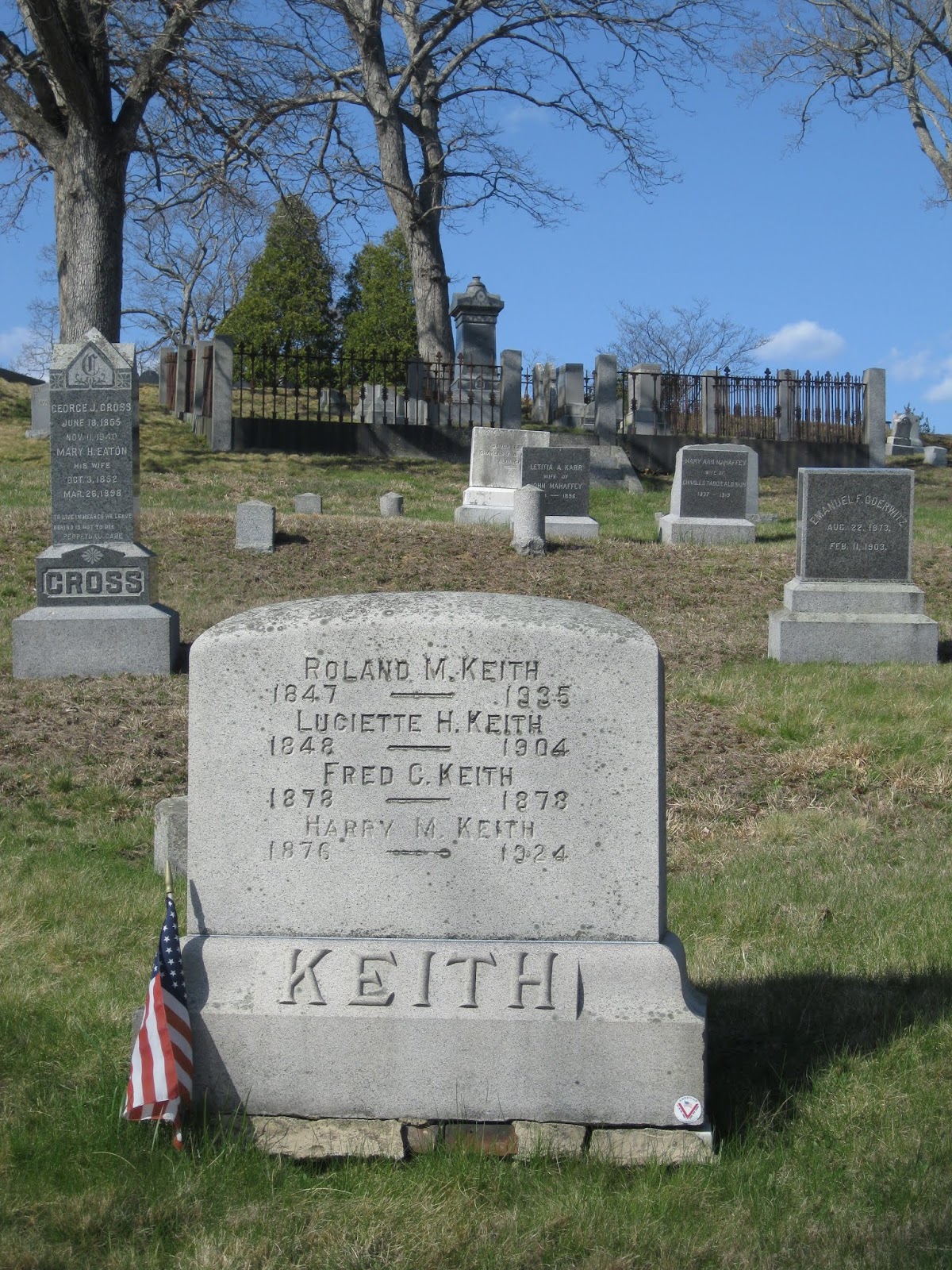
I have relatives buried in many of the cemeteries in the three Bridgewaters. I visited one of them, Mt. Prospect Cemetery in Bridgewater, seven years ago in April 2012. It's built on a hillside so I got a workout climbing up the hill but I found quite a few relatives, mostly from the Keith family but a few from the Fobes and Perkins families as well.
Here's a few of them:


Sunday, March 24, 2019
52 ANCESTORS IN 52 WEEKS 2019 WEEK 13: EDWARD FOBES OF BRIDGEWATER, MA.
I don't know much-yet- about 8x great grandfather Deacon Edward Fobes, so this will be a short 52 Ancestors in 52 Weeks entry. Here's a brief biography from Nahum Mitchell's History of Bridgewater, Ma.:
* 2. Dea. Edward (s. of John I) m. Elizabeth D. of John Howard, and had Elizabeth 1677, John 1679, Mary 1681, Bethiah 1683, Hannah 1686, Ephraim 1688, Joshua 1689, Benjamin 1692, and William 1698.—Edward the father, d. a. 1732.—Elizabeth m. Joseph Keith.—Mary never m.—Bethiah m. Samuel Keith 1703.—Hannah m. Timo. Keith, 17 10. p163
Mitchell's History of Bridgewater, Massachusetts, Published By Edward Alden Bridgewater, Ma.1897
What does stand out from the entry is that three of the Fobes daughters married three sons of Rev. James Keith. I am descended from Elizabeth Fobes who married Joseph Keith.
* 2. Dea. Edward (s. of John I) m. Elizabeth D. of John Howard, and had Elizabeth 1677, John 1679, Mary 1681, Bethiah 1683, Hannah 1686, Ephraim 1688, Joshua 1689, Benjamin 1692, and William 1698.—Edward the father, d. a. 1732.—Elizabeth m. Joseph Keith.—Mary never m.—Bethiah m. Samuel Keith 1703.—Hannah m. Timo. Keith, 17 10. p163
Mitchell's History of Bridgewater, Massachusetts, Published By Edward Alden Bridgewater, Ma.1897
What does stand out from the entry is that three of the Fobes daughters married three sons of Rev. James Keith. I am descended from Elizabeth Fobes who married Joseph Keith.
Tuesday, March 19, 2019
52 ANCESTORS IN 52 WEEKS 2019 WEEK 12: JOHN FOBES OF BRIDGEWATER, MA.
Back when first started researching my family's history I discovered my 9x great grandfather John Fobes. I couldn't find much information about him other than he was a Scotsman who'd come to Massachusetts and had originally lived in Duxbury before moving on to Bridgewater. But I did find some family trees online that fascinated me, including Scots ancestors with nicknames such as David "Trail the Axe" and John "with the black lip" Fobes.
Here's the entry for John Fobes from Nahum Mitchell's History of Bridgewater, Massachusetts:
John Fobes (from Duxbury) was one of the original proprietors of Bridgewater, where he settled, and d, a. 1661; made his nuncupative will before William Brett and Arthur Harris; his wid. Constant, sister of Experience Mitchell, m. John Briggs of Portsmouth R. I. 1662.—he had John, Edward, Mary, Caleb, William, Joshua, and Elizabeth.—John d. at George Allen's in Sandwich 1661.—William m. Elizabeth I), of Constant Southworth a 1667, and settled finally at Little Compton, and was with Capt. Church in Philip's war.—Joshua fell with Capt. Michael Pierce of Scituate in that disastrous battle with the Indians near Attleboro’, in 1676.—Caleb went to Norwich. -p162
Mitchell's History of Bridgewater, Massachusetts, Published By Edward Alden Bridgewater, Ma.1897
Here's the entry for John Fobes from Nahum Mitchell's History of Bridgewater, Massachusetts:
John Fobes (from Duxbury) was one of the original proprietors of Bridgewater, where he settled, and d, a. 1661; made his nuncupative will before William Brett and Arthur Harris; his wid. Constant, sister of Experience Mitchell, m. John Briggs of Portsmouth R. I. 1662.—he had John, Edward, Mary, Caleb, William, Joshua, and Elizabeth.—John d. at George Allen's in Sandwich 1661.—William m. Elizabeth I), of Constant Southworth a 1667, and settled finally at Little Compton, and was with Capt. Church in Philip's war.—Joshua fell with Capt. Michael Pierce of Scituate in that disastrous battle with the Indians near Attleboro’, in 1676.—Caleb went to Norwich. -p162
Mitchell's History of Bridgewater, Massachusetts, Published By Edward Alden Bridgewater, Ma.1897
Friday, March 15, 2019
PRIDE
 |
| My Irish immigrant great grandparents John and Anna (Kelly) McFarland |
((I wrote this back in 2008 when Borders Books was still in business))
We got a new book in at Borders last week for my "All
Things Local" section and the minute I saw it I knew I'd be
buying a copy. It's Peter F. Stevens' "Hidden History of the
Boston Irish" (trade paperback, $19.99 from History Press)
and a quick scan of the back made me grin. There was a
reference to Barney McGinniskin, who in 1851 became the
first Irishman on the Boston Police force. Barney announced
his arrival with: "Barney McGinniskin from the bogs of
Ireland!"
I could picture him roaring that out, an "in your face"
declaration of his presence despite the opposition to his hiring
that Stevens details. Many of the objections against him were
all too familiar to the Irish immigrants of the early 19th
century: he was taking work away from native born
Americans, American culture was threatened by the influx
of low born, poorly educated foreigners, and worst of all,
they were Catholic!
Barney lost his place on the force three years later during the
era of the aptly named "Know Nothing" Party's reign of anti-
Catholic terrorism, but the Irish kept coming, carving out
lives for themselves and their families in New England.
"No Irish Need Apply?' Fine, some of them started their own
businesses while others took on menial jobs that put roofs
over their heads and money in the bank. If they had to work
as maids or ditch diggers, they did; their children would have
the chance for better jobs as clerks or teachers. Bit by bit
they worked their way to their dreams. Among them were
my Mom's grandparents.
One of her grandfathers, John McFarland, started out as a
laborer in 1880 and was working for the Boston City Street
department by the 1910 census and as a gardener for the
City in 1920. At the time of his death he owned two houses.
By 1940, his sons were employed by shoe factories, a bottler,
and a diamond cutting company and each of them owned
their own homes. His grandchildren include three Boston
firemen. It's an American success story that's repeated in
many other families whose ancestors arrived here with very
little and achieved so very much through hard work and
perseverance.
I recently heard a conservative declare we make too much
of being "hyphenated" Americans, of being Irish-American,
or Italian-American or Polish-American. If he had his way,
there'd be no celebration of Columbus Day or St. Patrick's
Day or any other ethnic group festivities.
I was astonished as a historian, as a genealogist, as well as,
yes, an Irish-American. We should be proud of being
Americans but we should also be proud of where our
families came from and the contributions their cultures have
made to American culture as a whole. When I hear the debate
raging over immigration today I hear some of the same
arguments used against the immigrants of other times,
including my Irish ancestors. If those arguments had
prevailed then, what a much poorer country America would
be today!
And as a historian I am proud of the contribution Ireland itself
has made to music and literature, and in its role the Irish
monasteries played in preserving much of the Greek and
Roman literature during the Middle Ages.
So that's what I feel about being Irish and Irish-American:
pride in my ancestors for what they overcame, and grateful
to them for what they have given back to America in return!
Tuesday, March 12, 2019
SAMUEL EDSON & THE "IRISH DONATION"
((First posted in Feb. 2012))
One of the great things about researching my family's history is what I learn
about our country's history along the way. While I have a college degree in
history, there are areas and topics that I've never explored before that I've
finally encountered in the lives of my ancestors. One of those topics came
up last night when I was writing my post on Deacon Samuel Edson and is
contained in this quote:
"He was an active member of the council of war from 1667 to the end of
King Philip's war, and also of the committee to distribute contributions
made by the Irish people for that war, and also to those entitled thereto
in Bridgewater."
Now, while we have New England ancestry all the way back to the Pilgrims
and Puritans on my Dad's side of the family, I have Irish Catholic(and German)
ancestry on Mom's side. Given the long conflict between the English and
Irish, I found it hard to believe that the Irish would have sent any sort of
aid to English settlers fighting Indians in New England. I could imagine
them perhaps offering to hold the coats of the Englishmen, but sending
help, no. But then I remembered something I already knew about English
history and things began to make sense: it wasn't all of Ireland that sent
help. It was the part under the rule of the Puritans.
The Irish Catholics had rebelled in 1641 and for a time had been successful
due to the conflict in England between King Charles I and the English Parliament.
But when the English Civil War broke out they formed an alliance with
the Royalist side and the Parliament sent Oliver Cromwell in 1649 to deal
with the rebellion. He did so with such ruthless efficiency, especially in Ulster,
it set the stage for the next four hundred years of Irish history.
The Puritans in New England were supporters of their brethren in England.
While I'm not aware yet if they had been supportive of the Irish Protestants
in Cromwell's fight with the Catholics its possible the "Irish contributions"
were a repayment for aid sent from the New World.
I found this account of the "Irish donation" as it was also known:
"The fact that in Ireland there was a certain familiarity with Colonial affairs even
as early as the seventeenth century is proven in many ways, but none more so
than by the action taken by the citizens of Dublin when the news reached that
city of the distressed condition of the New England Colonists resulting from
"King Philip's War." No more striking instance of practical sympathy toward the
suffering Colonists is related in American history than this incident. The Indian
war of 1675-1676 was bloody and devastating in the extreme. Large numbers of
the inhabitants of Connecticut, Massachusetts, and Rhode Island fell in battle or
were murdered by the savage foe and many towns were destroyed, and it is
worthy of note that more than one hundred Irish names are enumerated among
the Colonial militia who fought the Indian hordes. In these times of distress and
misery it is recorded that Ireland was the only European country which sent relief
to the Colonists, and so large was the consignment that the Lord Mayor of Dublin
sent three Commissioners to Boston to take charge of the distribution of the "Irish
Donation," as it is called in the official records of the Colony of Massachusetts Bay.
It is not known what the "Irish Donation" actually consisted of, but that, with
traditional Irish generosity, it was liberal in the extreme we may judge from the
fact that the cost of the freight alone was the very large sum for those days of £475
sterling. The relief came in the ship Katherine, which sailed from Dublin for Boston
on August 28, 1676. In Massachusetts alone 47 towns and 2351 persons were
succored by this timely Irish relief."
A Hidden Phase of American History: Ireland's part in America's struggle for liberty
(Google eBook) by Michael Joseph O'Brien (Dodd, Mead and company, New York
1920)pp306-307
So Bridgewater, Ma. was one of the towns that received that "timely Irish relief",
and Samuel Edson, my ancestor, helped distribute it among the townspeople.
I love family history!
One of the great things about researching my family's history is what I learn
about our country's history along the way. While I have a college degree in
history, there are areas and topics that I've never explored before that I've
finally encountered in the lives of my ancestors. One of those topics came
up last night when I was writing my post on Deacon Samuel Edson and is
contained in this quote:
"He was an active member of the council of war from 1667 to the end of
King Philip's war, and also of the committee to distribute contributions
made by the Irish people for that war, and also to those entitled thereto
in Bridgewater."
Now, while we have New England ancestry all the way back to the Pilgrims
and Puritans on my Dad's side of the family, I have Irish Catholic(and German)
ancestry on Mom's side. Given the long conflict between the English and
Irish, I found it hard to believe that the Irish would have sent any sort of
aid to English settlers fighting Indians in New England. I could imagine
them perhaps offering to hold the coats of the Englishmen, but sending
help, no. But then I remembered something I already knew about English
history and things began to make sense: it wasn't all of Ireland that sent
help. It was the part under the rule of the Puritans.
The Irish Catholics had rebelled in 1641 and for a time had been successful
due to the conflict in England between King Charles I and the English Parliament.
But when the English Civil War broke out they formed an alliance with
the Royalist side and the Parliament sent Oliver Cromwell in 1649 to deal
with the rebellion. He did so with such ruthless efficiency, especially in Ulster,
it set the stage for the next four hundred years of Irish history.
The Puritans in New England were supporters of their brethren in England.
While I'm not aware yet if they had been supportive of the Irish Protestants
in Cromwell's fight with the Catholics its possible the "Irish contributions"
were a repayment for aid sent from the New World.
I found this account of the "Irish donation" as it was also known:
"The fact that in Ireland there was a certain familiarity with Colonial affairs even
as early as the seventeenth century is proven in many ways, but none more so
than by the action taken by the citizens of Dublin when the news reached that
city of the distressed condition of the New England Colonists resulting from
"King Philip's War." No more striking instance of practical sympathy toward the
suffering Colonists is related in American history than this incident. The Indian
war of 1675-1676 was bloody and devastating in the extreme. Large numbers of
the inhabitants of Connecticut, Massachusetts, and Rhode Island fell in battle or
were murdered by the savage foe and many towns were destroyed, and it is
worthy of note that more than one hundred Irish names are enumerated among
the Colonial militia who fought the Indian hordes. In these times of distress and
misery it is recorded that Ireland was the only European country which sent relief
to the Colonists, and so large was the consignment that the Lord Mayor of Dublin
sent three Commissioners to Boston to take charge of the distribution of the "Irish
Donation," as it is called in the official records of the Colony of Massachusetts Bay.
It is not known what the "Irish Donation" actually consisted of, but that, with
traditional Irish generosity, it was liberal in the extreme we may judge from the
fact that the cost of the freight alone was the very large sum for those days of £475
sterling. The relief came in the ship Katherine, which sailed from Dublin for Boston
on August 28, 1676. In Massachusetts alone 47 towns and 2351 persons were
succored by this timely Irish relief."
A Hidden Phase of American History: Ireland's part in America's struggle for liberty
(Google eBook) by Michael Joseph O'Brien (Dodd, Mead and company, New York
1920)pp306-307
So Bridgewater, Ma. was one of the towns that received that "timely Irish relief",
and Samuel Edson, my ancestor, helped distribute it among the townspeople.
I love family history!
SAMUEL EDSON & THE INDIANS
((First posted in Feb. 2012))
My ancestor Samuel Edson was involved in several land purchases from the
Indians living in the Bridgewater Ma. area and some of the documents concerning the
purchases still exist.
"This deed, made November 20th, A.D. 1672, witnessoth, that I, Pomponoho, alias Peter, an Indian, living at Titicut, in the colony of New Plymouth, in Now Eiig., have sold for the sum of sixteen pounds—viz., six pounds of current money of New England, and ten pounds in good merchantable com, us by bill appeareth,—all the lands lying on the north side of Titicut River, within the bounds of Bridgewater, what lands were mine, or were either my father's or grandfather's or any otherwise conferred on me, excepting those lands expressed as follows, viz. : one hundred acres of land lying up the river to tho eastward of a small brook, given to an Indian called Charles, my brother-in-law, and a certain parcel of land lying against the wear and bounded by the landing-place, running to the head of my field, containing about ten acres at the utmost, I say I, the above-said Pomponohe, alias Peter, have bargained, sold, and by these presents do bargain and sell for myself, my heirs, and assigns forever, unto Nicholas Byram, sen., Samuel Edson, sen., and William Brett, sen., in and for the use of the townsmen of Bridgewater,joint purchasers with them, which persons above mentioned were ordered by the court to make purchase of those lands, as by court record appears, I say I have sold all these lands, with every part thereof, and all the immunities and privileges belonging thereunto, to them, their heirs, and assigns forever, the same quietly and peaceably to possess, without the lawful lot, interruption, or molestation of me, the abovesaid Pomponohe, alias Peter, or other persons whatsoever, lawfully claiming by, from, or under me, them, or any of them. In witness whereof I have hereunto set to my hand and seal.
POMPONOHO (P|::
his mark.
read, sealed, and delivered
in presence of us.
"Joseph Hayward
"John Carr, Sen.
"Acknowledged before Josiah Winslow, Gov., Feb. 20, 1676.
"Recorded by Nathaniel Clark, Secretary, March, 1685."
- History of Plymouth County, Massachusetts: with biographical sketches of
many of its pioneers and prominent men, Part 2 , Duane Hamilton Hurd, ed.
(J. W. Lewis & co., Philadelphia 1884) p541
But only a few years later Deacon Samuel was appointed to a town Council of War
as tensions rose with the Indians under King Philip. When war came, it was marked
with savagery on both sides. The theater of war ranged through most of southern New
England, and even spread into this area where I live now just south of Boston. There
would be need for the Irish donation funds in Samuel Edson's Bridgewater:
"April 9th, 1676, being Sunday, the enemy burnt a house and barn, and rifled several other houses in the town; but they soon fled and were not to be overtaken, though closely pursued. May 8th, about three hundred Indians with Tispaquin for their leader made another assault on the east end of the town on the south side of the river, and set fire to many of the houses ; but the inhabitants, " issuing from their garrison houses," fell Upon them so resolutely, that the enemy were repelled; and, a heavy shower of rain falling at the same time, the fires were soon extinguished. The attack was then renewed on the north side of the river, but the enemy was soon defeated, and the next morning entirely disappeared, after having burnt two houses and one barn. On this occasion thirteen houses and four barns only were burnt, and but five of these were in the village. The rest were on the borders of the settlement, and deserted at the time. There is a tradition that, excepting the garrison houses, every house but one in town was burnt. This was probably true as it respected the out-houses or dwellings on the borders or skirts of the town only, and not those in the centre or village, which were considered in some degree as fortified or garrison houses. This is the more probable, as the house excepted is said to have belonged to Nicholas Byram, which was in the easterly part of the town, and quite distant from the principal settlement. It stood where Capt. Isaac Whitman now lives. July 14 and 15, a party of Indians came upon the north side of the town, but, after killing a few cattle, retired. July 18, 19 and 20, the inhabitants pursued the enemy and took sixteen of them, of whom two only were men."
-"Description of Bridgewater 1818" by Nahum Mitchell in Collections of the
Massachusetts Historical Society Massachusetts Historical Society
(Society Press, Boston, 1818) pp156-157
So while there was damage to some buildings, and other attacks, Bridgewater never
suffered destruction on the scale of the towns west of Boston, such as the town of
Lancaster where others of my ancestors were entirely burned out.
My ancestor Samuel Edson was involved in several land purchases from the
Indians living in the Bridgewater Ma. area and some of the documents concerning the
purchases still exist.
"This deed, made November 20th, A.D. 1672, witnessoth, that I, Pomponoho, alias Peter, an Indian, living at Titicut, in the colony of New Plymouth, in Now Eiig., have sold for the sum of sixteen pounds—viz., six pounds of current money of New England, and ten pounds in good merchantable com, us by bill appeareth,—all the lands lying on the north side of Titicut River, within the bounds of Bridgewater, what lands were mine, or were either my father's or grandfather's or any otherwise conferred on me, excepting those lands expressed as follows, viz. : one hundred acres of land lying up the river to tho eastward of a small brook, given to an Indian called Charles, my brother-in-law, and a certain parcel of land lying against the wear and bounded by the landing-place, running to the head of my field, containing about ten acres at the utmost, I say I, the above-said Pomponohe, alias Peter, have bargained, sold, and by these presents do bargain and sell for myself, my heirs, and assigns forever, unto Nicholas Byram, sen., Samuel Edson, sen., and William Brett, sen., in and for the use of the townsmen of Bridgewater,joint purchasers with them, which persons above mentioned were ordered by the court to make purchase of those lands, as by court record appears, I say I have sold all these lands, with every part thereof, and all the immunities and privileges belonging thereunto, to them, their heirs, and assigns forever, the same quietly and peaceably to possess, without the lawful lot, interruption, or molestation of me, the abovesaid Pomponohe, alias Peter, or other persons whatsoever, lawfully claiming by, from, or under me, them, or any of them. In witness whereof I have hereunto set to my hand and seal.
POMPONOHO (P|::
his mark.
read, sealed, and delivered
in presence of us.
"Joseph Hayward
"John Carr, Sen.
"Acknowledged before Josiah Winslow, Gov., Feb. 20, 1676.
"Recorded by Nathaniel Clark, Secretary, March, 1685."
- History of Plymouth County, Massachusetts: with biographical sketches of
many of its pioneers and prominent men, Part 2 , Duane Hamilton Hurd, ed.
(J. W. Lewis & co., Philadelphia 1884) p541
But only a few years later Deacon Samuel was appointed to a town Council of War
as tensions rose with the Indians under King Philip. When war came, it was marked
with savagery on both sides. The theater of war ranged through most of southern New
England, and even spread into this area where I live now just south of Boston. There
would be need for the Irish donation funds in Samuel Edson's Bridgewater:
"April 9th, 1676, being Sunday, the enemy burnt a house and barn, and rifled several other houses in the town; but they soon fled and were not to be overtaken, though closely pursued. May 8th, about three hundred Indians with Tispaquin for their leader made another assault on the east end of the town on the south side of the river, and set fire to many of the houses ; but the inhabitants, " issuing from their garrison houses," fell Upon them so resolutely, that the enemy were repelled; and, a heavy shower of rain falling at the same time, the fires were soon extinguished. The attack was then renewed on the north side of the river, but the enemy was soon defeated, and the next morning entirely disappeared, after having burnt two houses and one barn. On this occasion thirteen houses and four barns only were burnt, and but five of these were in the village. The rest were on the borders of the settlement, and deserted at the time. There is a tradition that, excepting the garrison houses, every house but one in town was burnt. This was probably true as it respected the out-houses or dwellings on the borders or skirts of the town only, and not those in the centre or village, which were considered in some degree as fortified or garrison houses. This is the more probable, as the house excepted is said to have belonged to Nicholas Byram, which was in the easterly part of the town, and quite distant from the principal settlement. It stood where Capt. Isaac Whitman now lives. July 14 and 15, a party of Indians came upon the north side of the town, but, after killing a few cattle, retired. July 18, 19 and 20, the inhabitants pursued the enemy and took sixteen of them, of whom two only were men."
-"Description of Bridgewater 1818" by Nahum Mitchell in Collections of the
Massachusetts Historical Society Massachusetts Historical Society
(Society Press, Boston, 1818) pp156-157
So while there was damage to some buildings, and other attacks, Bridgewater never
suffered destruction on the scale of the towns west of Boston, such as the town of
Lancaster where others of my ancestors were entirely burned out.
Sunday, March 10, 2019
52 ANCESTORS IN 52 WEEKS 2019 WEEK 11: DEACON SAMUEL EDSON OF BRIDGEWATER, MA..
Rev. James Keith's wife was Susannah Edson, and her father (my 9x greatgrandfather) was immigrant ancestor Samuel Edson, who was among the first settlers of Bridgewater, Ma. William Richard Cutter has a long description of his life in another of his genealogical collections:
Deacon Samuel Edson, the immigrant ancestor, was an early settler in this country, being found in Salem, Massachusetts, in 1639, when he was acknowledged as an inhabitant and was granted a half an acre of land near Catt Cove and four acres of planting ground. In 1642 he was granted twenty-five acres of land in Mackerel Cove and two acres of meadow. About 1650 he moved to Bridgewater, Massachusetts, and was called an inhabitant there in a deed dated December 10, 1652, and died there in 1692, aged eighty years. He and his wife were buried in the old buryingground, and the oldest monument in the grave-‘ yard is erected over their graves. Deacon Samuel Edson, and Rev. James Keith, of Scotland, the first minister of Bridgewater, were given grants of land after the fifty-four proprietors had taken their shares, making fiftysix shares. He erected the first cornmill in the town in 1662, on Town river, and later he deeded this mill to his five daughters; the deed was recorded April 19, 1636. His will was dated January 15, 1688-89, proved September 20, 1692. He was made freeman before 1657. His home was on the south side of the river, near his mill. It is not known that he was a millwright by trade, but it is known that he was a good farmer and had mechanical ability. In 1660 he owned three shares in the town, and he very likely conveyed two of these to his sons Samuel and Joseph, as in the great division of 1683 he had only one share. He acquired a large estate by his industry and thrift, and was well to-do. He held several town offices; in 1666 appointed a member of the council of war; in 1676 representative to the general court at Plymouth, and in the same year was on a committee to distribute the town share of the Irish contributions for the distress of the Indian wars; in November, 1672, was on a committee which received the deed of conveyance from Chief Pomonoho of the Titicut purchase, “in and for the use of the townsmen of Bridgewater joint purchasers with them." In December, 1686, he with Ensign John Hayward and Deacon John \Villis, agents for the town, received a confirmatory deed of the Indian Chief W'ampatuck for the purchasers and the town of all the lands previously conveyed to them by Massasoit, on March 3, 1649. In 1667 was foreman of the jury to lay out roads, as well as in 1672; in 1680 was on a committee to settle the Bridgewater and Middleborough boundary line, and the same year to settle the Bridgewater and Taunton line. He was one of the first deacons of the town and served from about 1664 to the end of his life. Was associated with very prominent men and influential in town affairs. He is said to have been of a large, athletic frame, of medium weight and with a fine constitution which could endure almost every hardship; dignified and grave in manner, active and keen in argument and very firm in his ideas, but he was not an obstinate man and would cheerfully admit the accuracy of a different judgment. It is said that he was more inclined to listen than to debate, but when he did speak at town meetings he generally suc— ceeded in convincing his audience that he had carefully considered his subjects. The strength and vigor of his intellect, the quickness of his perceptions, the extent and accuracy of his memory and the struggle of mental enterprise, supplied in no inconsiderable degree the deficiencies of education. While he was respected for these attributes of his mind and character, it was to his constant practice of the christian virtues and the influence of his example-that his pre-eminence was greatly due. '
He married, about 1637, in England, Susanna Orcutt, probably an elder sister of William Orcutt, who came from Scituate and settled in Bridgewater before 1682. “Her education and natural abilities were said to be full equal to his, and this coupled with an expressive modesty of deportment and unaffected piety, gave to her person an elevated position and to her character a high rank among the matrons of the town. She exhibited a majestic figure, rather above the medium height, an elegant and majestic mein, with a countenance happily combining graceful dignity with cheerful benignity.” Children: Susanna, born probably in England in 1638; Sarah, born in Salem about 1640; Elizabeth, born in Salem about 1643; Samuel, mentioned below; Mary, born in Bridgewater about 1647; Joseph, born about 1649; Josiah, born in Bridgewater, 1651; Bethiah, born about 1653.-pp259-260
New England Families, Genealogical and Memorial: A Record of the Achievements of Her People in the Making of Commonwealths and the Founding of a Nation, Volume 1 Lewis historical publishing Company, New York, New York 1913
Deacon Samuel Edson, the immigrant ancestor, was an early settler in this country, being found in Salem, Massachusetts, in 1639, when he was acknowledged as an inhabitant and was granted a half an acre of land near Catt Cove and four acres of planting ground. In 1642 he was granted twenty-five acres of land in Mackerel Cove and two acres of meadow. About 1650 he moved to Bridgewater, Massachusetts, and was called an inhabitant there in a deed dated December 10, 1652, and died there in 1692, aged eighty years. He and his wife were buried in the old buryingground, and the oldest monument in the grave-‘ yard is erected over their graves. Deacon Samuel Edson, and Rev. James Keith, of Scotland, the first minister of Bridgewater, were given grants of land after the fifty-four proprietors had taken their shares, making fiftysix shares. He erected the first cornmill in the town in 1662, on Town river, and later he deeded this mill to his five daughters; the deed was recorded April 19, 1636. His will was dated January 15, 1688-89, proved September 20, 1692. He was made freeman before 1657. His home was on the south side of the river, near his mill. It is not known that he was a millwright by trade, but it is known that he was a good farmer and had mechanical ability. In 1660 he owned three shares in the town, and he very likely conveyed two of these to his sons Samuel and Joseph, as in the great division of 1683 he had only one share. He acquired a large estate by his industry and thrift, and was well to-do. He held several town offices; in 1666 appointed a member of the council of war; in 1676 representative to the general court at Plymouth, and in the same year was on a committee to distribute the town share of the Irish contributions for the distress of the Indian wars; in November, 1672, was on a committee which received the deed of conveyance from Chief Pomonoho of the Titicut purchase, “in and for the use of the townsmen of Bridgewater joint purchasers with them." In December, 1686, he with Ensign John Hayward and Deacon John \Villis, agents for the town, received a confirmatory deed of the Indian Chief W'ampatuck for the purchasers and the town of all the lands previously conveyed to them by Massasoit, on March 3, 1649. In 1667 was foreman of the jury to lay out roads, as well as in 1672; in 1680 was on a committee to settle the Bridgewater and Middleborough boundary line, and the same year to settle the Bridgewater and Taunton line. He was one of the first deacons of the town and served from about 1664 to the end of his life. Was associated with very prominent men and influential in town affairs. He is said to have been of a large, athletic frame, of medium weight and with a fine constitution which could endure almost every hardship; dignified and grave in manner, active and keen in argument and very firm in his ideas, but he was not an obstinate man and would cheerfully admit the accuracy of a different judgment. It is said that he was more inclined to listen than to debate, but when he did speak at town meetings he generally suc— ceeded in convincing his audience that he had carefully considered his subjects. The strength and vigor of his intellect, the quickness of his perceptions, the extent and accuracy of his memory and the struggle of mental enterprise, supplied in no inconsiderable degree the deficiencies of education. While he was respected for these attributes of his mind and character, it was to his constant practice of the christian virtues and the influence of his example-that his pre-eminence was greatly due. '
He married, about 1637, in England, Susanna Orcutt, probably an elder sister of William Orcutt, who came from Scituate and settled in Bridgewater before 1682. “Her education and natural abilities were said to be full equal to his, and this coupled with an expressive modesty of deportment and unaffected piety, gave to her person an elevated position and to her character a high rank among the matrons of the town. She exhibited a majestic figure, rather above the medium height, an elegant and majestic mein, with a countenance happily combining graceful dignity with cheerful benignity.” Children: Susanna, born probably in England in 1638; Sarah, born in Salem about 1640; Elizabeth, born in Salem about 1643; Samuel, mentioned below; Mary, born in Bridgewater about 1647; Joseph, born about 1649; Josiah, born in Bridgewater, 1651; Bethiah, born about 1653.-pp259-260
New England Families, Genealogical and Memorial: A Record of the Achievements of Her People in the Making of Commonwealths and the Founding of a Nation, Volume 1 Lewis historical publishing Company, New York, New York 1913
Thursday, March 07, 2019
MORE ABOUT THE REV. JAMES KEITH HOUSE PT. 2
Along with the details of the construction of Rev. James Keith's house, Williams Latham also wrote about the history of its ownership:
In the case of the inhabitants of Bridgewater versus the inhabitants of West Bridgewater, reported in the seventh volume of Pickering Reports, page 191, and in the ninth volume of Pickering, page 55, in the years 1828 9, brought for the support of Daniel Keith, a pauper, then aged eighty.one years, a great.grandson of the Rev. James Keith. This pauper, with his father, Daniel Keith, and grandfather, John Keith, son of the Rev. James Keith, lived and died in the plaintiff , town. It became necessary to prove where, in old Bridgewater, minister Keith lived and died; and sundry old people were witnesses of, and sundry depositions of ancient people were then, 1828.9, taken for that purpose, as well as to prove the genealogy of the pauper; and some of said deponants and witnesses well remembered the house, then, 1828, owned and occupied by Aarrabella, daughter of said Amasa Howard, deceased,and widow of Benjamin Eaton, deceased, as far back as 1750, and said it was then, 1750. an ancient looking house, and had always appeared the same as it then, 1828.9, appeared. That case was tried, and before the whole court, twice; and the fact that the Rev. James Keith, lived and died in that house, was then well and satisfactorily established.
The homestead of Rev. James Keith consisted of two house.lots of six acres each, with a ten acre lot at the head of said house lots, and with a house thereon, built by the town, conditionally given by the town to him, in consideration of his future services as their minister, and remained entire until about 1800. And though this house and a portion of the homestead on which it stands, has been owned and occupied by many persons, as tenants in common and otherwise, yet the title to this house and portion of the homestead ns always remained in, and been confined to four persons and their families, to wit;
James Keith and his children, down to 1723,. . . 61 years;
Ephraim Fobes, brother and son, down to 1792, . 69 years;
Amasa Howard and daughters, down to 1834, . . 42 years;
Thomas Pratt and son, George M., down to 1882, . 48 years.
-pp239-240
Epitaphs in Old Bridgewater, Massachusetts: Illustrated with Plans and Views Henry T.Pratt, Publisher, Bridgewater, Mass. 1882
Ephraim Fobes is my 8x great granduncle, and Amasa Howard and Thomas Pratt are distant cousins. All are connected to Rev. James Keith by blood and marriage. So for two centuries the Keith House was in the family, albeit different branches,
In the case of the inhabitants of Bridgewater versus the inhabitants of West Bridgewater, reported in the seventh volume of Pickering Reports, page 191, and in the ninth volume of Pickering, page 55, in the years 1828 9, brought for the support of Daniel Keith, a pauper, then aged eighty.one years, a great.grandson of the Rev. James Keith. This pauper, with his father, Daniel Keith, and grandfather, John Keith, son of the Rev. James Keith, lived and died in the plaintiff , town. It became necessary to prove where, in old Bridgewater, minister Keith lived and died; and sundry old people were witnesses of, and sundry depositions of ancient people were then, 1828.9, taken for that purpose, as well as to prove the genealogy of the pauper; and some of said deponants and witnesses well remembered the house, then, 1828, owned and occupied by Aarrabella, daughter of said Amasa Howard, deceased,and widow of Benjamin Eaton, deceased, as far back as 1750, and said it was then, 1750. an ancient looking house, and had always appeared the same as it then, 1828.9, appeared. That case was tried, and before the whole court, twice; and the fact that the Rev. James Keith, lived and died in that house, was then well and satisfactorily established.
The homestead of Rev. James Keith consisted of two house.lots of six acres each, with a ten acre lot at the head of said house lots, and with a house thereon, built by the town, conditionally given by the town to him, in consideration of his future services as their minister, and remained entire until about 1800. And though this house and a portion of the homestead on which it stands, has been owned and occupied by many persons, as tenants in common and otherwise, yet the title to this house and portion of the homestead ns always remained in, and been confined to four persons and their families, to wit;
James Keith and his children, down to 1723,. . . 61 years;
Ephraim Fobes, brother and son, down to 1792, . 69 years;
Amasa Howard and daughters, down to 1834, . . 42 years;
Thomas Pratt and son, George M., down to 1882, . 48 years.
-pp239-240
Epitaphs in Old Bridgewater, Massachusetts: Illustrated with Plans and Views Henry T.Pratt, Publisher, Bridgewater, Mass. 1882
Ephraim Fobes is my 8x great granduncle, and Amasa Howard and Thomas Pratt are distant cousins. All are connected to Rev. James Keith by blood and marriage. So for two centuries the Keith House was in the family, albeit different branches,
Wednesday, March 06, 2019
MORE ABOUT THE REV. JAMES KEITH HOUSE PT.1
I did some more searching on the Keith House in West Bridgewater and hit the jackpot. I found information in of all things a book of epitaphs written by Williams Latham, including illustrations
of the evolution of the house over its first200 years:

Here is some of what Mr. Latham wrote about the Keith House:
The house was built 1662. It fronted south, was two stories high in front, one story high back side, posts, sixteen feet high, fifteen feet wide in front, thirty.four feet deep, with front entry, five feet wide; chamber stairs and chimney back of front door, in the southeast corner of the house, one front room, about ten by twelve, with a bed-room back of that, and a kitchen, with pantry, back of bed.room and chimney. In the second story was an entry, a front room, and a bed-room corresponding to the rooms below. No cellar under this part of the house.
In 1678, the house was enlarged by an addition of eighteen by thirty.four feet, to the east side of the house; two stories high in front one story high back side, making one large front room, eighteen by eighteen feet, with a bed.room, back stairs, and an enlargement of the kitchen, in the back part. The rooms in the second story corespond.ing to the front room and bed.room belov;. The back part of the second story of the old and new part of the house remaining unfinished. A cellar under a portion of this new part, with a stone drain across the road to the Town river.
The house remained in this condition, without material alteration for 159 years, from 1678 down to 1837, when Thomas Pratt, father of said George M. Pratt, cut off about fourteen feet of the north side of the house, so as to leave the north side of the same height as the front side of the house, thereby making the south. roof thirteen and one.half feet long, and the north roof only twelve feet long; building a new chimney in the place of the old one, then taken down, but much smaller; and leaving the rooms in the front and middle parts of the house as they were before this amputation. The brick in this old.chimney were much larger than modern brick, and were laid in clay. The shingles upon the walls were taken off, and clapbiards put on in place thereof. This house now (1882) being a two story house, thirty.two feet front, and twenty feet back„with a porch annexed to the back side. The windows upon the three sides of the house being the same ever since the memory of man, except such as were cut off as aforesaid, and except square glass in place of the old diamond glass and bull.s eyes.
The annex or addition of eighteen by thirty.four feet, made in 1678, was quite fully developed and apparent on a personal examination of the inside of the house, a few years ago, by the writer; and the frame.work, timber, doors, materials, and inside construction of lite house exhibit strong marks of antiquity. pp-239-240
Epitaphs in Old Bridgewater, Massachusetts: Illustrated with Plans and Views Henry T.Pratt, Publisher, Bridgewater, Mass. 1882
There is more information about the court case involving Bridgewater and West Bridgewater, as well as about the ownership of the house. I'll discuss that in Part 2
To be continued...
of the evolution of the house over its first200 years:

Here is some of what Mr. Latham wrote about the Keith House:
The house was built 1662. It fronted south, was two stories high in front, one story high back side, posts, sixteen feet high, fifteen feet wide in front, thirty.four feet deep, with front entry, five feet wide; chamber stairs and chimney back of front door, in the southeast corner of the house, one front room, about ten by twelve, with a bed-room back of that, and a kitchen, with pantry, back of bed.room and chimney. In the second story was an entry, a front room, and a bed-room corresponding to the rooms below. No cellar under this part of the house.
In 1678, the house was enlarged by an addition of eighteen by thirty.four feet, to the east side of the house; two stories high in front one story high back side, making one large front room, eighteen by eighteen feet, with a bed.room, back stairs, and an enlargement of the kitchen, in the back part. The rooms in the second story corespond.ing to the front room and bed.room belov;. The back part of the second story of the old and new part of the house remaining unfinished. A cellar under a portion of this new part, with a stone drain across the road to the Town river.
The house remained in this condition, without material alteration for 159 years, from 1678 down to 1837, when Thomas Pratt, father of said George M. Pratt, cut off about fourteen feet of the north side of the house, so as to leave the north side of the same height as the front side of the house, thereby making the south. roof thirteen and one.half feet long, and the north roof only twelve feet long; building a new chimney in the place of the old one, then taken down, but much smaller; and leaving the rooms in the front and middle parts of the house as they were before this amputation. The brick in this old.chimney were much larger than modern brick, and were laid in clay. The shingles upon the walls were taken off, and clapbiards put on in place thereof. This house now (1882) being a two story house, thirty.two feet front, and twenty feet back„with a porch annexed to the back side. The windows upon the three sides of the house being the same ever since the memory of man, except such as were cut off as aforesaid, and except square glass in place of the old diamond glass and bull.s eyes.
The annex or addition of eighteen by thirty.four feet, made in 1678, was quite fully developed and apparent on a personal examination of the inside of the house, a few years ago, by the writer; and the frame.work, timber, doors, materials, and inside construction of lite house exhibit strong marks of antiquity. pp-239-240
Epitaphs in Old Bridgewater, Massachusetts: Illustrated with Plans and Views Henry T.Pratt, Publisher, Bridgewater, Mass. 1882
There is more information about the court case involving Bridgewater and West Bridgewater, as well as about the ownership of the house. I'll discuss that in Part 2
To be continued...
Tuesday, March 05, 2019
BRIDGEWATER VS. WEST BRIDGEWATER: THE CASE OF DANIEL KEITH
While researching my ancestor the Reverend James Keith I discovered a courtcase from October 1828 involving a Keith cousin who was a paper and the towns of Bridgewater and West Bridgewater. This is from Oliver Pickering's Massachusetts Reports: Cases Argued and Determined in the Supreme Judicial Court of Massachusetts:
The Inhabitants of Bridgewater versus The Inhabitants of West Bridgewater.
Before the town of West Bride water was formed out of a part of the town ol Bridgewater, the great-grandfather of a pauper gained a settlement in Bridgewater by a residence in that part of the town which is now West Bridgewater; the pauper, his father, and grandfather, resided in that part of the town which is now Bridgewater, and the pauper owned and was taxed for real estate in the part of the town which is now Bridgewater, so that he would have gained a settlement therein if il had been a separate town. By the Si. 1821, c. 82, creating the town of West Bridgewater, it is provided, that 11 all persons who may hereafter become chargeable as paupers to the said towns of Bridgewater and West Bridgewater, shall be considered as belonging to that town on the territory of which they had their settlement at the time of passing this act, and shall in future be chargeable to that town only." Held, that the pauper's settlement was in West Bridgewater.
This was assumpsit for the support of Daniel Keith, a pauper. At the trial of the case, before Morton J., the only question was, whether the settlement of the pauper was in West Bridgewater, all the other facts necessary to the maintaining of the action being admitted.
It appeared from the evidence, that the pauper, his father, and his grandfather, (so far as the memory of the witnesses extended,) always lived on the territory now included in the town of Bridgewater, and that the pauper, previous to the St. 1821, c. 82, establishing the town of West Bridgewater, and when of full age, owned real estate of sufficient value in the territory now Bridgewater, and was taxed for it sufficiently to have gained thereby a settlement therein, in his own right, had either territory been a separate town. But the plaintiffs offered evidence tending to show that the pauper's great-grandfather, James Keith, was settled as minister of Bridgewater in 1664 and resided on that part of the town now West Bridgewater until his death, which happened between 1718 and 1720. The plaintiffs contended, that if the jury were satisfied of these facts in relation to James Keith, he thereby acquired a settlement in that part of the town now West Bridgewater, and that consequently, by virtue of the above statute of 1821, c. 82, the pauper's settlement was in West Bridgewater.
The defendants, on the other hand, contended that by the statute the legal settlement of the pauper was in what is now Bridgewater. They also contended that James Keith could not, by reason of his being minister of Bridgewater, and his The defendants, on the other hand, contended that by the statute the legal settlement of the pauper was in what is now Bridgewater. They also contended that James Keith could not, by reason of his being minister of Bridgewater, and his residence as above mentioned, have acquired a settlement in Bridgewater previous to 1692, and that even on the plaintiffs'' construction of the act of 1821, they were bound to prove that the pauper's grandfather was under twenty-one years of age at the time when James Keith could have acquired a settlement under the provincial act of 1692.
The judge, in order to reserve the questions of law which had been raised, for the whole Court, instructed the jury, that if they were satisfied that James Keith was minister of Bridgewater, and resided in that part of the town which is now West Bridgewater, they should find a verdict for the plaintiffs. The jury accordingly found a verdict for the plaintiffs; which was to be set aside and a new trial granted, or judgment was to be entered thereon, according to the opinion of the Court. -pp55-56
Massachusetts Reports: Cases Argued and Determined in the Supreme Judicial Court of Massachusetts, Volume 26 Little, Brown and Company, Boston, Ma. 1864
The Inhabitants of Bridgewater versus The Inhabitants of West Bridgewater.
Before the town of West Bride water was formed out of a part of the town ol Bridgewater, the great-grandfather of a pauper gained a settlement in Bridgewater by a residence in that part of the town which is now West Bridgewater; the pauper, his father, and grandfather, resided in that part of the town which is now Bridgewater, and the pauper owned and was taxed for real estate in the part of the town which is now Bridgewater, so that he would have gained a settlement therein if il had been a separate town. By the Si. 1821, c. 82, creating the town of West Bridgewater, it is provided, that 11 all persons who may hereafter become chargeable as paupers to the said towns of Bridgewater and West Bridgewater, shall be considered as belonging to that town on the territory of which they had their settlement at the time of passing this act, and shall in future be chargeable to that town only." Held, that the pauper's settlement was in West Bridgewater.
This was assumpsit for the support of Daniel Keith, a pauper. At the trial of the case, before Morton J., the only question was, whether the settlement of the pauper was in West Bridgewater, all the other facts necessary to the maintaining of the action being admitted.
It appeared from the evidence, that the pauper, his father, and his grandfather, (so far as the memory of the witnesses extended,) always lived on the territory now included in the town of Bridgewater, and that the pauper, previous to the St. 1821, c. 82, establishing the town of West Bridgewater, and when of full age, owned real estate of sufficient value in the territory now Bridgewater, and was taxed for it sufficiently to have gained thereby a settlement therein, in his own right, had either territory been a separate town. But the plaintiffs offered evidence tending to show that the pauper's great-grandfather, James Keith, was settled as minister of Bridgewater in 1664 and resided on that part of the town now West Bridgewater until his death, which happened between 1718 and 1720. The plaintiffs contended, that if the jury were satisfied of these facts in relation to James Keith, he thereby acquired a settlement in that part of the town now West Bridgewater, and that consequently, by virtue of the above statute of 1821, c. 82, the pauper's settlement was in West Bridgewater.
The defendants, on the other hand, contended that by the statute the legal settlement of the pauper was in what is now Bridgewater. They also contended that James Keith could not, by reason of his being minister of Bridgewater, and his The defendants, on the other hand, contended that by the statute the legal settlement of the pauper was in what is now Bridgewater. They also contended that James Keith could not, by reason of his being minister of Bridgewater, and his residence as above mentioned, have acquired a settlement in Bridgewater previous to 1692, and that even on the plaintiffs'' construction of the act of 1821, they were bound to prove that the pauper's grandfather was under twenty-one years of age at the time when James Keith could have acquired a settlement under the provincial act of 1692.
The judge, in order to reserve the questions of law which had been raised, for the whole Court, instructed the jury, that if they were satisfied that James Keith was minister of Bridgewater, and resided in that part of the town which is now West Bridgewater, they should find a verdict for the plaintiffs. The jury accordingly found a verdict for the plaintiffs; which was to be set aside and a new trial granted, or judgment was to be entered thereon, according to the opinion of the Court. -pp55-56
Massachusetts Reports: Cases Argued and Determined in the Supreme Judicial Court of Massachusetts, Volume 26 Little, Brown and Company, Boston, Ma. 1864
Sunday, March 03, 2019
52 ANCESTORS IN 52 WEEKS 2019 WEEK 10: JOSEPH KEITH OF BRIDGEWATER, MA..
7x great grandfather James Keith was one of the leading citizens of Bridgewater, Ma. and judging by the value of his estate, a prosperous one. Here's his brief biography in Nahum Mitchell's history of Bridgewater:
3. Joseph (s. of James 1) m. Elizabeth, D. of Dea. Edward Fobes, and had Anna 1695, Susanna 1697, Joseph 1699, Jemima 1701, Eleazar 1703, Abigail 1705, Ephraim 1707, Ichabob 1709, Martha 1711, Mary 1713, Elizabeth 1715; his will 1730; her's 1757; she made Constant Southworth her ex'or. Anna m. Capt. Ebenezer Alden 1717.—Susanna m. Jonathan Cary 1717, and d. young.—Jemima m. Dea. James Packard 1722.— Eleazar m. Keziah, -D. of Henry Kingman, 1726, settled in Easton, and had Lemuel, Seth, and perhaps other children.— Abigail m. Robert Howard 1725.—Martha m. Constant Southworth 1734.—Ichabod left a wid. Lydia, but no children.—She m. a Dr. Jones of Abington for her 2d husband.—Mary m. Jonathan Kingman 1732.—Eliz. m. Samuel Lathrop 1731. He was ex'or. of his father's will, and had his homestead, and was Representative 1726.-p214
History of the Early Settlement of Bridgewater in Plymouth County, Massachusetts, Henry T. Platt, Printer Bridgewater, Ma 1897
I have found his probate file and will transcribe it.
3. Joseph (s. of James 1) m. Elizabeth, D. of Dea. Edward Fobes, and had Anna 1695, Susanna 1697, Joseph 1699, Jemima 1701, Eleazar 1703, Abigail 1705, Ephraim 1707, Ichabob 1709, Martha 1711, Mary 1713, Elizabeth 1715; his will 1730; her's 1757; she made Constant Southworth her ex'or. Anna m. Capt. Ebenezer Alden 1717.—Susanna m. Jonathan Cary 1717, and d. young.—Jemima m. Dea. James Packard 1722.— Eleazar m. Keziah, -D. of Henry Kingman, 1726, settled in Easton, and had Lemuel, Seth, and perhaps other children.— Abigail m. Robert Howard 1725.—Martha m. Constant Southworth 1734.—Ichabod left a wid. Lydia, but no children.—She m. a Dr. Jones of Abington for her 2d husband.—Mary m. Jonathan Kingman 1732.—Eliz. m. Samuel Lathrop 1731. He was ex'or. of his father's will, and had his homestead, and was Representative 1726.-p214
History of the Early Settlement of Bridgewater in Plymouth County, Massachusetts, Henry T. Platt, Printer Bridgewater, Ma 1897
I have found his probate file and will transcribe it.
Thursday, February 28, 2019
THE WILL OF REV. JAMES KEITH OF BRIDGEWATER, MA.

I've finally gotten around to transcribing the will of my 8x great grandfather the Reverend James Keith of Bridgewater, Ma. As I said in a previos post it is neatly written and this made transcribing it easier that has been the case with the wills of other ancestors. There are only two words I could not figure out at all and these are shown by (unknown word). A few others have (?) after them which means I guessed at the word.
The three witnesses are my 7x great grandfather Edward Fobes and his sons Ephraim and Benjamin.
I James Keith minister of the town of Bridgwarer in the County of Plimouth in New England being through gods goodness intire in my understanding & memory, but expecting my departure, and relying on the mercyof god in Christ for eternal life, do make my last will & testament with respect
to my outward estate, in manner &form as followeth.
Imprimis I appoint my executors mentioned upon this my will to receive all that may appear to be due to me & to pay all my just debts & to discharge my funeral expenses.
Besides what I have already given to my children, I do further give & bequeath to my five sons James Keith, Joseph Keith, Samuel Keith, Timothy Keith, John Keith, & my two daughters Margret Hunt & Mary Howard the produce (?) of my home being (?) housing and lands consisting of two & twenty acres, be it more or less, when said housing & lands are sold, & I do hereby appoint my executors, or such as they shall import(?) to make sale of said housing & lands in time convenient & the produce thereof to be equally divided among my said five sons and two daughters above mentioned to them, their heirs, or Asignes.
I give & bequeath to my son James Keith my best (nknown word) & (unknown word) my brown cloak, my boots, my best hat & best shirt to him, his heirs or Asignes. All the rest of my wearing apparelI give to my four sons Joseph Keith, Samuel Keith, Timothy Keith, John Keith to be equally among them, to them, their heirs or Asignes.
I give to my son Josiah Keith ten pounds to be paid to him his heirs or Asignes by my executors or such they shall appoint.
All the rest of my effects which shall be leftat my decease for that which is and by content to my loving wife Mary & what else(?) I am now posest of I may have occasion to dispose of before my departure & leave to my five sons James Keith, Joseph Keith, Samuel Keith, Timothy Keith, John Keith, & my two daughters Mqrgaret Hunt & Mary Haward to be equally divided among them, to them, their heirs or Asignes.
I do appoint my two sons James Keith & Joseph Keith to be joynt executors of this my will, which I declare to be last will & testament this thirteenth day of July in the year of our Lord one thousand seven hundred & eighteen & in the fourth year of the reign of our gracious sovereign King George.
James Keith
Signed & sealed & declared
to be his last will & testament
in the presence of us
Edward Fobes
Ephraim Fobes
Benjamin Fobes
Subscribe to:
Posts (Atom)