It's time to start thinking about the Fourth Annual Great Genealogy Poetry Challenge!
In past years I've issued the Challenge in mid-October but I decided to do it a
bit earlier this year to give folks an extra two weeks to find a poem to use in
their blogposts.
These are the rules:
1. Find a poem by a local poet, famous or obscure, from the region
one of your ancestors lived in. It can be about an historical event, a
legend, a person, or even about some place (like a river)or a local
animal. It can even be a poem you or one of your ancestors have written!
Or if you prefer, post the lyrics of a song or a link to a video
of someone performing the song.
2. Post the poem or song to your blog (remembering to cite the source
where you found it.)
3.Tell us how the subject of the poem or song relates to your ancestor's
home or life.
4.Submit your post's link here to me by midnight Sunday November 18th
and I'll publish all links to the entries on Thanksgiving Day, November 22nd!
If you submit a humorous poem or song that will be entered under the
"Willy Puckerbrush" division. Willy was the late geneablogger Terry
Thornton's alias for some humorous posts and comments.
There have been some great blogposts in previous years and I'm hoping the
extra two weeks will make it easier for more folks to participate.
I'm looking forward to seeing what everyone comes up with this year!
Sunday, September 30, 2012


Saturday, September 29, 2012
ABINGTON CIVIL WAR ENCAMPMENT, SEPTEMBER, 2012
This year here in Abington, Massachusetts we've been celebrating the town's 300th
anniversary. This happens to coincide with the 100th anniversary of the War
Memorial Bridge at Island Grove Park which commemorates Abington's Civil War
veterans. So the town marked the occasion this past weekend with a rededication
of the bridge and a Civil War encampment by re-enactors.
I missed the rededication ceremonies on Saturday because of a prior commitment
but walked down to on Sunday afternoon but by that time they were beginning the
process of breaking camp and brought in cars to load up their tents and gear. I was
struck by the incongruity of watching a lady in a 19th century dress loading up a
SUV and a merchant with goods packed in plastic tubs:


There was a fashion show going on at the other side of the Grove so there
weren't many people around at the time near the tents. I wandered around
and took some pictures.


The fashion show ended and people began drifting back to the camp:

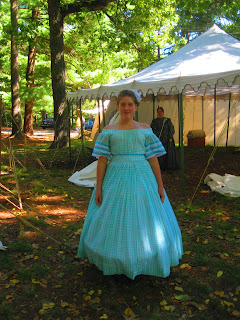


So while I didn't see any of the re-enactor soldiers what I saw gave me plenty
to think about as I headed home.
(For some great photos of the activities on Saturday, check out the gallery
here at the Quincy Patriot Ledger website.)
anniversary. This happens to coincide with the 100th anniversary of the War
Memorial Bridge at Island Grove Park which commemorates Abington's Civil War
veterans. So the town marked the occasion this past weekend with a rededication
of the bridge and a Civil War encampment by re-enactors.
I missed the rededication ceremonies on Saturday because of a prior commitment
but walked down to on Sunday afternoon but by that time they were beginning the
process of breaking camp and brought in cars to load up their tents and gear. I was
struck by the incongruity of watching a lady in a 19th century dress loading up a
SUV and a merchant with goods packed in plastic tubs:


There was a fashion show going on at the other side of the Grove so there
weren't many people around at the time near the tents. I wandered around
and took some pictures.

 |
| The Boston Sanitation Commission Tent |

 |
| I think this might have been an officer's tent. |
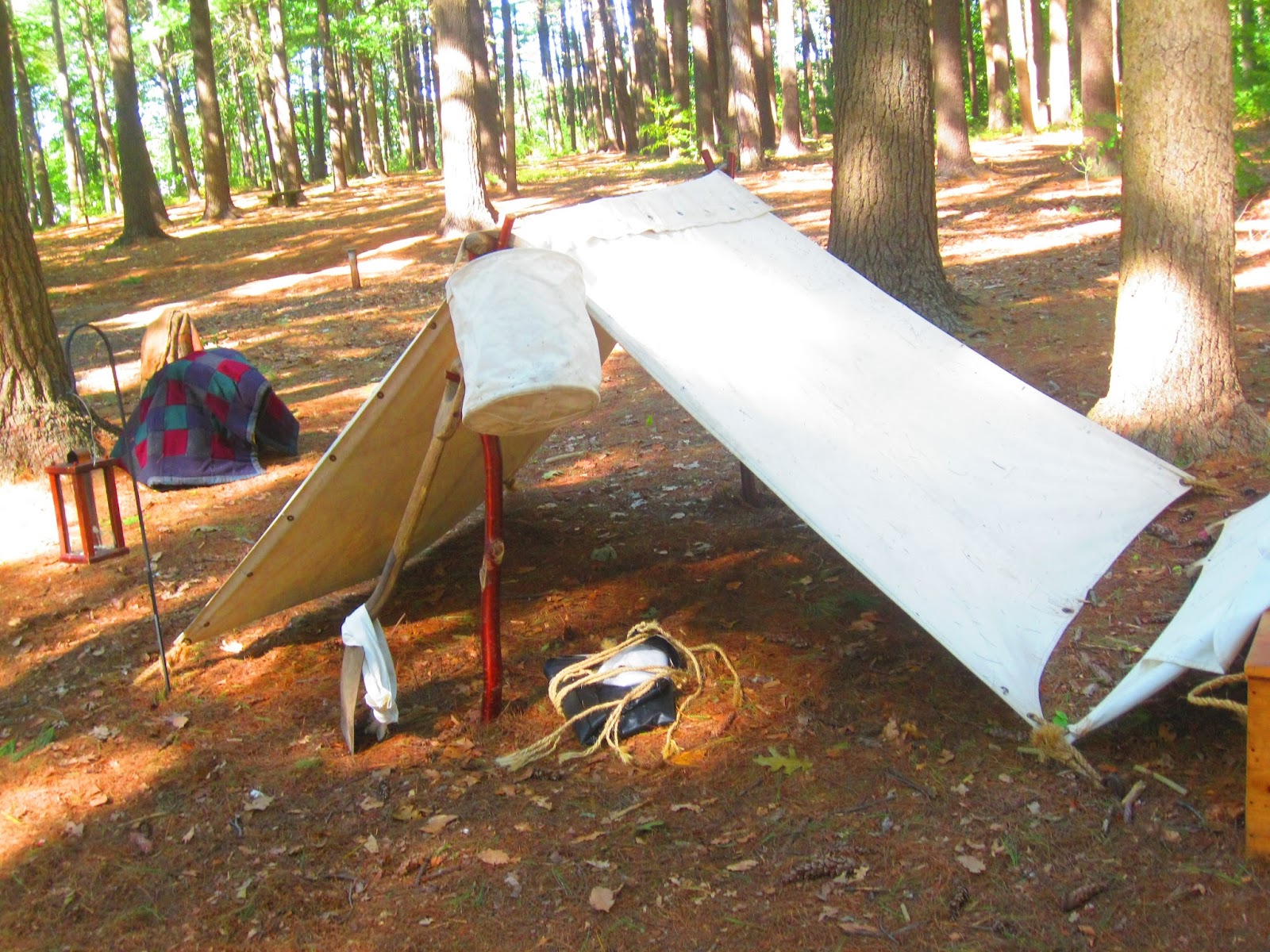 |
| My ancestor Asa Ellingwood may have slept in one like this. |

The fashion show ended and people began drifting back to the camp:


 |
| The tailor. |


So while I didn't see any of the re-enactor soldiers what I saw gave me plenty
to think about as I headed home.
(For some great photos of the activities on Saturday, check out the gallery
here at the Quincy Patriot Ledger website.)
Thursday, September 27, 2012
THE SECOND AMERICAN CIVIL WAR BLOG CHALLENGE BLOGPOSTS
Welcome to the Second American Civil War Blog Challenge! The rules
for the challenge were these:
"Did you have ancestors in America during the Civil War? If so, where were
they and what were their circumstances? How did the Civil War affect them
and their family? Did the men enlist and did they perish in battle or die of
illness? On which side did they fight, or did you have relatives fighting on
BOTH sides? How did the women left at home cope, or did any of them find
ways to help the war effort? Were your ancestors living as slaves on Southern
plantations and if so when were they freed, or were they freemen who
enlisted to fight? Did any ancestor take part in a battle that took place in
1862?
Write a blogpost on these questions, or, if you think of another topic to do
with your family history and the Civil War, write about that. Send me the link
after you publish it on your blog by midnight September 15th and I'll publish
all the links here ..."
Twelve bloggers(counting myself) submitted fourteen blogposts with stories
that explored their families and the Civil War from various angles. All are well
worth your attention, so let's get started!
Denise Spurlock's ancestor fought on both sides of the Civil War. She tells us
how in "Ambrose B. Martindale, Confederate Conscript, Union Volunteer" at
Denise's Life in the Past Lane blog.
There was a third approach a man could take to the Civil War and Jacob Snider of
Waynesboro, Pennsylvania took it. Ed Hamilton discusses the consequences in
"A Third Side in the American Civil War" at My Old Ohio Home.
In September of 1861 author Robert Burns Clark's 2x great grandfather and
great grandfather posed for a picture before they left to fight for the
Confederacy. Robert tells us what became of them, and what he sees when
he looks at that picture in "Marching Off To War".
Fellow Massachusetts genealogist Sara Campbell contributes two posts inspired
by her research from her Remembering Those Who Came Before Us blog.
The first, "See the World" is the story of a man who served in the Union
Navy across the ocean in Europe.
The second," Civil War Research - Holyoke's Richard Wall" concerns the history
of a family from Holyoke, Ma, that Sara has "adopted"
Thousands of Irish immigrants to America fought in the Civil War, some for the
Confederacy but most for the Union. Richard Billies' ancestor was one and Richard
writes about him in "Michael Patrick Murphy" at North Against South.
For some time now, TransylvanianDutch blogger John Newmark has been
transcribing records pertaining to the part his and his wife's ancestors played
during the War. He describes them and provides links to the transcriptions
with his "Second American Civil War Blog Challenge" post.
80,000 men from Maine served in the Civil War, including Pam Seavey Schaffner's
3x great grandfather and other members of his family. Pam writers about three
of them in "Oh Brave Brackley Boys of Freeman" at Digging Down East.
Like John Newmark, Dear Myrtle has written a number of posts over the years about
four Civil War ancestors. She gives a brief summary of those posts along with the
links at "2nd American Civil War Blog Challenge". (I found the first one about the
widow claiming a pension especially interesting!)
Holly Timm also contributed two posts. The first, "brother against brother ... "
describes the havoc the war brought to Harlan County, Kentucky.The other tells
about the roles three of Holly's relatives played at Gettysburg and asks the
question, "who were they ... ". You can find both posts at her genealogy musings
blog.
At Bits And Pieces Les Larrabee recounts the sad tale of one his wifes's relatives
in "Gideon Barnes Came Home to Die" and tells us how a fellow geneablogger
helped with his research!
Over at Genea-Musings, Randy Seaver uses information from a Civil War Pension
File and online sources to fill in the blanks in "Isaac Seaver - My Only Civil War Soldier"
Russ Worthington takes a different tack on the challenge at his Family Tree Maker
User blog and shows us how he used the FTM Timeline Feature to help research
his ancestor's Union Army service. Even if you don't use Family Tree Maker, check
out his "The 2nd Americal Civil War Blog Challenge - and FTM2012 Timelines ."
It might give you some ideas.
Finally, my own 2x great grandfather Asa Freeman Ellingwood returned to the
Union Army after having already served and been discharged for medical reasons.
Find out how in "ASA ELLINGWOOD IN THE VETERANS RESERVE CORPS" here
on West in New England.
That concludes this year's edition of the Civil War Challenge. My thanks to all
the bloggers who took part!
I'll be holding three more of these to coincide with the observance of the 150th
Anniversary of the War, so you all have advanced notice and hopefully find something
in your own family's experiences that you can write a post about for next year,
I look forward to reading it!
for the challenge were these:
"Did you have ancestors in America during the Civil War? If so, where were
they and what were their circumstances? How did the Civil War affect them
and their family? Did the men enlist and did they perish in battle or die of
illness? On which side did they fight, or did you have relatives fighting on
BOTH sides? How did the women left at home cope, or did any of them find
ways to help the war effort? Were your ancestors living as slaves on Southern
plantations and if so when were they freed, or were they freemen who
enlisted to fight? Did any ancestor take part in a battle that took place in
1862?
Write a blogpost on these questions, or, if you think of another topic to do
with your family history and the Civil War, write about that. Send me the link
after you publish it on your blog by midnight September 15th and I'll publish
all the links here ..."
Twelve bloggers(counting myself) submitted fourteen blogposts with stories
that explored their families and the Civil War from various angles. All are well
worth your attention, so let's get started!
Denise Spurlock's ancestor fought on both sides of the Civil War. She tells us
how in "Ambrose B. Martindale, Confederate Conscript, Union Volunteer" at
Denise's Life in the Past Lane blog.
There was a third approach a man could take to the Civil War and Jacob Snider of
Waynesboro, Pennsylvania took it. Ed Hamilton discusses the consequences in
"A Third Side in the American Civil War" at My Old Ohio Home.
In September of 1861 author Robert Burns Clark's 2x great grandfather and
great grandfather posed for a picture before they left to fight for the
Confederacy. Robert tells us what became of them, and what he sees when
he looks at that picture in "Marching Off To War".
Fellow Massachusetts genealogist Sara Campbell contributes two posts inspired
by her research from her Remembering Those Who Came Before Us blog.
The first, "See the World" is the story of a man who served in the Union
Navy across the ocean in Europe.
The second," Civil War Research - Holyoke's Richard Wall" concerns the history
of a family from Holyoke, Ma, that Sara has "adopted"
Thousands of Irish immigrants to America fought in the Civil War, some for the
Confederacy but most for the Union. Richard Billies' ancestor was one and Richard
writes about him in "Michael Patrick Murphy" at North Against South.
For some time now, TransylvanianDutch blogger John Newmark has been
transcribing records pertaining to the part his and his wife's ancestors played
during the War. He describes them and provides links to the transcriptions
with his "Second American Civil War Blog Challenge" post.
80,000 men from Maine served in the Civil War, including Pam Seavey Schaffner's
3x great grandfather and other members of his family. Pam writers about three
of them in "Oh Brave Brackley Boys of Freeman" at Digging Down East.
Like John Newmark, Dear Myrtle has written a number of posts over the years about
four Civil War ancestors. She gives a brief summary of those posts along with the
links at "2nd American Civil War Blog Challenge". (I found the first one about the
widow claiming a pension especially interesting!)
Holly Timm also contributed two posts. The first, "brother against brother ... "
describes the havoc the war brought to Harlan County, Kentucky.The other tells
about the roles three of Holly's relatives played at Gettysburg and asks the
question, "who were they ... ". You can find both posts at her genealogy musings
blog.
At Bits And Pieces Les Larrabee recounts the sad tale of one his wifes's relatives
in "Gideon Barnes Came Home to Die" and tells us how a fellow geneablogger
helped with his research!
Over at Genea-Musings, Randy Seaver uses information from a Civil War Pension
File and online sources to fill in the blanks in "Isaac Seaver - My Only Civil War Soldier"
Russ Worthington takes a different tack on the challenge at his Family Tree Maker
User blog and shows us how he used the FTM Timeline Feature to help research
his ancestor's Union Army service. Even if you don't use Family Tree Maker, check
out his "The 2nd Americal Civil War Blog Challenge - and FTM2012 Timelines ."
It might give you some ideas.
Finally, my own 2x great grandfather Asa Freeman Ellingwood returned to the
Union Army after having already served and been discharged for medical reasons.
Find out how in "ASA ELLINGWOOD IN THE VETERANS RESERVE CORPS" here
on West in New England.
That concludes this year's edition of the Civil War Challenge. My thanks to all
the bloggers who took part!
I'll be holding three more of these to coincide with the observance of the 150th
Anniversary of the War, so you all have advanced notice and hopefully find something
in your own family's experiences that you can write a post about for next year,
I look forward to reading it!
Monday, September 17, 2012
ELISHA HOUGHTON'S PENSION FILE PT 6
In the last entry in this series about Elisha Houghton's Revolutionary War
Pension file, I posted the transcription of Elisha's request to be transferred
from the Massachusetts Veterans Roll to that of Vermont where he had
relocated.He made the request in January of 1823 and it was granted by
September of the same year. The final image from his file in a combination
of printed and handwritten information from both 1818, the year of the
original pension filing, and 1823 when the transfer was made:

"4.189 From
Massachusetts
_______________________
to Vermont
Elisha Houghton
Capt Brown
private,
Massachusetts line 1778 3 years
in the army of the United States during the Revolutionary War
________________________________________________
Subscribed on the Roll of Massachusetts
at the rate of -8- Dollars per month to commence on
the 6th of May, 1818.
_________________________________________________
Certificate of Pension issued the 17th of Nov. 1818,
and sent to Jo. Woodbridge, Esq
Stockbridge, Ma.
_________________________________________________
Arrears to the 4th of Sept. 1818 31.76
Semi-anl. all'ce ending 4th Mar 1819 48.00
_______
Continued $79.76
_______
{Revolutionary claim)
Act 18th March, 1818
He died Nov 1826
Adams,
Berkshire Co"
On the right hand side of the sheet are three oval shapes that probably were
left by wax seals. There are also two handwritten items. One is written along
the left hand side of the fold the length of the paper from top to bottom and
reads:
"Notification sent September 6th 1823
Parker L. Hall, Lenox, Massachusetts "
To the right of that is another notation:
"Date of death on
other side
from AB."
The added notes are a little confusing. The "He died Nov 1826" was added
later but because of where it was placed it makes it appear Elisha died in
Adams, Berkshire County, Ma. when he actually died in Vermont. Also there
are some figures just to the left of sum of 31.76 that I couldn't decipher.
So my 5x great grandfather collected $96 dollars a year for eight years from
1818 until his death at age eighty in Vermont in 1826. Why he had moved to
Vermont, and who he was lving with. is something I need to investigate further.
Pension file, I posted the transcription of Elisha's request to be transferred
from the Massachusetts Veterans Roll to that of Vermont where he had
relocated.He made the request in January of 1823 and it was granted by
September of the same year. The final image from his file in a combination
of printed and handwritten information from both 1818, the year of the
original pension filing, and 1823 when the transfer was made:

"4.189 From
Massachusetts
_______________________
to Vermont
Elisha Houghton
Capt Brown
private,
Massachusetts line 1778 3 years
in the army of the United States during the Revolutionary War
________________________________________________
Subscribed on the Roll of Massachusetts
at the rate of -8- Dollars per month to commence on
the 6th of May, 1818.
_________________________________________________
Certificate of Pension issued the 17th of Nov. 1818,
and sent to Jo. Woodbridge, Esq
Stockbridge, Ma.
_________________________________________________
Arrears to the 4th of Sept. 1818 31.76
Semi-anl. all'ce ending 4th Mar 1819 48.00
_______
Continued $79.76
_______
{Revolutionary claim)
Act 18th March, 1818
He died Nov 1826
Adams,
Berkshire Co"
On the right hand side of the sheet are three oval shapes that probably were
left by wax seals. There are also two handwritten items. One is written along
the left hand side of the fold the length of the paper from top to bottom and
reads:
"Notification sent September 6th 1823
Parker L. Hall, Lenox, Massachusetts "
To the right of that is another notation:
"Date of death on
other side
from AB."
The added notes are a little confusing. The "He died Nov 1826" was added
later but because of where it was placed it makes it appear Elisha died in
Adams, Berkshire County, Ma. when he actually died in Vermont. Also there
are some figures just to the left of sum of 31.76 that I couldn't decipher.
So my 5x great grandfather collected $96 dollars a year for eight years from
1818 until his death at age eighty in Vermont in 1826. Why he had moved to
Vermont, and who he was lving with. is something I need to investigate further.
Saturday, September 15, 2012
ASA ELLINGWOOD IN THE VETERANS RESERVE CORPS
Last year I posted transcriptions of the Civil War Pension File of my 2x
great grandfather Asa F Ellingwood. Asa had enlisted in the 5th Maine
Volunteer Regiment in June, 1861 and had been present at the First
Battle of Bull Run. He was injured in the Union retreat with a hernia
when he was knocked over by the horse of a Union officer and then
developed nephritis after falling ill from the alternating heat and rain.
He was discharged with a Certificate of Disability on Dec 23 1861.
But not quite three years later he reenlisted by joining the Veterans
Reserve Corps as described in his Pension File:
"Asa Ellingwood. Reenlisted Sept 3" 1864
at West Lebanon N.H. in V.R.C. for 3 years
Muster Roll of Unassigned Det V.R.C.
(to which assigned) from Oct 31" 1864 to Apl
30" 1865 Present. Muster Roll of 243 Co 1" Batt
V.R.C. (to which transferred) June 26" 1865,
for May & June, 1865 Present same to Augt,
31" 1865. Muster Roll of Co A 9" V.R.C. (to which
transferred Sept 22" 1865) for Sept & Oct, 1865
Present. He was mustered out on Det M.O.R.
Nov. 16 " 1865 as Private at Washington, D.C.
by reason of G.O. No 155 A.G.O. Oct .26" 1865.
Disability at date of enlistment "Right
Inguinal Hernia"

The Veterans Reserve Corps was organized in April 1863 to have injured
or wounded soldiers perform duties that would free up able bodied soldiers
for the front lines, The Reserves were divided into two battalions: the First
Battalion, made up of men who were able to bear arms and serve as pickets,
sentries, and prison guards, and the Second, made up of more seriously
injured men who were able to perform as cooks and other light duty.
Asa seems to be the exception to the rule, because even though he was in
the First Battalion, he worked as a cook.
I can think of two reasons why this might have happened: first, the nature of
his disability. I won't go into the details of what a Inguinal Hernia is because it's
not for the squeamish, and, frankly, I'm squeamish. But obviously it was
serious enough to keep him from the usual assignments for members of the
First Battalion V.R.C.. The second reason might be that he'd might have had
experience in civilian life cooking at a lumber camp in Maine or over in
New Hampshire.
As a cook, Asa would have been assigned to some permanent
installation since troops in the field cooked their own meals from their
field rations. I haven't as yet discovered where he might have been
stationed when he was marked as "Present" in the Muster Rolls listed in
the above image. Perhaps the location of where he was mustered out is
a clue, Washington, D.C. There were a large number of V.R.C. troops on
duty in the capital and they would after all have to be fed. If that was the
case, Asa would have been there at the time of Lincoln's assassination and
the period after. He might have witnessed the execution of John Wilkes
Booth's co-conspirators in July of 1865 when members of the V.R.C. helped
with the hangings.
While I was learning all this I was brought back to the matter of the inquiry
into Asa's pension. He was given a medical discharge from his first period
in the Union Army with the 5th Maine. The procedure to enlist in the V.R.C.
required a medical examination to determine fitness for duty. So why the
hearing and questioning when he applied for an adjustment to the amount
of his pension? All I can think of is that there were a greater number of men
applying for pension money and some might have been "working the system".
The War Department would have become a bit more thorough in making
sure the disability claims were real.
But Asa Ellingwood did his duty twice, and returned home to his wife Florilla
and to the daughter Clara Ellingwood, my great grandmother, who had been
born while he was away.
great grandfather Asa F Ellingwood. Asa had enlisted in the 5th Maine
Volunteer Regiment in June, 1861 and had been present at the First
Battle of Bull Run. He was injured in the Union retreat with a hernia
when he was knocked over by the horse of a Union officer and then
developed nephritis after falling ill from the alternating heat and rain.
He was discharged with a Certificate of Disability on Dec 23 1861.
But not quite three years later he reenlisted by joining the Veterans
Reserve Corps as described in his Pension File:
"Asa Ellingwood. Reenlisted Sept 3" 1864
at West Lebanon N.H. in V.R.C. for 3 years
Muster Roll of Unassigned Det V.R.C.
(to which assigned) from Oct 31" 1864 to Apl
30" 1865 Present. Muster Roll of 243 Co 1" Batt
V.R.C. (to which transferred) June 26" 1865,
for May & June, 1865 Present same to Augt,
31" 1865. Muster Roll of Co A 9" V.R.C. (to which
transferred Sept 22" 1865) for Sept & Oct, 1865
Present. He was mustered out on Det M.O.R.
Nov. 16 " 1865 as Private at Washington, D.C.
by reason of G.O. No 155 A.G.O. Oct .26" 1865.
Disability at date of enlistment "Right
Inguinal Hernia"

The Veterans Reserve Corps was organized in April 1863 to have injured
or wounded soldiers perform duties that would free up able bodied soldiers
for the front lines, The Reserves were divided into two battalions: the First
Battalion, made up of men who were able to bear arms and serve as pickets,
sentries, and prison guards, and the Second, made up of more seriously
injured men who were able to perform as cooks and other light duty.
Asa seems to be the exception to the rule, because even though he was in
the First Battalion, he worked as a cook.
I can think of two reasons why this might have happened: first, the nature of
his disability. I won't go into the details of what a Inguinal Hernia is because it's
not for the squeamish, and, frankly, I'm squeamish. But obviously it was
serious enough to keep him from the usual assignments for members of the
First Battalion V.R.C.. The second reason might be that he'd might have had
experience in civilian life cooking at a lumber camp in Maine or over in
New Hampshire.
As a cook, Asa would have been assigned to some permanent
installation since troops in the field cooked their own meals from their
field rations. I haven't as yet discovered where he might have been
stationed when he was marked as "Present" in the Muster Rolls listed in
the above image. Perhaps the location of where he was mustered out is
a clue, Washington, D.C. There were a large number of V.R.C. troops on
duty in the capital and they would after all have to be fed. If that was the
case, Asa would have been there at the time of Lincoln's assassination and
the period after. He might have witnessed the execution of John Wilkes
Booth's co-conspirators in July of 1865 when members of the V.R.C. helped
with the hangings.
While I was learning all this I was brought back to the matter of the inquiry
into Asa's pension. He was given a medical discharge from his first period
in the Union Army with the 5th Maine. The procedure to enlist in the V.R.C.
required a medical examination to determine fitness for duty. So why the
hearing and questioning when he applied for an adjustment to the amount
of his pension? All I can think of is that there were a greater number of men
applying for pension money and some might have been "working the system".
The War Department would have become a bit more thorough in making
sure the disability claims were real.
But Asa Ellingwood did his duty twice, and returned home to his wife Florilla
and to the daughter Clara Ellingwood, my great grandmother, who had been
born while he was away.
Thursday, September 13, 2012
ELISHA HOUGHTON'S PENSION FILE PT 5
Sometime between 1820 and 1823 my ancestor Elisha Houghton moved to
Vermont from Western Massachusetts. So far I haven't been able to find out
why he went there instead of to Oxford County Maine where his children
now lived. Perhaps there were relatives or old friends living in Vermont.
In any case when he left Massachusetts he had to apply to have his pension
payments transferred to his new place of residence. The remaining images
in Elisha's file deal with that transfer.

The first image is a folded sheet of paper. On the left hand side is a hand-
written note:
"Elisha Houghton must make a new affidavit agreeably to the within form
and transmit it to the War Department before his name can be transferred.
10 Jan 1823"
On the right is the following (I'm not sure that the date is the 10th or 15th):
"Transferred from Massachusetts to Vermont on the 10th(? ) Feby 1823
from 4th Sept. 1823.
Elisha Houghton
Mar 19"
Next is the actual transfer application. It's another preprinted form with
information filled "in the blanks" which I've designated with italicized print:

APPLICATION FOR A TRANSFER
____________________
"State of Vermont
County of Bennington ss.
On this 21st day of January 1823, before me, the subscriber, a Justice of the
Peace for the said county of Bennington, personally appeared Elisha Houghton
who, on his oath, declares that he is the same person who formerly belonged
to the company commanded by Captain Joshua Brown in the regiment
commanded by Colonel Timothy Bigelow in the service of the United States;
that his name was placed on the pensions roll of the state of Massachusetts
from whence he has lately removed; that he now resides in the state
(district, or territory) of Vermont where he intends to remain, and wishes his
pension to be there payable, in the future. That at present receives eight
dollars per month.
his
Elisha X Houghton
mark
Sworn and subscribed to, before
me. the day and year aforesaid } O.C. Merrill, Justice of Peace.
NOTE. The oath to be taken before a duly qualified magistrate, whose
official character and signature must be properly authenticated."
Then on the back is a handwritten note:
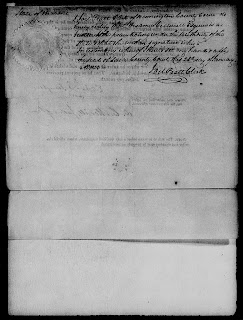
"State of Vermont
I, Joel Pratt Clerk of Bennington County Court do hereby certify that Orsamus
C Merrill Esquire is a Justice of the peace acting under the Authority of this
State & that the within signature is his.
In testimony whereof I hereto set my hand & affix the seal of said county
court this 28th day of January AD1823-
Joel Pratt Clerk"
Next we'll see if Elisha's transfer was allowed and the amount of his pension.
Vermont from Western Massachusetts. So far I haven't been able to find out
why he went there instead of to Oxford County Maine where his children
now lived. Perhaps there were relatives or old friends living in Vermont.
In any case when he left Massachusetts he had to apply to have his pension
payments transferred to his new place of residence. The remaining images
in Elisha's file deal with that transfer.

The first image is a folded sheet of paper. On the left hand side is a hand-
written note:
"Elisha Houghton must make a new affidavit agreeably to the within form
and transmit it to the War Department before his name can be transferred.
10 Jan 1823"
On the right is the following (I'm not sure that the date is the 10th or 15th):
"Transferred from Massachusetts to Vermont on the 10th(? ) Feby 1823
from 4th Sept. 1823.
Elisha Houghton
Mar 19"
Next is the actual transfer application. It's another preprinted form with
information filled "in the blanks" which I've designated with italicized print:

APPLICATION FOR A TRANSFER
____________________
"State of Vermont
County of Bennington ss.
On this 21st day of January 1823, before me, the subscriber, a Justice of the
Peace for the said county of Bennington, personally appeared Elisha Houghton
who, on his oath, declares that he is the same person who formerly belonged
to the company commanded by Captain Joshua Brown in the regiment
commanded by Colonel Timothy Bigelow in the service of the United States;
that his name was placed on the pensions roll of the state of Massachusetts
from whence he has lately removed; that he now resides in the state
(district, or territory) of Vermont where he intends to remain, and wishes his
pension to be there payable, in the future. That at present receives eight
dollars per month.
his
Elisha X Houghton
mark
Sworn and subscribed to, before
me. the day and year aforesaid } O.C. Merrill, Justice of Peace.
NOTE. The oath to be taken before a duly qualified magistrate, whose
official character and signature must be properly authenticated."
Then on the back is a handwritten note:

"State of Vermont
I, Joel Pratt Clerk of Bennington County Court do hereby certify that Orsamus
C Merrill Esquire is a Justice of the peace acting under the Authority of this
State & that the within signature is his.
In testimony whereof I hereto set my hand & affix the seal of said county
court this 28th day of January AD1823-
Joel Pratt Clerk"
Next we'll see if Elisha's transfer was allowed and the amount of his pension.
Tuesday, September 11, 2012
SEPTEMBER 11TH, 2001
((The majority of this post was first published on 11Sep 2008. I've
changed the ending to reflect that bin Laden was found.))
Sept 11th 2001
I was on my way to work at the Borders bookstore which opened
at 9:00. As usual I was listening to WBZ AM, the Boston news radio
station, and I was somewhere on Rte 37 in Braintree when the news
bulletin came about the first plane hitting the South Tower of the
World Trade Center in New York. At first I thought it was some
terrible accident as I listened to the report. I remember at one traffic
stop the light turned green and the first car in line didn't move right
away. Nobody honked their horn at the driver. They were all listening
to the news.
I was running a few minutes late already and so I was just pulling into
a parking space when news came at 9:02 of the second crash. Now I
and the rest of America knew the first crash had not been a mistake.
We were under attack. I went into the store and punched in, then
knocked on the Cash Office door. Linda, the office manager
at the time, was listening to the radio. Given that there had been a
previous attack on the Twin Towers by terrorists we realized this must
be another by the same group or another like it. We talked about it for
a few minutes but the store was about to open and I needed to be out
on the sales floor.
It was a surreal day. Linda would relay the news to the staff about the
collapse of the Towers and the other two planes crashing into the
Pentagon and the field in Pennsylvania. We heard that the planes had
come from our own Logan Airport and had many New Englanders
aboard them, which made it even harder to hear. One of the passengers
lived in my town of Abington. Work went on as it did for so many
other Americans that day even though our minds and hearts weren't
into doing our jobs.
That night when I got home the networks kept showing the same
images over and over of the planes crashing, the Towers falling and
of the people running ahead of the looming cloud. I was angry at
whoever had done this to so many innocent people, and I wanted
them caught and punished for it.
Today, it's a different world. September 11th changed it forever.
We no longer wait now for Osama bin Laden to be caught and punished.
Justice has been done.
But we still mourn, and we will never forget.
changed the ending to reflect that bin Laden was found.))
Sept 11th 2001
I was on my way to work at the Borders bookstore which opened
at 9:00. As usual I was listening to WBZ AM, the Boston news radio
station, and I was somewhere on Rte 37 in Braintree when the news
bulletin came about the first plane hitting the South Tower of the
World Trade Center in New York. At first I thought it was some
terrible accident as I listened to the report. I remember at one traffic
stop the light turned green and the first car in line didn't move right
away. Nobody honked their horn at the driver. They were all listening
to the news.
I was running a few minutes late already and so I was just pulling into
a parking space when news came at 9:02 of the second crash. Now I
and the rest of America knew the first crash had not been a mistake.
We were under attack. I went into the store and punched in, then
knocked on the Cash Office door. Linda, the office manager
at the time, was listening to the radio. Given that there had been a
previous attack on the Twin Towers by terrorists we realized this must
be another by the same group or another like it. We talked about it for
a few minutes but the store was about to open and I needed to be out
on the sales floor.
It was a surreal day. Linda would relay the news to the staff about the
collapse of the Towers and the other two planes crashing into the
Pentagon and the field in Pennsylvania. We heard that the planes had
come from our own Logan Airport and had many New Englanders
aboard them, which made it even harder to hear. One of the passengers
lived in my town of Abington. Work went on as it did for so many
other Americans that day even though our minds and hearts weren't
into doing our jobs.
That night when I got home the networks kept showing the same
images over and over of the planes crashing, the Towers falling and
of the people running ahead of the looming cloud. I was angry at
whoever had done this to so many innocent people, and I wanted
them caught and punished for it.
Today, it's a different world. September 11th changed it forever.
We no longer wait now for Osama bin Laden to be caught and punished.
Justice has been done.
But we still mourn, and we will never forget.
Monday, September 10, 2012
DOWN MEXICO (MAINE) WAY
I was searching Google's News Archive for old newspaper articles on my
Ellingwood family when I found this from The Lewiston (Me.) Evening Journal
for 12Sep 1898. It's an article with bits of news and gossips from the small towns
surrounding Lewiston:
"FROM MANY MAINE TOWNS
__________________
MEXICO
John Mason has moved from Ridlion-
ville into the Babb House on the Harlow
Hill road, Mexico.
Horace Ellingwood of the 1st Maine
regiment is in town. He was one of the
number detailed for hospital service sev-
eral months ago. He was in fairly good
health until early in August when he
was laid up by measles and is now forty
pounds lighter than when he enlisted
Asa West from Andover, Hiram West
from Upton and several others, eighteen
in all, passed through here recently on
their return from the eastern part of the
State where they have been to visit the
mother of Asa and Hiram West, who is
nearly 100 years old. During their visit
they corraled horses at night, set up
tents, cooked their own food and took
time leisurely...."
Now this is what I'd call a 2 for 1 deal! . Going by the 1898 date, Horace was a
soldier during the Spanish-American War, It's ironic that he had been assigned
to hospital service and then fallen ill himself, since the same thing happened
to my grandfather during WW1. Now I need to figure out how he's related to me.
I'd thought he was my first cousin twice removed Horatio Ellingwood but I
realized that Horatio was only a year old in 1898.
The third section is a real find though. Asa and Hiram West are my 2x great
granduncles, brothers to my 2x great grandfather Jonathan Phelps West. Asa would
have been 68 years old on this horseback trip, and Hiram 60. Now their mother
Arvilla (Ames) West died in Hermon Maine in 1907 where she was living with one
of her daughters. But in 1898 she wasn't as close to 100 as the article claims. She
was actually 88years old.
I checked and depending on which route you'd use on modern highways distance
between Upton and Hermon Maine is between 135 to 155 miles through terrain
that is wooded and mountainous. Given their ages, I'm in awe of Asa and Hiram's
energy and durability traveling that distance not by train or stagecoach but by
riding it horseback and camping out instead of staying at hotels or inns. Perhaps
when they made this trip 114 years ago this week the brothers were making their
last hurrah, knowing it might well be the last time they'd be able to do such a
thing. (Asa would die in 1907, Hiram seve years later in 1914).
I wonder what Arvilla thought about two "boys" when they rode up to the house in
Hermon? Did she scold them over risking getting a chill coming all that way, or did
she enjoy a good long visit with them for perhaps the last time?
I'd like to think she did both things.
Ellingwood family when I found this from The Lewiston (Me.) Evening Journal
for 12Sep 1898. It's an article with bits of news and gossips from the small towns
surrounding Lewiston:
"FROM MANY MAINE TOWNS
__________________
MEXICO
John Mason has moved from Ridlion-
ville into the Babb House on the Harlow
Hill road, Mexico.
Horace Ellingwood of the 1st Maine
regiment is in town. He was one of the
number detailed for hospital service sev-
eral months ago. He was in fairly good
health until early in August when he
was laid up by measles and is now forty
pounds lighter than when he enlisted
Asa West from Andover, Hiram West
from Upton and several others, eighteen
in all, passed through here recently on
their return from the eastern part of the
State where they have been to visit the
mother of Asa and Hiram West, who is
nearly 100 years old. During their visit
they corraled horses at night, set up
tents, cooked their own food and took
time leisurely...."
Now this is what I'd call a 2 for 1 deal! . Going by the 1898 date, Horace was a
soldier during the Spanish-American War, It's ironic that he had been assigned
to hospital service and then fallen ill himself, since the same thing happened
to my grandfather during WW1. Now I need to figure out how he's related to me.
I'd thought he was my first cousin twice removed Horatio Ellingwood but I
realized that Horatio was only a year old in 1898.
The third section is a real find though. Asa and Hiram West are my 2x great
granduncles, brothers to my 2x great grandfather Jonathan Phelps West. Asa would
have been 68 years old on this horseback trip, and Hiram 60. Now their mother
Arvilla (Ames) West died in Hermon Maine in 1907 where she was living with one
of her daughters. But in 1898 she wasn't as close to 100 as the article claims. She
was actually 88years old.
I checked and depending on which route you'd use on modern highways distance
between Upton and Hermon Maine is between 135 to 155 miles through terrain
that is wooded and mountainous. Given their ages, I'm in awe of Asa and Hiram's
energy and durability traveling that distance not by train or stagecoach but by
riding it horseback and camping out instead of staying at hotels or inns. Perhaps
when they made this trip 114 years ago this week the brothers were making their
last hurrah, knowing it might well be the last time they'd be able to do such a
thing. (Asa would die in 1907, Hiram seve years later in 1914).
I wonder what Arvilla thought about two "boys" when they rode up to the house in
Hermon? Did she scold them over risking getting a chill coming all that way, or did
she enjoy a good long visit with them for perhaps the last time?
I'd like to think she did both things.
Wednesday, August 29, 2012
REMINDER ABOUT THE SECOND AMERICAN CIVIL WAR BLOG CHALLENGE DEADLINE
Just a reminder that there is a little over two weeks left until the
September 15th deadline for submissions to the Second American Civil
War Blog Challenge
Did you have ancestors in America during the Civil War? If so, where were
they and what were their circumstances? How did the Civil War affect them
and their family? Did the men enlist and did they perish in battle or die of
illness? On which side did they fight, or did you have relatives fighting on
BOTH sides? How did the women left at home cope, or did any of them find
ways to help the war effort? Were your ancestors living as slaves on Southern
plantations and if so when were they freed, or were they freemen who
enlisted to fight? Did any ancestor take part in a battle that took place in
1862?
Write a blogpost on these questions, or, if you think of another topic to do
with your family history and the Civil War, write about that. Send me the link
after you publish it on your blog by midnight September 15th and I'll publish
all the links here on September 30th.
September 15th deadline for submissions to the Second American Civil
War Blog Challenge
Did you have ancestors in America during the Civil War? If so, where were
they and what were their circumstances? How did the Civil War affect them
and their family? Did the men enlist and did they perish in battle or die of
illness? On which side did they fight, or did you have relatives fighting on
BOTH sides? How did the women left at home cope, or did any of them find
ways to help the war effort? Were your ancestors living as slaves on Southern
plantations and if so when were they freed, or were they freemen who
enlisted to fight? Did any ancestor take part in a battle that took place in
1862?
Write a blogpost on these questions, or, if you think of another topic to do
with your family history and the Civil War, write about that. Send me the link
after you publish it on your blog by midnight September 15th and I'll publish
all the links here on September 30th.
Monday, August 27, 2012
ELISHA HOUGHTON'S PENSION FILE PT 4
This image from Elisha's pension file is one of my favorite family
documents for the reasons that it was the first time I'd ever
heard of the word "firkin". (cousin Chris Dunham explained it to me).
The preprinted part is in bold face, the filled in parts are italicized.

"District of Massachusetts,ss1
On this day Sixth day of July 1820:Personally appeared in open
Court before the circuit Court of Common Pleas, begun and holden
in Lenox ,within and for County of Berkshire ,in the Western Circuit,
on the 4th Monday of June 1820, the same Court, being a Court
of record for said Circuit; preceeding according to the course of the
common Law, with a jurisdiction, unlimited in point of amount,
kereping a record of its proceedings, and having the power of fine
and imprisonment,
Elisha Houghton aged 71 years, resident in Adams in the County
of Berkshire aforesaid, who being first duly sworn, according to
law,doth on his oath declare, that he served in the revolutionary
war as follows; that he enlisted in the company commanded by
Captain Brown in the regiment commanded by Colonel Bigelow
in the line of the State of Massachusetts on the Continental
establishment. That his original declaration is dated May 6th
1818 and that his pension certificate is numbered 4,189.
And I do solemnly swear, that I was a resident Citizen of the
United States, on the 18th day of March, 1818, and I have not
since that time, by gift, sale or in any manner disposed of my
property, or any part thereof with intent, thereby to diminish it,
as to bring myself within the provisions of an Act of Congress
entitled "An Act to provide for certain persons, engaged in
the land and naval services of the United States, in the
Revolutionary war," passed on the 18th day of March, 1818,
and that I have not, nor has any person in trust for me any
property or securities, contracts, or debts, due to me, nor
have I any income, other than what is contained in the schedule,
hereto annexed, and by me subscribed-schedule of property,
necessary clothing and bedding excepted-to wit:
1 Tub and firkin --------.33
1 Iron pot--------------- -.75
1 Salt mortar-------------.12
1 Tea kettle--------------.75
1 Sugar box of Plates---.19
1 Tin tumbler ------------.6
1 Old Pail------------------.13
_______
2.33
That I am by occupation a Labourer that I am not able to labor,
that the number of my family residing with me is none.
(signed) Elisha Houghton
Sworn to, and declared on the Five day of July 1820, before the
said Court
Parker L Hall (illegible) pro tem
I Parker L Hall Clerk of the Circuit Court of Common Pleas
within and for the County of Berkshire do hereby certify, that the
foregoing oath and the schedule thereto annexed, are truly copied
from the record of said Court; and I do further certify,that it is the
opinion of the said Court, that the total amount in value of the
property exhibited in the aforesaid schedule is two dollars and
thirty three cents.
In testimony whereof, I have hereunto set my hand, and affixed
the seal of said Court on this ninth day of August 1820.
Parker L Hall }Clerk of the Court for the County of Berkshire."
ELISHA HOUGHTON'S PENSION FILE PT 3
The next image is of the other side of Elisha's affidavit. It appears the piece
of paper was folded in half twice lengthways which created four panels. There
are some words I couldn't read and I note them in parentheses. Likewise,
there are two words I'm not sure I've read correctly so I've used a (?) to
show that.

The text above the first fold appears to be an earlier version of Justice
Samuel Putnam's certification of Elisha's testimony. Apparently he decided to
write it on the bottom of the first side instead. He didn't sign this version:
"I
do certify that it appears to my satisfaction
that the said Elisha Houghton did serve
in the revolutionary war as stated in
the within declaration against the common
enemy and I now transmit the procedings
and testimony taken and had before me
to the secretary for the department of war
pursuant to the directions of the (can't read it)
out of Congress-"
The second panel served as a cover to the document when it was folded
up. As such the writing is at a right angle to the rest of the page:
"Elisha Houghton
Bigelow's Mass. Regt.
Correct."
The third and fourth panels are statements by two witnesses as to the
character of Elisha Houghton and the truth of his story.
"I Asa Dean of Adams in the County of Berkshire Physician do certify
that I have known Elisha Houghton within mentioned a number
of years & that his reputation(?) for truth is good and I have no
no doubt of the truth of this notation(?) made by him within
mentioned as his story has always been the same (can't read)
his (can't read) Asa Dean
May 6th 1818
Sworn to before me
S. Putnam Just. S.J.C."
"I Nathan Putnam of Adams also do certify that I have
known Elisha Houghton a number of years & I have no
doubt but the certificate of Dr. Asa Dean above is true
Nathan Putnam
May 6. 1818
Sworn to before me
S. Putnam J.S.J.C."
of paper was folded in half twice lengthways which created four panels. There
are some words I couldn't read and I note them in parentheses. Likewise,
there are two words I'm not sure I've read correctly so I've used a (?) to
show that.

The text above the first fold appears to be an earlier version of Justice
Samuel Putnam's certification of Elisha's testimony. Apparently he decided to
write it on the bottom of the first side instead. He didn't sign this version:
"I
do certify that it appears to my satisfaction
that the said Elisha Houghton did serve
in the revolutionary war as stated in
the within declaration against the common
enemy and I now transmit the procedings
and testimony taken and had before me
to the secretary for the department of war
pursuant to the directions of the (can't read it)
out of Congress-"
The second panel served as a cover to the document when it was folded
up. As such the writing is at a right angle to the rest of the page:
"Elisha Houghton
Bigelow's Mass. Regt.
Correct."
The third and fourth panels are statements by two witnesses as to the
character of Elisha Houghton and the truth of his story.
"I Asa Dean of Adams in the County of Berkshire Physician do certify
that I have known Elisha Houghton within mentioned a number
of years & that his reputation(?) for truth is good and I have no
no doubt of the truth of this notation(?) made by him within
mentioned as his story has always been the same (can't read)
his (can't read) Asa Dean
May 6th 1818
Sworn to before me
S. Putnam Just. S.J.C."
"I Nathan Putnam of Adams also do certify that I have
known Elisha Houghton a number of years & I have no
doubt but the certificate of Dr. Asa Dean above is true
Nathan Putnam
May 6. 1818
Sworn to before me
S. Putnam J.S.J.C."
ELISHA HOUGHTON'S PENSION FILE PT 2
This next part of Elisha Houghton's pension file is an image
of a sheet of paper with handwriting on both sides. This side
is the more legible.The other side is a mess, so I'll discuss that
in the next installment.

"Commonwealth of Massachusetts
(“District of” crossed out) Berkshires of Commonwealth of
Massachusetts.On this sixth day of May 1818 Before me the
subscriber one of the Justices of the Supreme Judicial Court
of said Commonwealth personally appears Elisha Houghton
aged sixty eight years resident in the town of Adams in said
district who being by me first duly sworn according to law
doth on his oath make the following declaration in order to
obtain the provisions made by the late act of congress entitled
`an act to provide for certain persons engaged in the land
and naval services of the United States in the revolutionary war
` that the said Houghton enlisted as a private in May 1778 in
the town of Harvard in the state of Massachusetts in the
company commanded by Captain Joshua Brown of the fifteenth
Regiment of commanded by Col. Timothy Bigelow.That he
continued in the service of the United States until May 1781
when he was discharged from service at West Point in the
State of Newyork. That he was in the Battles of Bunker Hill
Stillwater Monmouth and Newport and that he is in reduced
circumstances and stands in need of the assistance of his
country for support and that he has no other evidence now in
his possession of his said services and relinquishes all claim
to any other Pension but what he now asks for.
Sworn to and declared before me this day and year aforesaid
Berks.ss S. Putnam Just
May 6 1818 S.J. Court of Massts
I Samuel Putnam one of the Justices of the aforesaid Court do
certify that it does appear to my satisfaction that the said Elisha
Houghton did serve in the Revolutionary war as stated in the
preceding declaration against the Common enemy and I now
transmit it the preceding and testimony taken here before me to
the Secretary of the Department of War. Given under my hand
at said Court.
S. Putnam Justice S.J. Court of Massachusetts"
of a sheet of paper with handwriting on both sides. This side
is the more legible.The other side is a mess, so I'll discuss that
in the next installment.

"Commonwealth of Massachusetts
(“District of” crossed out) Berkshires of Commonwealth of
Massachusetts.On this sixth day of May 1818 Before me the
subscriber one of the Justices of the Supreme Judicial Court
of said Commonwealth personally appears Elisha Houghton
aged sixty eight years resident in the town of Adams in said
district who being by me first duly sworn according to law
doth on his oath make the following declaration in order to
obtain the provisions made by the late act of congress entitled
`an act to provide for certain persons engaged in the land
and naval services of the United States in the revolutionary war
` that the said Houghton enlisted as a private in May 1778 in
the town of Harvard in the state of Massachusetts in the
company commanded by Captain Joshua Brown of the fifteenth
Regiment of commanded by Col. Timothy Bigelow.That he
continued in the service of the United States until May 1781
when he was discharged from service at West Point in the
State of Newyork. That he was in the Battles of Bunker Hill
Stillwater Monmouth and Newport and that he is in reduced
circumstances and stands in need of the assistance of his
country for support and that he has no other evidence now in
his possession of his said services and relinquishes all claim
to any other Pension but what he now asks for.
Sworn to and declared before me this day and year aforesaid
Berks.ss S. Putnam Just
May 6 1818 S.J. Court of Massts
I Samuel Putnam one of the Justices of the aforesaid Court do
certify that it does appear to my satisfaction that the said Elisha
Houghton did serve in the Revolutionary war as stated in the
preceding declaration against the Common enemy and I now
transmit it the preceding and testimony taken here before me to
the Secretary of the Department of War. Given under my hand
at said Court.
S. Putnam Justice S.J. Court of Massachusetts"
ELISHA HOUGHTON'S PENSION FILE PT 1
This is the beginning of my transcription of the images of the Revolutionary
War Pension file of my ancestor Elisha Houghton. The file covers his original
filing in his native state of Massachusetts, and then his application to have
his pension transferred to the state of Vermont. THe pages are a mixture of
preprinted text and handwritten additions, so I've used a system I've used
previously by boldfacing the preprinted words and italicizing the added
parts. Words or phrases that I couldn't decipher are in parentheses.
The first image is the file cover with the following:
Service Number
Mass. Elisha Houghton S39725
The second image is of the beginning of Elisha's paperwork. It's folded
in thirds, with no writing on the left hand panel. The middle is a preprinted
form.The file number 3925 is written above the printed word INVALID. To
the left of that is the abbreviation Revy for Revolutionary. The rest reads

File No. 39725
Elisha Houghton
Pri Rev War
_________
Act: 18th March 18th
Index:--Vol.S, Page 232
(Arrangement of 1870)
On the right hand fold someone wrote:
27-Aug-25 Hist. to Kate
Starbird. Her letter in (I can't read the next word) of Elias
Monk (I can't make out the rest).
This last part refers to a researcher named Kate Starbird. Apparently she'd
written a letter inquiring about the records of Elisha Houghton and Elias
Monk. A copy of a typewritten reply to her on Elisha's record is included
in Elisha's record. It is dated August 25th, 1927.
War Pension file of my ancestor Elisha Houghton. The file covers his original
filing in his native state of Massachusetts, and then his application to have
his pension transferred to the state of Vermont. THe pages are a mixture of
preprinted text and handwritten additions, so I've used a system I've used
previously by boldfacing the preprinted words and italicizing the added
parts. Words or phrases that I couldn't decipher are in parentheses.
The first image is the file cover with the following:
Service Number
Mass. Elisha Houghton S39725
The second image is of the beginning of Elisha's paperwork. It's folded
in thirds, with no writing on the left hand panel. The middle is a preprinted
form.The file number 3925 is written above the printed word INVALID. To
the left of that is the abbreviation Revy for Revolutionary. The rest reads

File No. 39725
Elisha Houghton
Pri Rev War
_________
Act: 18th March 18th
Index:--Vol.S, Page 232
(Arrangement of 1870)
On the right hand fold someone wrote:
27-Aug-25 Hist. to Kate
Starbird. Her letter in (I can't read the next word) of Elias
Monk (I can't make out the rest).
This last part refers to a researcher named Kate Starbird. Apparently she'd
written a letter inquiring about the records of Elisha Houghton and Elias
Monk. A copy of a typewritten reply to her on Elisha's record is included
in Elisha's record. It is dated August 25th, 1927.
Saturday, August 25, 2012
A TALE OF TWO HANNAHS
Back when I really caught the genealogy bug I downloaded the Personal
Ancestry File program and then filled in the pedigree chart using the information
my Aunt Dorothy had sent us years before and then I moved on to what I
found in our original copu of Florence O' Connor's The Ancestors and Descendants
of Asa Freeman Ellingwood and Florilla (Dunham) Ellingwood. Then once that
was done I started trying to fill in the blanks. One of these was the identity of the
wife of Elisha Houghton who was Florilla Dunham's great grandmother.
On page 200 of the O'Connor book, Elisha's wife is listed as "unknown". Eventually
I was able to find a record online for the marriage of an Elisha Houghton and a
Meriah Pairs in Bolton, Ma on 30Nov, 1765.(Her name is also given as Moriah Peirce
or Pierce in other records.). Here's an image of the record
I moved on to find Meriah's parents. Given the variations of Meriah's last name I'd
already encountered, I tried every spelling I could think of in my search. Her birth
record gave her father's name as John and her mother's as Hannah Pierce, so at
least I had the first name. Given that Elisha and Meriah had married in Bolton, I
seached the online records for there and the neighboring towns of Lancaster and
Harvard in the years prior to Meriah's birth in 1748. I found a marriage record with
the date of 22 Nov 1744 for John Pirce and Hanna Stone in Harvard Ma. It fit the right
period of years, and confident that I'd found the right person, I continued on tracing
Hannah Stone's lineage eventually back to Deacon Simon Stone and Mary Whipple.
Then I moved on to my next "blank".
Neat, huh?
((CUE the "WRONG ANSWER!" buzzer here))
Not hardly, but it would be several years before I discovered why not.
About two weeks ago, I was checking out some of the new shaking leaves on
Ancestry.com and found two records for an intention of marriage for John Pirce,
and a Hannah Houghton made on 10Mar 1747. It would appear that Hannah
(Stone) Pierce died sometime between 1744 and 1747, and that Hannah
(Houghton)Pierce is instead the mother of Meriah Pierce. Looking into this
further it adds up. Hannah Houghton' s parents were Thomas Houghton and
Meriah Moore, which would mean Meriah Peirce was named after her grandmother.
Moreover, Elisha and Meriah (Pierce)Houghton were ist cousins once removed,
sharing descent from James Houghton and Mary Sawyer.
So I've been doing a bit of "Bonsai Genealogy" lately:snipping off the Stones from
my family tree and grafting the new Moore branch on to it.
Ancestry File program and then filled in the pedigree chart using the information
my Aunt Dorothy had sent us years before and then I moved on to what I
found in our original copu of Florence O' Connor's The Ancestors and Descendants
of Asa Freeman Ellingwood and Florilla (Dunham) Ellingwood. Then once that
was done I started trying to fill in the blanks. One of these was the identity of the
wife of Elisha Houghton who was Florilla Dunham's great grandmother.
On page 200 of the O'Connor book, Elisha's wife is listed as "unknown". Eventually
I was able to find a record online for the marriage of an Elisha Houghton and a
Meriah Pairs in Bolton, Ma on 30Nov, 1765.(Her name is also given as Moriah Peirce
or Pierce in other records.). Here's an image of the record
I moved on to find Meriah's parents. Given the variations of Meriah's last name I'd
already encountered, I tried every spelling I could think of in my search. Her birth
record gave her father's name as John and her mother's as Hannah Pierce, so at
least I had the first name. Given that Elisha and Meriah had married in Bolton, I
seached the online records for there and the neighboring towns of Lancaster and
Harvard in the years prior to Meriah's birth in 1748. I found a marriage record with
the date of 22 Nov 1744 for John Pirce and Hanna Stone in Harvard Ma. It fit the right
period of years, and confident that I'd found the right person, I continued on tracing
Hannah Stone's lineage eventually back to Deacon Simon Stone and Mary Whipple.
Then I moved on to my next "blank".
Neat, huh?
((CUE the "WRONG ANSWER!" buzzer here))
Not hardly, but it would be several years before I discovered why not.
About two weeks ago, I was checking out some of the new shaking leaves on
Ancestry.com and found two records for an intention of marriage for John Pirce,
and a Hannah Houghton made on 10Mar 1747. It would appear that Hannah
(Stone) Pierce died sometime between 1744 and 1747, and that Hannah
(Houghton)Pierce is instead the mother of Meriah Pierce. Looking into this
further it adds up. Hannah Houghton' s parents were Thomas Houghton and
Meriah Moore, which would mean Meriah Peirce was named after her grandmother.
Moreover, Elisha and Meriah (Pierce)Houghton were ist cousins once removed,
sharing descent from James Houghton and Mary Sawyer.
So I've been doing a bit of "Bonsai Genealogy" lately:snipping off the Stones from
my family tree and grafting the new Moore branch on to it.
Wednesday, August 22, 2012
THE MILITARY CAREER OF ELISHA HOUGHTON
I was able to find Elisha Houghton's service records and muster rolls on
the Footnotes.com website (Now the Fold3 website). This is the information
they gave me in chronological order of his military career with the
Massachusetts 15th Regiment of the Continental Army in a company
commanded by Captain Joshua Brown. I've added three battles that
Elisha says in his pension file he was present at:
1May 1777 enlists for 3 years
19Sep 1777 Battle of Stillwater
1Nov 1777 appointed Sgt
10Dec 1777 Sick at Albany.
Jan 1778 reduced to ranks as Pvt.
21Feb 1778 On command at Albany Jan 1778

5Mar 1778 Sick in Albany Feb1778 Valley Forge
Apr 1778 Sick in camp March 1778 Valley Forge
2May 1778 On Guard Apr 1778 Valley Forge

2Jun 1778 Sgt May 1778 Valley Forge
28Jun 1778 Battle of Monmouth
29Aug 1778 Battle of Newport
25Sep 1779 reduced to ranks as Pvt.
1May 1780 discharged at "Camp near Robinson's Farm(?)"
(This doesn't include his previous service with the militia at Boston.)
Elisha seems to have had a tumultuous time in the army. He was made
a sergeant, busted down into the ranks as a private, regained his
original rank, and then was busted down again where he stayed until
he was mustered out of the army. So far I haven't been able to find
out what caused his reduction of rank twice. Was he a discipline
problem? Many of the New England natives who'd joined the
Continental Army were used to the less formal discipline of the
their own militia. Unless Elisha did something notable enough to
make the journal of one of his officers I may never find out what
he did.
In an earlier post on Elisha in 2009 I raised a question about terms.
I knew what "on guard" meant and of course "sick", but what did "on
command" mean? Not finding much information on my own I asked my
friends on Facebook if anyone knew what the term meant. I received
answers and suggestions from genealogist and non-genealogist friends
alike, and I finally decided that the best explanation was that Elisha
was either on a special detail or detached duty from his company
during those periods he was "on command". Fellow blogger Susan
Clark of Nolichucky Roots sent me a link to a Google ebook that seems
to confirm my theory:
"The term "on command," as given on the published returns of the
Revolutionary Army, is understood to be equivalent to the term
"on detached service," as used at the present day, and the number
of men so reported should be included with the number of "
present and fit for duty" to determine the effective force of the Army. . ."
((A letter from Col F.C. Ainsworth, quoted in The Scotch-Irish:
Or, The Scot in North Britain, North Ireland, and North America, Volume 1
by Charles Augustus Hanna, G.P. Putnam & Sons, 1902, p.7))
So that's an overview of Elisha Houghton's Revolutionary War service
before I start the transcription of his pension file. But first there's another
matter I need to clear up, involving a mistake I made about the identity
of Elisha's wife.
the Footnotes.com website (Now the Fold3 website). This is the information
they gave me in chronological order of his military career with the
Massachusetts 15th Regiment of the Continental Army in a company
commanded by Captain Joshua Brown. I've added three battles that
Elisha says in his pension file he was present at:
1May 1777 enlists for 3 years
19Sep 1777 Battle of Stillwater
1Nov 1777 appointed Sgt
10Dec 1777 Sick at Albany.
Jan 1778 reduced to ranks as Pvt.
21Feb 1778 On command at Albany Jan 1778

5Mar 1778 Sick in Albany Feb1778 Valley Forge
Apr 1778 Sick in camp March 1778 Valley Forge
2May 1778 On Guard Apr 1778 Valley Forge

2Jun 1778 Sgt May 1778 Valley Forge
28Jun 1778 Battle of Monmouth
29Aug 1778 Battle of Newport
25Sep 1779 reduced to ranks as Pvt.
1May 1780 discharged at "Camp near Robinson's Farm(?)"
(This doesn't include his previous service with the militia at Boston.)
Elisha seems to have had a tumultuous time in the army. He was made
a sergeant, busted down into the ranks as a private, regained his
original rank, and then was busted down again where he stayed until
he was mustered out of the army. So far I haven't been able to find
out what caused his reduction of rank twice. Was he a discipline
problem? Many of the New England natives who'd joined the
Continental Army were used to the less formal discipline of the
their own militia. Unless Elisha did something notable enough to
make the journal of one of his officers I may never find out what
he did.
In an earlier post on Elisha in 2009 I raised a question about terms.
I knew what "on guard" meant and of course "sick", but what did "on
command" mean? Not finding much information on my own I asked my
friends on Facebook if anyone knew what the term meant. I received
answers and suggestions from genealogist and non-genealogist friends
alike, and I finally decided that the best explanation was that Elisha
was either on a special detail or detached duty from his company
during those periods he was "on command". Fellow blogger Susan
Clark of Nolichucky Roots sent me a link to a Google ebook that seems
to confirm my theory:
"The term "on command," as given on the published returns of the
Revolutionary Army, is understood to be equivalent to the term
"on detached service," as used at the present day, and the number
of men so reported should be included with the number of "
present and fit for duty" to determine the effective force of the Army. . ."
((A letter from Col F.C. Ainsworth, quoted in The Scotch-Irish:
Or, The Scot in North Britain, North Ireland, and North America, Volume 1
by Charles Augustus Hanna, G.P. Putnam & Sons, 1902, p.7))
So that's an overview of Elisha Houghton's Revolutionary War service
before I start the transcription of his pension file. But first there's another
matter I need to clear up, involving a mistake I made about the identity
of Elisha's wife.
Tuesday, August 21, 2012
ELISHA HOUGHTON HAD A GUN....AND THEN HE DIDN'T.
((I've planned several times in the past to post a transcription of
my 5x great grandfather Elisha Houghton's Revolutionary War
Pension file. I'm going to give it another shot(really) but in the
meantime here's a prelude first published in 2009. Bad enough
Elisha had to deal with the British, but he had to deal with
having a gun taken by his fellow patriots as well!))
I mentioned my ancestor Elisha Houghton the other day and
that he was a veteran of the Revolutionary War. I found this
story about him in History of the Town of Harvard, Massachusetts
1732-1893 by Henry Steadman Nourse (p323):
"Coliney of the Massachusetts Bay.
To the Honnorabel General Coart seting at Watertown the Petion
of Elisha Houghton a Solder under Comand of Captan Hastings in Conl
Whitcomb's Rigement in the year 1775 and I was in the fight on Bunkers
hill So Called in Charlston on the 17 of June in the year 1775 as above
sd and on my Return I and others Lited on one Jacob Davis who was
wounded who requested our help and in tacking Care of the sd Davis
Caused me your Petinor to take Mistick Road to convey the sd Davis to
where he thought he could be tacken Care of and in so Doing 1 came
acros by Winter hill to go to head Quater at Cambridge and in Coming
by the Gard of Connal Starks which was set on sd hill they took away
my Gun which I and others that Knew sd Gun Judged to be worth teen
Dolers. I Endevuered to Recover my Gun again but was Denied the
Same which may be made Evident to this Coart by Reading the Paper
acompining this Petition. 1 also Sertify this Coart that I have Never
Reseved my Gun since Nor any Consideration for the same. I therefore
your Poor Petitioner Humbly Pray that this Coart would be Pleased to
take my Case into your Consideration and alow me Pay for my Gun
and your Petitioner as in Duty bound Shall Ever Pray. Bolton Jan. the —
1776 Elisha Houghton
This may Certify that Elisha Houghton of Col Whitcomb's Regiment
in Capt. Hasting's Company was in the Action on Bunker's hill and
helping bringing the wounded men off to Cambridge went mistick Road over
Winter hill and the Guard that was set on winter hill took away the Guns,
and this sd Houghton's Gun was among the Rest, the next Day with [a]
number of others sd Houghton went in order to Get his Gun with an officer
with him, but could not find it and have Never heard of it since—as I know of.
Josiah Whitney, Lt. Col. of sd Rgmt.
Dorchester Camp Febury 29th. 1776"
I don't know if Elisha ever got recompensed for his lost gun, but I suspect he
waa the one of the earliest victims of "requisitioning" in the American
military tradition.
my 5x great grandfather Elisha Houghton's Revolutionary War
Pension file. I'm going to give it another shot(really) but in the
meantime here's a prelude first published in 2009. Bad enough
Elisha had to deal with the British, but he had to deal with
having a gun taken by his fellow patriots as well!))
I mentioned my ancestor Elisha Houghton the other day and
that he was a veteran of the Revolutionary War. I found this
story about him in History of the Town of Harvard, Massachusetts
1732-1893 by Henry Steadman Nourse (p323):
"Coliney of the Massachusetts Bay.
To the Honnorabel General Coart seting at Watertown the Petion
of Elisha Houghton a Solder under Comand of Captan Hastings in Conl
Whitcomb's Rigement in the year 1775 and I was in the fight on Bunkers
hill So Called in Charlston on the 17 of June in the year 1775 as above
sd and on my Return I and others Lited on one Jacob Davis who was
wounded who requested our help and in tacking Care of the sd Davis
Caused me your Petinor to take Mistick Road to convey the sd Davis to
where he thought he could be tacken Care of and in so Doing 1 came
acros by Winter hill to go to head Quater at Cambridge and in Coming
by the Gard of Connal Starks which was set on sd hill they took away
my Gun which I and others that Knew sd Gun Judged to be worth teen
Dolers. I Endevuered to Recover my Gun again but was Denied the
Same which may be made Evident to this Coart by Reading the Paper
acompining this Petition. 1 also Sertify this Coart that I have Never
Reseved my Gun since Nor any Consideration for the same. I therefore
your Poor Petitioner Humbly Pray that this Coart would be Pleased to
take my Case into your Consideration and alow me Pay for my Gun
and your Petitioner as in Duty bound Shall Ever Pray. Bolton Jan. the —
1776 Elisha Houghton
This may Certify that Elisha Houghton of Col Whitcomb's Regiment
in Capt. Hasting's Company was in the Action on Bunker's hill and
helping bringing the wounded men off to Cambridge went mistick Road over
Winter hill and the Guard that was set on winter hill took away the Guns,
and this sd Houghton's Gun was among the Rest, the next Day with [a]
number of others sd Houghton went in order to Get his Gun with an officer
with him, but could not find it and have Never heard of it since—as I know of.
Josiah Whitney, Lt. Col. of sd Rgmt.
Dorchester Camp Febury 29th. 1776"
I don't know if Elisha ever got recompensed for his lost gun, but I suspect he
waa the one of the earliest victims of "requisitioning" in the American
military tradition.
Tuesday, August 14, 2012
THE FLIGHT OF JOSIAH SAWYER
((Another post from 2009. I've since determined that Josiah is
my 7x great granduncle))
Before continuing on with some of the more serious stories concerning my
Willard family relations and the Indian wars in New England, there's one
story about how a Sawyer cousin escaped death.
Deacon Josiah Sawyer was the son of William Sawyer and Hannah Houghton
(also related to me from my Houghton line) and grandson of Thomas Sawyer.
He was born in Lancaster, Ma. in 1714 but at the time of this story in 1735
he was living in Bolton, Ma. with his father. He would later go on to be a
Deacon of the church in Berlin, Ma.
I'll let author William Richard Cutter describe the incident:
"While returning home one evening afoot, as was his custom, an Indian
waylaid him, just as he was descending the hill north of the Quaker
meeting-house. Sawyer dodged the upraised tomahawk and took to his
heels. Fortunately for him, he was a good runner, for he was unarmed.
The savage soon saw that he was outclassed, and gave up the pursuit.
By measurement the next day it was found that one of the leaps, as the
footprints showed, was sixteen feet. That leap is famous in Berlin history."
(William Richard Cutter, Historic Homes and Places and Genealogical and
Personal Memoirs Relating to the Families of Middlesex County, Massachusetts
N.Y., N.Y., Lewis Historical Publishing Company, 1908 p 1379)
Now two things about this tale makes me smile. One is the wording of the first
sentence. On a first casual reading, it might make you think it was poor Josiah's
habit to be waylaid by Indians while walking home.
The second is the image of the leap measuring. It must have occurred while a
party of Josiah's neighbors were looking for the Indian and following the
tracks of the chase. I wonder how they measured the jump, did they actually
measure it? And was it actually 16 feet, or did it grow in the retelling?
Finally, did his escape from his Indian pursuer and his miraculous leap perhaps
inspire Josiah Sawyer's calling to the clergy?
For if it did, then I suppose we could call it a leap of faith!
THE INDIAN ATTACK ON RUTLAND,MA., 14 AUGUST,1723
((Today marks the 289th anniversary of an Indian attack on the town
of Rutland, Ma. of which several of my cousins were victims. This was
first posted in February, 2009))
It seems as though my Willard and Sawyer relations had more than their share of
adventurous and sometimes fatal encounters with Indians well into the 18th century.
As I mentioned previously, Cyprian Stevens had married Mary Willard, one of
Simon Willard's daughters, and their family was prominent in the continuing
settling of the New England wilderness. Their son Joseph Stevens and his
family were living in Rutland, Ma. on the morning of 14 Aug, 1723
when tragedy struck:
"... after family devotions and breakfast, he and his four sons went to Meeting
and were surprised by five hostile Indians. While Captain Stevens made his
escape in the bushes, two sons, Samuel and Joseph, were slain and scalped,
and the other two Phineas and Isaac, carried away prisoners to Canada. The
pluck of Phineas, who carried his younger brother on his back when he was
exhausted, saved him from being slaughtered to get him out of the way or left
to die alone in the forest. It was more than a year before the boys were
redeemed. A subscription was taken in the Framingham church, where the
Stevens family had been members, April 19, 1724. The father made two trips
to Canada and returned finally with Isaac August 19, 1725. Isaac was much
attached to his Indian foster mother and would have preferred to stay with
her, it is said. The cost of this ransom and other misfortunes impoverished
Captain Stevens and he died in want, Nov. 15, 1769."
((Ellery Bicknell Crane, Historic Homes and Institutions and Genealogical
and Personal Memoirs of Worcester County, Massachusetts N.Y. N.Y,
Lewis Publishing Company,1907 p 277 ))
Meanwhile their cousin, Reverend Joseph Willard, the minister of Rutland,
was out hunting when he was attacked by other members of the
Indian war party:
"Being out with his gun on August 14th, hunting, or to collect fodder for
the coming winter, he was surprised by two Indians, — one of the Indians'
guns missed fire, the other did no execution. Mr. Willard returned the fire and
wounded one of them, it is said, mortally ; the other closed in with Mr. Willard ;
but he would have been more than a match for him, had not other three come
to his assistance. And it was some considerable time before they killed Mr.
Willard. "
((Jonas Reed and Daniel Bartlett, A History of Rutland: Worcester County,
Massachusetts, from Its Earliest Settlement, with a Biography of Its First Settlers
Worcester, Ma, Mirrick & Bartlett, Printers, 1836))
Another account says the young Stevens boys witnessed his cousin's death before
being taken to Canada. Phineas was 16 years old and during his captivity learned
much about the Indian's methods of war and hunting, and in his adulthood would
become, as we'll see, one of the leading Indian fighters of the colony.
of Rutland, Ma. of which several of my cousins were victims. This was
first posted in February, 2009))
It seems as though my Willard and Sawyer relations had more than their share of
adventurous and sometimes fatal encounters with Indians well into the 18th century.
As I mentioned previously, Cyprian Stevens had married Mary Willard, one of
Simon Willard's daughters, and their family was prominent in the continuing
settling of the New England wilderness. Their son Joseph Stevens and his
family were living in Rutland, Ma. on the morning of 14 Aug, 1723
when tragedy struck:
"... after family devotions and breakfast, he and his four sons went to Meeting
and were surprised by five hostile Indians. While Captain Stevens made his
escape in the bushes, two sons, Samuel and Joseph, were slain and scalped,
and the other two Phineas and Isaac, carried away prisoners to Canada. The
pluck of Phineas, who carried his younger brother on his back when he was
exhausted, saved him from being slaughtered to get him out of the way or left
to die alone in the forest. It was more than a year before the boys were
redeemed. A subscription was taken in the Framingham church, where the
Stevens family had been members, April 19, 1724. The father made two trips
to Canada and returned finally with Isaac August 19, 1725. Isaac was much
attached to his Indian foster mother and would have preferred to stay with
her, it is said. The cost of this ransom and other misfortunes impoverished
Captain Stevens and he died in want, Nov. 15, 1769."
((Ellery Bicknell Crane, Historic Homes and Institutions and Genealogical
and Personal Memoirs of Worcester County, Massachusetts N.Y. N.Y,
Lewis Publishing Company,1907 p 277 ))
Meanwhile their cousin, Reverend Joseph Willard, the minister of Rutland,
was out hunting when he was attacked by other members of the
Indian war party:
"Being out with his gun on August 14th, hunting, or to collect fodder for
the coming winter, he was surprised by two Indians, — one of the Indians'
guns missed fire, the other did no execution. Mr. Willard returned the fire and
wounded one of them, it is said, mortally ; the other closed in with Mr. Willard ;
but he would have been more than a match for him, had not other three come
to his assistance. And it was some considerable time before they killed Mr.
Willard. "
((Jonas Reed and Daniel Bartlett, A History of Rutland: Worcester County,
Massachusetts, from Its Earliest Settlement, with a Biography of Its First Settlers
Worcester, Ma, Mirrick & Bartlett, Printers, 1836))
Another account says the young Stevens boys witnessed his cousin's death before
being taken to Canada. Phineas was 16 years old and during his captivity learned
much about the Indian's methods of war and hunting, and in his adulthood would
become, as we'll see, one of the leading Indian fighters of the colony.
Monday, August 13, 2012
JEREMIAH SWAIN
((Today is the 302nd anniversary of the death of my 9x great grandfather,
Jeremiah Swain, who was prominent in early Massachusetts Bay Colony
history. My discovery of this poem led to a 14 part series of posts on his
life. First posted in Apr 2009))
On May 29,1844, at the Bi-Centennial Celebration of the Founding of
Old Reading, Massachusetts (now three towns: Reading, North Reading,
and Wakefield), the Honorable Lilley Eaton stepped forward and read a
poem he'd written about the history of the town and some of it's important
citizens. Among these was my ancestor Jeremiah Swain(also spelled
Swayne or Sweyn)
"At my old map I looked again,
And found the house of Major Swayne ;
'Twas situated near the ground
Where Stowell, Issacher, is found.
This Major Swayne, the records say,
Was a great warrior in his day,
And in our ancient Indian wars,
A victor chief, beloved of Mars ;
And when King Philip with his troop,
With tomahawk and dread war-whoop,
With poisoned arrows and firebrand,
Bore down upon the pilgrim land,
Old Major Swayne, with courage true,
Forth to the post of danger flew,
Was made commander of the free,
And led them on victory.
And once, 'tis said, it so fell out,
While Major Swayne was on a scout,
Exploring swamps and other by-land,
Within the State of old Rhode Island,
He found the Indians, whom he sought,
Gathered in force, within a fort.
Our hero's numbers being few,
He wished to hide them from their view,
So lurking near their palisade,
Concealed them there in ambuscade ;
Then bold as e'er a lion was,
His glitt'ring steel the Major draws,
And, mounting on a rising stone,
He cries in loud, undaunted tone,
"We've found the foe, let's storm the fort,
To drive them thence will be but sport;
Come, Captain Poole and Sergeant Brown,
Wheel up your squadrons into line."
The Indians heard this fearless boast,
And thought there came a mighty host ;
With terror struck, and wild dismay,
They quit the fort and ran away ;
Our little band, with triumph then,
Into the empty fortress ran,
Unfurled the flag of liberty,
And gain'd a bloodless victory."
Lilley Eaton & James Flint, Historical Address and Poem: Delivered at
the Bi-centennialCelebration of the Incorporation of the Old Town of
Reading May 29, 1844, (Boston, Ma. S.N. Dickinson, 1844) pp.73-74
Now I'm well aware of poetic license but as I'll show in future posts Lilley Eaton took
quite a bit of it in his description of my ancestor's part in what is also known as the
Great Swamp Battle. Suffice it to say at this point that while Jeremiah Swain would
rise in rank in the Massachusetts militia, he was only a lieutenant at the time of the
battle, and the victory was hardly as bloodless as Mr. Eaton portrays it. But two
hundred years had passed and there was no internet around to consult about the
actual event so Lilley Eaton no doubt relied on tradition in composing his poem.
As I said, there'll be more to come, but for the moment, this is my descent from
Jeremiah Swain and his wife Mary Smith:
Jeremiah Swain m. Mary Smith
Sarah Swain m. John Laughton
John Laughton Jr. m Hepzibah(Hepzibath) Stimson (Stimpson)
John Laughton 3rd m. Jane Adams
John Laughton 4th m. Lydia Ann McGraugh
John Laughton 5th m. Amata Greenleaf
Esther Laughton m. Philip Richardson
Louisa Almata Richardson m. Jonathan Phelps West (my great great grandparents)
Jeremiah Swain, who was prominent in early Massachusetts Bay Colony
history. My discovery of this poem led to a 14 part series of posts on his
life. First posted in Apr 2009))
On May 29,1844, at the Bi-Centennial Celebration of the Founding of
Old Reading, Massachusetts (now three towns: Reading, North Reading,
and Wakefield), the Honorable Lilley Eaton stepped forward and read a
poem he'd written about the history of the town and some of it's important
citizens. Among these was my ancestor Jeremiah Swain(also spelled
Swayne or Sweyn)
"At my old map I looked again,
And found the house of Major Swayne ;
'Twas situated near the ground
Where Stowell, Issacher, is found.
This Major Swayne, the records say,
Was a great warrior in his day,
And in our ancient Indian wars,
A victor chief, beloved of Mars ;
And when King Philip with his troop,
With tomahawk and dread war-whoop,
With poisoned arrows and firebrand,
Bore down upon the pilgrim land,
Old Major Swayne, with courage true,
Forth to the post of danger flew,
Was made commander of the free,
And led them on victory.
And once, 'tis said, it so fell out,
While Major Swayne was on a scout,
Exploring swamps and other by-land,
Within the State of old Rhode Island,
He found the Indians, whom he sought,
Gathered in force, within a fort.
Our hero's numbers being few,
He wished to hide them from their view,
So lurking near their palisade,
Concealed them there in ambuscade ;
Then bold as e'er a lion was,
His glitt'ring steel the Major draws,
And, mounting on a rising stone,
He cries in loud, undaunted tone,
"We've found the foe, let's storm the fort,
To drive them thence will be but sport;
Come, Captain Poole and Sergeant Brown,
Wheel up your squadrons into line."
The Indians heard this fearless boast,
And thought there came a mighty host ;
With terror struck, and wild dismay,
They quit the fort and ran away ;
Our little band, with triumph then,
Into the empty fortress ran,
Unfurled the flag of liberty,
And gain'd a bloodless victory."
Lilley Eaton & James Flint, Historical Address and Poem: Delivered at
the Bi-centennialCelebration of the Incorporation of the Old Town of
Reading May 29, 1844, (Boston, Ma. S.N. Dickinson, 1844) pp.73-74
Now I'm well aware of poetic license but as I'll show in future posts Lilley Eaton took
quite a bit of it in his description of my ancestor's part in what is also known as the
Great Swamp Battle. Suffice it to say at this point that while Jeremiah Swain would
rise in rank in the Massachusetts militia, he was only a lieutenant at the time of the
battle, and the victory was hardly as bloodless as Mr. Eaton portrays it. But two
hundred years had passed and there was no internet around to consult about the
actual event so Lilley Eaton no doubt relied on tradition in composing his poem.
As I said, there'll be more to come, but for the moment, this is my descent from
Jeremiah Swain and his wife Mary Smith:
Jeremiah Swain m. Mary Smith
Sarah Swain m. John Laughton
John Laughton Jr. m Hepzibah(Hepzibath) Stimson (Stimpson)
John Laughton 3rd m. Jane Adams
John Laughton 4th m. Lydia Ann McGraugh
John Laughton 5th m. Amata Greenleaf
Esther Laughton m. Philip Richardson
Louisa Almata Richardson m. Jonathan Phelps West (my great great grandparents)
Thursday, August 09, 2012
WILLIAM GERRISH VERSUS THOMAS WOODBRIDGE REVISITED
((Today marks the 325 anniversary of the death of my 9x great grandfather
William Gerrish. He seems to have had one of those abrasive personalities
and was involved in some interesting court cases, including this one.
First posted June 22, 2009. ))
Both Stephen Greenleaf and Stephen Greenleaf Jr. had made good marriages with
women from prominent colonial families. Stephen the elder had married Elizabeth
Coffin, daughter of Tristram Coffin; Stephen Junior married Elizabeth Gerrish,
whose father was Captain William Gerrish.
The Greenleaf, Coffin and Gerrish families ran profitable mercantile and ship
construction businesses in the towns of Newbury and Amesbury as well in Boston.
And despite the religious beliefs of the founding Puritan fathers, the business
world back then was just as competitive as it is today. Take the case of William
Gerrish and Thomas Woodbridge.
Actually, make that cases. They faced each other in court in Essex County at least
three times, twice over debts, and the third time my ancestor William Gerrish took
Thomas Woodbridge to court for slander:
"Capt. Wm. Gerrish v. Thomas Woodbridge. Slander. Withdrawn.:
Caleb Moody testified that he heard Woodbridge say that Captain Gerish
was a cheating knave, that he had cheated him out of 180li., and that he
had told a damnable or devilish lie. Sworn in court.
Jno. Joanes and Steven Swet testified. Sworn in court.
Joseph Hills, aged about seventy years, deposed that in the presence of
Mr. Henry Sewall he heard Woodbridge say that there were fifty men in
Newbury who would say that Capt. Gerrish had cheated them and that
he would be cast out of the church. Deponent asked Rev. Mr. Jno.
Woodbridg to give him a meeting at his son's house, which he did,
and said Hills then declared that the meeting was to prevent contention
between Capt. Gerrish and Woodbridge. Mr. Jno. Woodbridg said he
was very much troubled at his son's speeches many times and he had
counselled him to moderation, and asked deponent to advise him how
to act. "I answered yt he was more able to advise himselfe also ye sd
Tho. Woodbridg then said yt what he had spoken to mee about Cheating
he had spoken to som others and bid them goe tell Capt Gerrish."
Sworn in court.
Anthony Somerby, aged sixty-six years, deposed that Woodbridge said
Gerrish had without question cheated the town of Newbury of many a
pound, and that he doubted not that he had taken away the boards
from Mr. Richardsun's house. Sworn in court.
Tristram Coffin, aged forty-four years, deposed that Woodbridge called
Capt. Gerrish a cheating knave and that he made a profession of religion
to cover his knavery, whereupon deponent advised Woodbridge to be more
moderate in his words, for Capt.Gerrish was a rational man and would do
what was right. Also at said Woodbridge's house, the latter asked deponent
why he told Gerrish he was drunk. Deponent said he did not tell him so but
he did say that he believed "that he wass six and twenty." Woodbridge said
that he was as well then as at this present time, and also that there were
only five men in town who would not say that Gerrish had cheated them, to
which deponent replied that he had traded with Capt. Gerrish for many
score pounds and he had never cheated him. Daniell Lunt said the same.
Woodbridge replied that Lunt, deponent and Rich. Doell were three of the
five, that he would make Capt. Gerish's house a dung hill and would make
Capt. Gerish "fly the town" or else he should make him fly the town, and
within eight months he would make it appear what Capt. Gerish was, etc.
Sworn in court."
Records and Files of the Quarterly Courts of Essex County, Massachusetts
Vol.VI 1675- 1678 Essex Institute, Salem, Ma. 1917 pp125-126
I think "180li" must be 180 pounds. I'm also not sure what the reference about
being "six and twenty" means in reference to drunkeness unless it was the 17th
century equivalent of "three flags to the wind" or something? I feel some
sympathy for poor John Woodbridge asking for advice in how to deal with his
verbose son Thomas!
You can read the particulars of the other two cases in the same book on
Googlebooks which includes very long lists of trade goods with fascinating
names!
William Gerrish. He seems to have had one of those abrasive personalities
and was involved in some interesting court cases, including this one.
First posted June 22, 2009. ))
Both Stephen Greenleaf and Stephen Greenleaf Jr. had made good marriages with
women from prominent colonial families. Stephen the elder had married Elizabeth
Coffin, daughter of Tristram Coffin; Stephen Junior married Elizabeth Gerrish,
whose father was Captain William Gerrish.
The Greenleaf, Coffin and Gerrish families ran profitable mercantile and ship
construction businesses in the towns of Newbury and Amesbury as well in Boston.
And despite the religious beliefs of the founding Puritan fathers, the business
world back then was just as competitive as it is today. Take the case of William
Gerrish and Thomas Woodbridge.
Actually, make that cases. They faced each other in court in Essex County at least
three times, twice over debts, and the third time my ancestor William Gerrish took
Thomas Woodbridge to court for slander:
"Capt. Wm. Gerrish v. Thomas Woodbridge. Slander. Withdrawn.:
Caleb Moody testified that he heard Woodbridge say that Captain Gerish
was a cheating knave, that he had cheated him out of 180li., and that he
had told a damnable or devilish lie. Sworn in court.
Jno. Joanes and Steven Swet testified. Sworn in court.
Joseph Hills, aged about seventy years, deposed that in the presence of
Mr. Henry Sewall he heard Woodbridge say that there were fifty men in
Newbury who would say that Capt. Gerrish had cheated them and that
he would be cast out of the church. Deponent asked Rev. Mr. Jno.
Woodbridg to give him a meeting at his son's house, which he did,
and said Hills then declared that the meeting was to prevent contention
between Capt. Gerrish and Woodbridge. Mr. Jno. Woodbridg said he
was very much troubled at his son's speeches many times and he had
counselled him to moderation, and asked deponent to advise him how
to act. "I answered yt he was more able to advise himselfe also ye sd
Tho. Woodbridg then said yt what he had spoken to mee about Cheating
he had spoken to som others and bid them goe tell Capt Gerrish."
Sworn in court.
Anthony Somerby, aged sixty-six years, deposed that Woodbridge said
Gerrish had without question cheated the town of Newbury of many a
pound, and that he doubted not that he had taken away the boards
from Mr. Richardsun's house. Sworn in court.
Tristram Coffin, aged forty-four years, deposed that Woodbridge called
Capt. Gerrish a cheating knave and that he made a profession of religion
to cover his knavery, whereupon deponent advised Woodbridge to be more
moderate in his words, for Capt.Gerrish was a rational man and would do
what was right. Also at said Woodbridge's house, the latter asked deponent
why he told Gerrish he was drunk. Deponent said he did not tell him so but
he did say that he believed "that he wass six and twenty." Woodbridge said
that he was as well then as at this present time, and also that there were
only five men in town who would not say that Gerrish had cheated them, to
which deponent replied that he had traded with Capt. Gerrish for many
score pounds and he had never cheated him. Daniell Lunt said the same.
Woodbridge replied that Lunt, deponent and Rich. Doell were three of the
five, that he would make Capt. Gerish's house a dung hill and would make
Capt. Gerish "fly the town" or else he should make him fly the town, and
within eight months he would make it appear what Capt. Gerish was, etc.
Sworn in court."
Records and Files of the Quarterly Courts of Essex County, Massachusetts
Vol.VI 1675- 1678 Essex Institute, Salem, Ma. 1917 pp125-126
I think "180li" must be 180 pounds. I'm also not sure what the reference about
being "six and twenty" means in reference to drunkeness unless it was the 17th
century equivalent of "three flags to the wind" or something? I feel some
sympathy for poor John Woodbridge asking for advice in how to deal with his
verbose son Thomas!
You can read the particulars of the other two cases in the same book on
Googlebooks which includes very long lists of trade goods with fascinating
names!
Subscribe to:
Posts (Atom)